


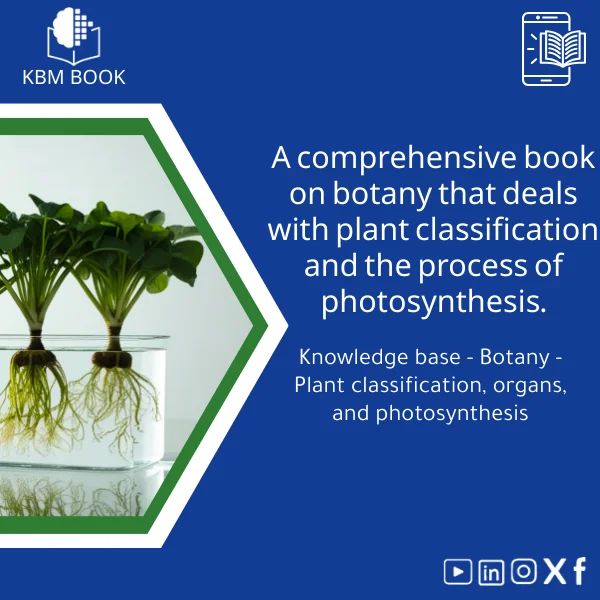
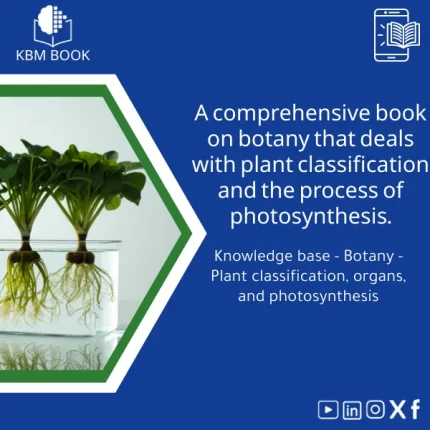
Comprehensive Botany Book on Plant Taxonomy and Photosynthesis
Original price was: 179.00 $.139.00 $Current price is: 139.00 $.
A structured, searchable botany book designed as a Knowledge Base Module (KBM) — an end-to-end reference on plant taxonomy, organ structure, and the biochemistry of photosynthesis. Built for students, researchers, and professionals who need reliable, hierarchical knowledge they can search, cite, and apply immediately.
Key benefits & value for students, researchers, and professionals
This botany book is not a single long narrative — it’s a modular knowledge base optimized for retrieval and application. Each feature below translates into immediate, measurable value.
Structured taxonomy mapped to practical outcomes
The plant taxonomy section is arranged as an indexed tree (kingdom → phylum → class → order → family → genus → species) with diagnostic keys and representative species profiles. Benefit: faster identifications, reliable citations for reports, and reproducible lab classification exercises.
Organ anatomy tied to function and lab technique
Chapters on roots, stems, leaves, flowers, and reproductive systems integrate micrographs, dissection checklists, and staining protocols. Benefit: shortens prep time for practicals and improves diagnostic accuracy in field work.
Photosynthesis decoded for application
From chloroplast structure to electron transport and carbon fixation, the photosynthesis module provides reaction diagrams, rate-determining steps, and experimental data examples. Benefit: supports lab design, hypothesis testing, and interpretation of gas-exchange measurements.
Use cases & real-life scenarios
Undergraduate coursework and exam preparation
Students can export focused PDF chapters (e.g., “Plant organs” or “Taxonomic keys”) and use the included flashcards and practice questions for targeted revision.
Field surveys and lab research
Researchers conducting floristic surveys can use the taxonomy guide and downloadable CSV species lists to populate data templates and ensure consistent naming conventions across teams.
Teaching and curriculum design
Instructors can reuse lecture outlines, slide-ready diagrams, and stepwise lab protocols to build courses aligned with learning outcomes, saving hours of preparation.
Who is this product for?
Designed specifically for the target audience:
- Natural sciences and biology students seeking a reliable botany book and textbook PDF for study and assignments.
- Researchers needing structured plant taxonomy guides and exportable data for analysis.
- Laboratory staff and educators who want ready-made anatomy protocols and teaching materials.
- Professionals in agronomy, conservation, and horticulture who need quick access to validated photosynthesis models and species traits.
How to choose the right KBM version
We offer tiered delivery tailored to use:
- Student PDF pack: compact PDF textbook with indexed chapters and practice questions — best if you want an offline botany textbook PDF.
- Research kit (PDF + CSV/JSON): full KBM with structured data exports and appendices — best for fieldwork and data integration.
- Instructor bundle: includes editable slide decks, lab protocols, and assessment pools — best for teachers and trainers.
Choose based on whether you primarily need readable content (PDF) or machine-ready data (JSON/CSV) for integration with tools and LMS.
Quick comparison with typical alternatives
Compared to single-author textbooks, video courses, or scattered articles, this KBM approach focuses on:
- Depth + Structure: Modular taxonomy and physiology sections reduce redundancy and speed search.
- Interoperability: Structured exports enable data reuse — not possible with most PDFs alone.
- Practicality: Lab-ready protocols and checklists bridge theory and practice faster than long-form books.
Best practices & tips to get maximum value
- Start with the taxonomy overview chapter to align your naming conventions before importing CSV lists.
- Use the organ dissection checklists as your standard operating procedure in practical sessions.
- Extract the photosynthesis kinetics module into a separate PDF when designing experiments to keep protocols handy at the bench.
- Sync JSON exports with your reference manager to ensure citations and species data remain consistent.
Common mistakes when buying or using similar products — and how to avoid them
- Buying a general textbook expecting structured data: If you need machine-readable lists or keys, choose the Research kit rather than a plain PDF.
- Assuming diagrams are editable: Opt for the Instructor bundle if you need editable slides and figures.
- Overlooking nomenclature versions: Check the taxonomy appendix for the referenced classification standard and update notes.
Product specifications
- Title: Comprehensive Botany Book — Plant Taxonomy, Organs & Photosynthesis
- Format: PDF (print-ready) + optional JSON and CSV exports (structured KBM)
- Language: English
- Modules: 12 hierarchical modules (taxonomy, anatomy, physiology, photosynthesis, protocols, datasets)
- Pages (PDF): ~420 pages with high-resolution diagrams and micrographs
- Data files: CSV species lists, JSON taxonomy tree, XML metadata for LMS import
- License: Single-user commercial and academic license (details provided at checkout)
- Delivery: Instant download after purchase — includes README and usage notes
FAQ
Can I download the botany textbook PDF immediately after purchase?
Yes. All purchases include instant download links. Choose the Student PDF pack for a compact textbook PDF, or the Research kit for additional data exports.
Is the taxonomy content updated to current classification systems?
The KBM references current major classification standards and includes an update log. Dataset exports include version metadata so you can track taxonomic changes over time.
Can I use diagrams and protocols in my lectures or publications?
The Instructor bundle includes editable figures and slide templates for teaching. Publication reuse depends on the license selected at checkout — commercial reuse may require extended licensing.
What formats are best for integrating with research tools?
Use the JSON taxonomy tree and CSV species lists for easy import into analysis pipelines, databases, or laboratory information management systems (LIMS).
Ready to add a professional botany book to your toolkit?
Get an organized, searchable knowledge base that saves preparation time, improves data consistency, and supports research-quality workflows.
Tip: select the Research kit if you plan to export species lists or integrate with your lab systems; choose the Instructor bundle if you need editable teaching materials.
Related products
Astrophysics Book: Understanding Stars, Galaxies, and Dark Energy
A searchable, hierarchical Knowledge Base Module (KBM) that converts astrophysics and cosmology into a practical, exam-ready and research-ready reference. Designed for students, researchers, and professionals who need immediate access to reliable explanations, equations, and data models for stars, galaxies, and dark energy.
Biochemistry Book: Understanding Chemical Processes in Living Systems
Cell Biology Guide: Structure, Division, and Transport Insights
Comprehensive Microbiology Book on Bacteria, Viruses, and Fungi

Materials Physics Guide: Understanding Solid-State Properties
Organic Chemistry Guide: Carbon Chains and Reactions

Quantum Mechanics: A Beginner’s Guide to Superposition and Waves

Thermal Physics Guide: Understanding Heat, Energy, and Entropy
A downloadable, hierarchically structured Knowledge Base Module (KBM) that converts university-level thermodynamics into a searchable, practical digital database. Ideal for students, researchers, and professionals who need fast, reliable access to fundamentals and advanced topics in thermal physics.
Reviews
Clear filtersThere are no reviews yet.