


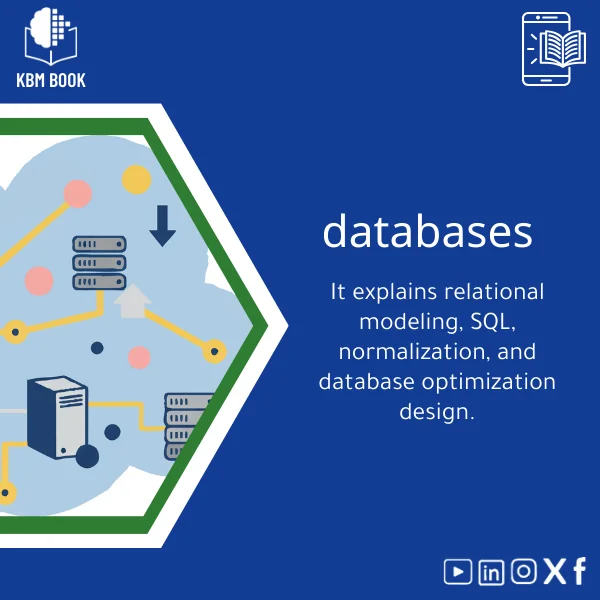
Distributed Database Systems Guide: Replication and Sharding Techniques
Original price was: 349.00 $.279.00 $Current price is: 279.00 $.
A structured, searchable Knowledge Base Module (KBM) that turns the theory and engineering of Distributed Database Systems into a practical, layered reference — from fundamentals of multi‑site database design to hands‑on replication and sharding patterns you can apply immediately.
Key benefits & value for students, researchers, and professionals
This KBM converts dispersed textbook sections, research notes, and operational checklists into a single, logically ordered database. Instead of reading chapters linearly, you jump to precisely the node you need — e.g., “asynchronous multi-master replication conflict resolution” or “range‑based sharding migration plan.”
Benefit breakdown
- Time savings: reduce search time for reliable patterns and configuration examples from hours to minutes.
- Clarity: hierarchical taxonomy separates fundamentals from advanced trade-offs so learners progress without gaps.
- Reproducibility: each technique includes sample commands, test cases, and expected outcomes for lab work and experiments.
- Portability: export as a distributed database book pdf or as structured files to include in course packs or engineering docs.
Use cases & real-life scenarios
Practical scenarios contained in the KBM, with clear steps and deliverables:
- Course assignment: a student maps consistency models (strong, eventual, causal) to concrete replication algorithms and demonstrates them in a lab.
- Research literature review: a researcher compiles comparative metrics for sharding strategies and cites canonical failure-modes documented in the KBM.
- Architecture design: a systems architect selects a replication topology for an international e‑commerce system and uses the KBM migration checklist to plan zero-downtime shard rebalancing.
- Operational runbook: on-call engineers follow the KBM’s incident playbooks for split‑brain recovery and rollbacks.
Each scenario links to code snippets, configuration templates, and recommended testing procedures so you can move from concept to validated implementation quickly.
Who is this product for?
The KBM is targeted at: students taking distributed systems or databases courses; researchers analyzing replication and partitioning; professionals designing, maintaining, or auditing multi‑site database deployments. If you need a practical, reliable reference rather than narrative textbooks, this KBM fits your workflow.
How to choose the right edition & format
We offer formats and coverage levels to match different needs:
- Core KBM (PDF + searchable index): best for students and quick study sessions — includes essential algorithms and short examples.
- Pro KBM (PDF + JSON/Markdown exports): for researchers and engineers who want to integrate the knowledge base into automation, note systems, or LMS.
- Enterprise KBM (pro + extended runbooks): includes operational playbooks, templates, and a sample test suite for validation — ideal for teams.
Choose by the depth you need (core → pro → enterprise) and by whether you want structured exports (for extraction into your documentation or tooling).
Quick comparison with typical alternatives
Typical alternatives are single‑author textbooks, scattered blog posts, or raw research papers. Compared to those, this KBM:
- Offers a structured, searchable hierarchy rather than linear prose.
- Combines practical configuration and test cases with theoretical context.
- Provides machine‑readable exports for faster reuse (unlike static PDFs alone).
Best practices & tips to get maximum value
- Start with the taxonomy view to map your learning path — fundamentals → design patterns → deployment checklists.
- Use the sample test cases to validate behavior in a controlled environment before applying changes to production.
- Export the sections you need into Markdown and include them in your course or team docs for quick reference.
- Apply the migration checklists verbatim during shard rebalancing or topology changes to reduce human error.
Common mistakes when buying or using distributed database resources — and how to avoid them
- Buying a single-format book: textbooks lack structured exports for practical reuse. Avoid by selecting an edition with JSON/Markdown exports.
- Skipping failure modes: choosing a replication strategy without incident playbooks leads to long outages. Use the KBM’s runbooks.
- Misapplying sharding keys: poor key choice causes hotspots. Follow the KBM’s analysis template to evaluate candidate keys with sample workloads.
Product specifications
- Title: Distributed Database Systems Guide — Replication & Sharding Techniques
- Formats: PDF (searchable) + optional JSON / Markdown export
- Coverage: fundamentals, replication topologies, sharding patterns, CAP/consistency tradeoffs, operational runbooks, migration & testing templates
- Language: English
- Delivery: instant download after purchase
- License: single-user or team license options (see checkout for details)
- Updates: versioned KBM updates available for Pro & Enterprise editions
FAQ
Can I get this as a searchable PDF or a structured export for my notes?
Yes. The Core edition provides a searchable PDF. The Pro edition includes structured exports (JSON and Markdown) so you can import sections into note systems, LMS, or documentation repositories.
Is the content practical enough to use in production planning?
Yes. The KBM includes configuration snippets, migration checklists, test cases, and incident playbooks designed for practical use. It is not a vendor-specific manual but contains reproducible techniques you can adapt to your stack.
How often is the KBM updated?
KBMs are versioned. Pro and Enterprise buyers receive periodic updates that include new patterns, corrected examples, and additional runbooks. Check the product page after purchase for the changelog and update policy.
Will this replace full textbooks or primary research papers?
The KBM is a structured, practical complement — not a replacement for deep theoretical texts. It synthesizes and organizes knowledge into actionable modules, making it faster to apply concepts than flipping through multiple sources.
Get the KBM and start building reliable multi‑site databases
Ready to move from fragmented notes to a searchable, actionable knowledge base on distributed database systems? Choose the edition that fits your needs and download instantly.
Secure checkout • Instant download • Trial excerpts available for academic evaluation
Related products
Astrophysics Book: Understanding Stars, Galaxies, and Dark Energy
A searchable, hierarchical Knowledge Base Module (KBM) that converts astrophysics and cosmology into a practical, exam-ready and research-ready reference. Designed for students, researchers, and professionals who need immediate access to reliable explanations, equations, and data models for stars, galaxies, and dark energy.
Atomic Physics Guide: Understanding Atomic and Electron Properties
Knowledge Base — Atomic/Electron Properties & Electromagnetic Interactions. A structured, searchable KBM for students, researchers, and professionals who need an authoritative atomic physics reference that organizes concepts, formulas, experiments, and practical applications from basics of atomic physics to advanced electron properties.
Comprehensive Genetics Book: DNA, Mendelian Genetics & Engineering
A structured, searchable knowledge base module (KBM) that turns genetics theory and practice into an immediately usable digital reference — from DNA structure to Mendelian genetics and contemporary genetic engineering techniques — optimized for students, researchers, and professionals who need reliable answers fast.
Cosmology Book: Guide to Big Bang and Galaxy Evolution
Electromagnetism Book: A Comprehensive Guide to Fields and Circuits
General Biology Book: A Guide to Cells, Genetics & Taxonomy
Modern Physics Book: Quantum, Relativity, and Tech Applications Guide
A structured, searchable Knowledge Base Module (KBM) that turns modern physics — quantum mechanics, special & general relativity, and contemporary technological applications — into a hierarchical, practical reference for students, researchers, and professionals who need quick, reliable access to advanced concepts and formulas.
Reviews
Clear filtersThere are no reviews yet.