


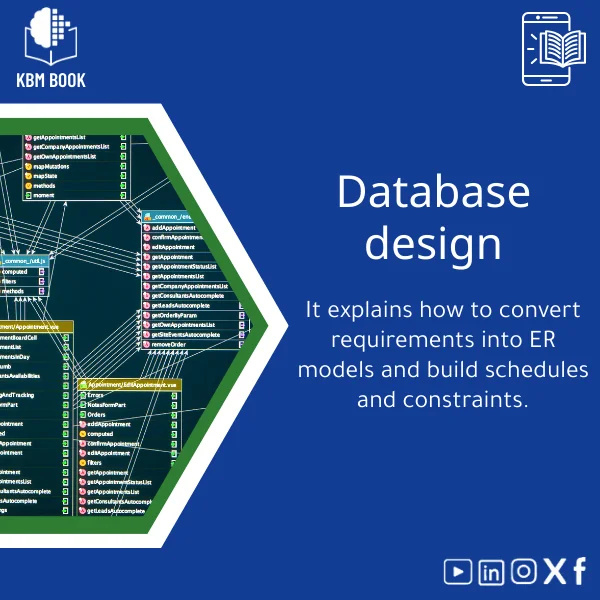
Comprehensive Data Science Book for Python and R Analysis
Original price was: 349.00 $.279.00 $Current price is: 279.00 $.
A structured, hierarchical knowledge base that converts data science theory into searchable, reusable modules — covering data analysis, statistics, and predictive modeling with ready-to-run Python & R examples for students, researchers, and professionals.
Key benefits & value for the buyer
This Data Science book is built as a Knowledge Base Module (KBM) — not just a linear textbook. That structure translates into immediate, measurable advantages:
- Faster problem solving: Find the exact algorithm, diagnostic checklist, or code snippet without reading entire chapters.
- Reproducibility: Complete Jupyter notebooks and R scripts allow you to run analyses end-to-end on your own data.
- Curriculum-ready: Use modules as lecture units, lab exercises, or assignment banks for teaching and training.
- Cross-tool portability: CSV, JSON, and notebook formats enable integration into research pipelines and enterprise systems.
Keywords: Data Science book, data science textbook, predictive modeling with Python and R.
Use cases & real-life scenarios
Students
Follow a step-by-step learning path: start with statistics and exploratory data analysis, progress to feature engineering and modeling, then practice validation and deployment — all with graded exercises and sample datasets.
Researchers
Quickly locate the right statistical test, reproducible code, and example workflows for peer-reviewed experiments. The KBM structure helps maintain consistency across multiple projects and collaborators.
Professionals & Teams
Onboard new analysts fast by sharing specific modules (e.g., time-series forecasting, model monitoring). Use ready-made notebooks to prototype solutions and export code for production hand-offs.
Example scenario
A marketing analyst needs a churn-prediction pipeline: they open the KBM node for classification workflows, run the example notebook with customer data, adapt feature-engineering steps, and deploy a tested model — all within a few hours, not days.
Who is this product for?
This Data Science book is explicitly designed for:
- Undergraduate and graduate students in statistics, computer science, and applied data fields.
- Researchers who require reproducible analysis and referenceable methods.
- Data analysts and engineers building predictive models in Python or R.
- Instructors and team leads assembling structured curricula or internal KBs.
How to choose the right format and edition
Pick based on how you’ll use the content:
- PDF + searchable index — best for reading and citation.
- Notebook edition (.ipynb) — best for hands-on practice and reproducibility.
- R package & scripts — if your workflow is R-centric or you need RMarkdown reports.
- Full KBM bundle — includes all formats plus sample datasets and JSON/CSV modules for system integration; recommended for teams.
Consider license: single-user for personal study or multi-user/team license for training and deployment.
Quick comparison with typical alternatives
Common alternatives: printed textbooks, scattered blog posts, and video courses. How this KBM differs:
- Printed textbooks often excel at theory but lack runnable code and rapid searchability; KBM provides both.
- Blog posts & tutorials can be fragmented and inconsistent; KBM is curated, consistent, and avoids repetition.
- Video courses are good for demos but poor for quick lookup and versioning; KBM modules are searchable and version-controlled.
Best practices & tips to get maximum value
- Integrate the notebook examples into your own Git repository and run CI tests to ensure reproducibility.
- Use the KBM’s metadata tags to create personalized learning paths (e.g., beginner > intermediate > advanced).
- Adapt and extend sample datasets for your domain; keep modifications documented as new KBM nodes.
- When teaching, assign specific KBM nodes as weekly labs to standardize student outcomes.
Common mistakes when buying/using similar products and how to avoid them
- Buying a theory-only book: If you need applied results, select a format with runnable code and datasets.
- Choosing the wrong format: Verify your toolchain supports the provided file types (Python 3.x, R 4.x, Jupyter).
- Assuming one-size-fits-all: For team use, get the multi-user license and the full KBM bundle; single-user editions limit redistribution.
- Not checking update policy: Prefer editions that include updates or patch notes for evolving libraries and methods.
Product specifications
- Format: KBM bundle — PDF (printable), Jupyter notebooks (.ipynb), R scripts & RMarkdown, CSV/JSON modules.
- Coverage: Introductory statistics → feature engineering → supervised & unsupervised models → model evaluation → deployment notes.
- Examples: 25+ reproducible notebooks, 12 RMarkdown reports, 15 sample datasets (CSV).
- Length: Approximately 450 pages equivalent (combined modules and notebooks).
- Compatibility: Python 3.8+ (pandas, scikit-learn, matplotlib), R 4.0+ (tidyverse, caret), JupyterLab.
- License options: Single-user, academic, team (choose at checkout).
- Delivery: Instant download after purchase; ZIP file with organized folder structure.
Frequently asked questions
Is this a printed book or a digital product?
This is a digital KBM bundle — PDF for reading plus notebooks, scripts, and datasets you can run and modify. A printable PDF is included if you prefer a physical copy made on demand.
Can I run the Python and R examples on Windows/macOS/Linux?
Yes. Examples are platform-agnostic and use standard libraries. We include a requirements.txt for Python and an R package list to reproduce the environment across operating systems.
What if I need updates for new library versions?
Certain editions include a 12-month update policy. Check the chosen license at checkout — team editions come with update notifications and patch files.
Can I use modules in coursework or company training?
Yes — academic and team licenses allow redistribution within classrooms and companies. Single-user licenses prohibit broader redistribution. Review the license terms before purchasing.
Ready to convert knowledge into practical workflows?
Purchase the full KBM bundle and get immediate access to modular, searchable, and reproducible material that accelerates learning, research, and production work.
Need a team license or custom integration? Contact our support to get a quote and deployment guidance before buying.
Related products
Biochemistry Book: Understanding Chemical Processes in Living Systems
Biological Anthropology Study Guide on Human Evolution
Cell Biology Guide: Structure, Division, and Transport Insights
Comprehensive Nuclear Physics Book on Structure and Radioactivity

Inorganic Chemistry Guide: Bonding and Crystal Solids
A structured, searchable Knowledge Base Module (KBM) that converts inorganic chemistry fundamentals and advanced topics—bonding models, lattice structures, defects, and solid-state properties—into a practical digital reference for students, researchers, and professionals who need fast, reliable answers without wading through textbooks.
Introductory General Chemistry Book on Matter and Reactions
A structured, searchable Knowledge Base Module (KBM) that converts core general chemistry concepts — matter, elements, reactions, stoichiometry and molarity — into a hierarchical reference you can query, teach from, or integrate into study workflows. Ideal as a concise General Chemistry book alternative for students, researchers, and professionals who need accurate, practical chemistry knowledge fast.

Reviews
Clear filtersThere are no reviews yet.