


Artificial Intelligence Book: Foundations in Reasoning and Planning
Original price was: 179.00 $.139.00 $Current price is: 139.00 $.
A structured, searchable Artificial Intelligence book—designed as a Knowledge Base Module (KBM) to teach and reference core AI foundations: symbolic reasoning, automated planning, computer vision basics, and applied NLP. Ideal for students, researchers, and professionals who need fast, reliable access to hierarchical, practical knowledge.
Key benefits & value for students, researchers, and professionals
This Artificial Intelligence book is packaged as a Knowledge Base Module (KBM) to replace scattered notes and long, static textbooks with a compact, searchable knowledge database. Each feature below is stated as a direct benefit:
From features to outcomes
- Structured hierarchy: Learn incrementally — definitions, theorems, algorithms, and applied examples are ordered so you can master essentials before moving to advanced topics.
- Practical examples & pseudocode: Implement core algorithms (A*, STRIPS planning, belief propagation, convolution basics, tokenization pipelines) without hunting for reliable sources.
- Cross-referenced citations: Quickly jump from a concept to original papers, standard datasets, and recommended libraries to support reproducible research.
- Export-ready entries: Use snippets in lectures, lab tasks, or technical reports—copy-clean content formatted for integration into slides and notebooks.
- Time savings: Replace hours of literature search with immediate access to validated, compact topic modules.
Use cases & real-life scenarios
Concrete examples show how the Artificial Intelligence book saves time and improves outcomes:
For students
- Prepare for exams by following the recommended learning path for reasoning and planning, with sample problems and model solutions.
- Complete project reports using the KBM’s structured literature summaries and annotated pseudocode.
For researchers
- Rapidly compose related-work sections using curated citations and concise comparative tables.
- Prototype new ideas by reusing algorithm breakdowns and data-prep checklists from the computer vision and NLP modules.
For professionals & instructors
- Build training modules and workshops with step-by-step lesson outlines and slide-ready content.
- Deploy as an internal reference for on-boarding, code review, and technical decisions.
Who is this product for?
This Artificial Intelligence book is tailored to:
- Undergraduate and graduate students taking AI, computer vision, or NLP courses.
- Researchers who need an authoritative, compact reference for reasoning, planning, and applied AI techniques.
- Industry engineers and data scientists seeking a quick refresher on algorithms and design patterns.
- Instructors preparing structured curricula or practical lab exercises.
How to choose the right format
The KBM is offered in formats suited to different workflows—select based on how you will use the material:
- Interactive searchable DB (recommended): Best for research and repeated lookup; integrates into knowledge managers and local search tools.
- PDF export: Good for printing, offline reading, and distributing to students.
- Plain text / code snippets: Use when you need to paste examples directly into notebooks or IDEs.
Choose the format that matches your workflow; if unsure, the searchable DB is the most flexible for long-term use.
Quick comparison with typical alternatives
Common alternatives include traditional textbooks, lecture slides, and scattered online tutorials. Compared to those:
- More focused than textbooks: Textbooks provide depth but often contain broad background; this KBM focuses on actionable core topics and cross-links.
- More reliable than ad-driven tutorials: Curated entries reduce noise and repetitive content—priority is clarity and proven references.
- More reusable than slides: Slide decks are teaching artifacts; KBMs are reference-grade and exportable into multiple teaching formats.
Best practices & tips to get maximum value
- Start with the learning path: follow the KBM sequence for reasoning → planning → perception → language to build concepts in the right order.
- Integrate snippets into your Jupyter/Colab environment to run and adapt examples immediately.
- Annotate and extend entries with your observations—KBMs are designed to be augmented.
- Use cross-references for literature reviews to ensure you cite canonical works efficiently.
Common mistakes when buying or using similar products — and how to avoid them
- Buying for novelty only: Avoid KBMs that promise breadth without depth. Choose modules that show concrete examples and references.
- Ignoring compatibility: Confirm the format matches your tools. Opt for the searchable DB if you plan to integrate into software workflows.
- Expecting a full course in one file: This KBM is focused on foundations; pair it with domain-specific modules for advanced or niche subjects.
Product specifications
- Title: Artificial Intelligence Book: Foundations in Reasoning and Planning
- Format(s): Searchable KBM (primary), PDF export, plain-text & code snippets
- Content scope: Symbolic reasoning, automated planning (STRIPS, heuristic search), core computer vision concepts, introductory NLP pipelines
- Size: ~120 structured entries + 40+ code snippets and 60+ curated references
- Language: English (structured for clarity and academic use)
- Usage notes: Licensed for individual use; instructor/lab licenses available—contact KBMBook for group access.
Frequently asked questions
Is this Artificial Intelligence book suitable as a primary textbook for a university course?
Yes — the KBM is structured to support a semester-long course when paired with practical labs. It excels as a compact course reference and is particularly useful for modules focusing on reasoning and planning. Instructors should supplement with problem sets and project assignments.
Will I get code examples I can run?
Yes — the KBM contains runnable pseudocode and code snippets formatted for easy copying into notebooks (Python-friendly). It is designed to accelerate prototyping rather than provide complete production-ready systems.
How often is the content updated?
KBMBook maintains periodic updates to references and examples. Major methodological changes trigger targeted updates; purchasers receive version notes and guidance on migrating any adapted content.
What if I need a group or classroom license?
Group and instructor licenses are available. Contact KBMBook customer support for bulk license options, classroom integration help, and instructor materials.
Ready to get reliable, structured AI knowledge?
Download the Artificial Intelligence book now and replace scattered sources with a compact, searchable KBM you can use for study, research, and professional reference.
Questions about formats, licensing, or classroom use? Contact KBMBook support before purchasing — we’ll help you choose the right package.
Related products
Astronomy Observational Techniques Guide for Celestial Motion
Biochemistry Book: Understanding Chemical Processes in Living Systems
Biological Anthropology Study Guide on Human Evolution
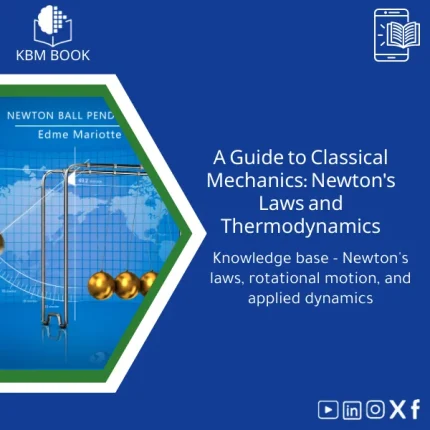
Classical Mechanics Guide: Newton’s Laws and Dynamics
A searchable, hierarchical Knowledge Base Module (KBM) that turns classical mechanics into a practical, ready-to-use reference for fast problem solving, lecture preparation, and applied engineering. Designed for students, researchers, and professionals who need precise access to Newton’s laws, rotational motion, and applied dynamics without the noise of textbooks.
Comprehensive Genetics Book: DNA, Mendelian Genetics & Engineering
A structured, searchable knowledge base module (KBM) that turns genetics theory and practice into an immediately usable digital reference — from DNA structure to Mendelian genetics and contemporary genetic engineering techniques — optimized for students, researchers, and professionals who need reliable answers fast.
Comprehensive Nuclear Physics Book on Structure and Radioactivity
Cosmology Book: Guide to Big Bang and Galaxy Evolution

Inorganic Chemistry Guide: Bonding and Crystal Solids
A structured, searchable Knowledge Base Module (KBM) that converts inorganic chemistry fundamentals and advanced topics—bonding models, lattice structures, defects, and solid-state properties—into a practical digital reference for students, researchers, and professionals who need fast, reliable answers without wading through textbooks.

Reviews
Clear filtersThere are no reviews yet.