


Civil Engineering Book: Planning and Design Guide
Original price was: 179.00 $.139.00 $Current price is: 139.00 $.
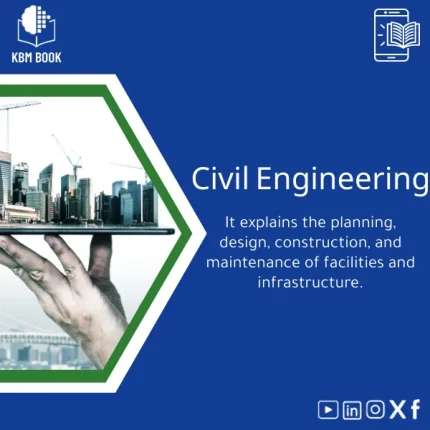
A structured, searchable Civil Engineering book (Knowledge Base Module) that converts planning, design, construction and maintenance know‑how into a hierarchical, ready‑to‑use database — ideal for students, researchers and practicing engineers who need reliable, fast access to engineering knowledge.
Key benefits & value for students, researchers and professionals
This Civil Engineering book is built as a Knowledge Base Module (KBM) — a compact, navigable database rather than a traditional textbook. The structure yields measurable benefits:
- Speed: lookup formulas, code snippets, and design standards in seconds using the indexed structure.
- Clarity: topics are sequenced from fundamentals (materials, statics) to advanced subjects (geotechnical design, hydraulic modelling) without repetition.
- Practicality: contains ready checklists (site investigation, structural checks), worked examples and exportable templates for project reports.
- Reliability: references to standards and concise cross-references reduce time spent verifying scattered sources.
- Reusability: elements designed to be copied into spreadsheets, BIM notes, or lecture slides.
Use cases & real-life scenarios
For undergraduate and graduate students
Use the KBM as an exam revision tool: drill key formulas, review summarized theory, and practice solved problems with step‑by‑step solutions. Build a concise revision sheet from the module in minutes.
For researchers
Quickly find methodological overviews, measurement standards, and comparative tables for literature reviews. The hierarchical structure helps trace a topic from definition to advanced modelling approaches.
For practicing engineers and project leads
Perform quick design checks on-site with checklists, extract templates for calculations, and use the built-in tables for material properties and load combinations. Save time when preparing tender documents or technical proposals.
Who is this product for?
This Civil Engineering book is tailored for:
- Students preparing coursework, exams, or lab reports.
- Researchers needing a condensed, citable reference while writing papers.
- Design engineers seeking repeatable templates and practical reference data.
- Instructors and trainers who want modular teaching units for lectures or workshops.
How to choose the right KBM (format & scope)
Choosing between textbook-style materials and a KBM depends on how you work:
- If you need quick lookup and template reuse, a KBM (this product) is the better choice.
- If you prefer narrative learning with extended theory, pair this KBM with a standard civil engineering textbook.
- Consider format: select the KBM with export options (PDF + structured data) if you plan to import content into spreadsheets or knowledge tools.
Quick comparison with typical alternatives
How this Civil Engineering book (KBM) compares to common alternatives:
- Versus classic textbooks: faster lookup, modular components, less narrative depth — designed to complement textbooks, not replace fundamental learning.
- Versus scattered PDFs & web articles: curated structure, consistent referencing, and no duplication across topics.
- Versus commercial software manuals: focuses on engineering principles, worked examples and templates rather than software UI instructions.
Best practices & tips to get maximum value
- Start with the roadmap index: follow the topic sequence for a guided study plan.
- Use the checklists on-site for fast compliance checks and safety reviews.
- Export calculation templates into your spreadsheets to standardize design workflows.
- Cross-reference the KBM with local standards for project-specific compliance.
Common mistakes when buying/using similar products — and how to avoid them
- Mistake: assuming a single PDF replaces structured learning.
Fix: use the KBM as a living reference and pair with problem sets for mastery. - Mistake: ignoring compatibility with tools.
Fix: choose KBMs with exportable formats and clear usage notes. - Mistake: buying generic material that lacks templates.
Fix: verify presence of practical templates and worked examples before purchase.
Product specifications
- Product type: Knowledge Base Module (Civil Engineering book)
- Scope: Planning, design, construction, maintenance of infrastructure
- Structure: Hierarchical topic map — Fundamentals → Design Methods → Case Studies → Checklists
- Formats included: Searchable PDF + structured export (CSV/JSON) for templates and tables
- Size: Approx. 250+ indexed entries, 120+ worked examples and design templates
- Language: English (clear technical Arabic cross-references for regional practice where applicable)
- Delivery: Instant digital download after purchase — ready for offline use
- Compatibility: Desktop and mobile PDF readers, importable to spreadsheets and knowledge apps
- Usage notes: Licensed for personal or team use based on selected license at checkout
Frequently asked questions
What file formats are provided and can I import tables into Excel?
The KBM includes a searchable PDF for reading and CSV/JSON exports for tables, templates and calculation data. CSV files can be opened directly in Excel or other spreadsheet apps for immediate use.
Is this a replacement for a civil engineering textbook?
No — the KBM is designed as a practical, structured reference and toolkit. It complements textbooks by providing quick access, templates and checklists. For foundational theory, pair it with a core textbook.
How current are standards and references inside the KBM?
Each entry cites the version of standards or references used at the time of publication. The KBM focuses on fundamental methods and provides citation notes so you can verify the latest local standards before final design.
Can I use material from the KBM in my reports or lectures?
Yes — the KBM is created for reuse. Licensing terms at checkout define whether use is personal, academic or for a team. Templates and diagrams are provided to be adapted into professional deliverables.
Ready to streamline your engineering workflow?
Access a structured Civil Engineering book that saves hours on research, organizes your design templates, and standardizes project workflows. Immediate download — start applying the knowledge in the next project or exam.
Related products
Analytical Chemistry Book: Qualitative and Quantitative Methods Guide
Biochemistry Book: Understanding Chemical Processes in Living Systems
Biological Anthropology Study Guide on Human Evolution
Cell Biology Guide: Structure, Division, and Transport Insights
Classical Mechanics Guide: Newton’s Laws and Dynamics
A searchable, hierarchical Knowledge Base Module (KBM) that turns classical mechanics into a practical, ready-to-use reference for fast problem solving, lecture preparation, and applied engineering. Designed for students, researchers, and professionals who need precise access to Newton’s laws, rotational motion, and applied dynamics without the noise of textbooks.
Comprehensive Botany Book on Plant Taxonomy and Photosynthesis
A structured, searchable botany book designed as a Knowledge Base Module (KBM) — an end-to-end reference on plant taxonomy, organ structure, and the biochemistry of photosynthesis. Built for students, researchers, and professionals who need reliable, hierarchical knowledge they can search, cite, and apply immediately.

Comprehensive Microbiology Book on Bacteria, Viruses, and Fungi

Inorganic Chemistry Guide: Bonding and Crystal Solids
A structured, searchable Knowledge Base Module (KBM) that converts inorganic chemistry fundamentals and advanced topics—bonding models, lattice structures, defects, and solid-state properties—into a practical digital reference for students, researchers, and professionals who need fast, reliable answers without wading through textbooks.
Reviews
Clear filtersThere are no reviews yet.