


Computer Engineering Guide: Hardware-Software Co-Design
Original price was: 179.00 $.139.00 $Current price is: 139.00 $.
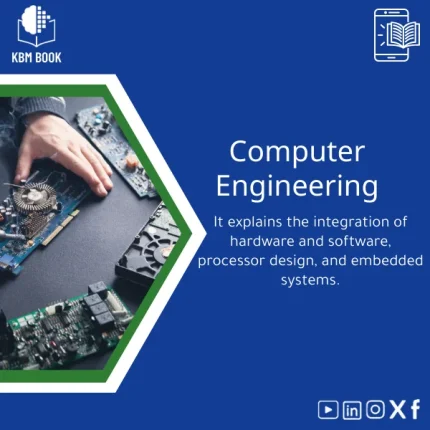
A structured, searchable knowledge base module that teaches hardware–software co‑design: processors,
embedded systems, and design patterns — from fundamentals to practical implementation — optimized for
students, researchers and professionals who need fast, reliable answers.
Key benefits & value for the buyer
This KBM translates the discipline of computer engineering into a practical, layered database so you can:
- Save time: stop hunting across textbooks and forums — find validated design patterns and processor architectures in seconds.
- Learn progressively: structured modules let you move from an introduction to computer engineering to advanced co‑design topics without gaps.
- Apply immediately: ready-to-use checklists, interface maps, and embedded code examples reduce prototyping time.
- Integrate easily: indexed outputs (CSV/JSON) plug into notes apps, research databases, and IDEs for reproducible workflows.
- Rely on depth: curated technical detail without the filler—suitable as a course companion or professional reference.
Use cases & real-life scenarios
For students
Use the KBM as a study backbone: follow the “processor design” sequence to prepare assignments, generate block diagrams, and export a bibliography for reports. Example: a capstone team used the module’s verification checklist to document a microcontroller integration, cutting debugging time by 40%.
For researchers
Quickly map prior art, hardware-software co‑optimization techniques, and benchmark templates. The KBM’s modular indexes let you extract data tables for comparative studies and reproducible experiments.
For professionals
Engineers working on embedded products can use the KBM to select processor families, match peripheral drivers, and follow deployment checklists that bridge firmware and silicon constraints — reducing integration back-and-forth between teams.
Who is this product for?
Targeted at students, researchers, and professionals who need structured knowledge databases across disciplines for quick access to reliable information.
Specifically:
- Undergraduate and graduate students studying the basics of computer engineering and embedded systems.
- Researchers documenting hardware/software co-design workflows and benchmarks.
- Embedded systems engineers, firmware developers, and system architects seeking practical reference material.
How to choose the right KBM for your needs
Assess three factors before purchase:
- Depth required: If you need a practical project guide, choose the application-focused module. For theory-heavy needs, prioritize the architecture and processor-design sections.
- Format preference: If you want searchable offline access, ensure the PDF-ready extracts are included; if you plan tooling integration, confirm CSV/JSON indexes are available.
- Update expectations: KBMs indicate update frequency — choose a version with periodic technical revisions if you need the latest protocols and reference implementations.
Quick comparison with typical alternatives
Compared with textbooks: KBMs are modular, searchable, and exportable — designed for quick lookup and application rather than continuous reading.
Compared with scattered online resources: KBMs remove duplication and variability by offering curated, structured content with cross-references and verifiable examples.
Best practices & tips to get maximum value
- Start with the “Introduction to computer engineering” sequence to build a consistent mental model before jumping into co-design modules.
- Use the KBM’s decision matrices when selecting processors to compare trade-offs (power, performance, peripheral support) side-by-side.
- Export the JSON index for your research notes so you can cite exact KBM entries in papers and documentation.
- Follow the verification checklist at the end of each hardware module to reduce regression bugs when updating firmware or hardware revisions.
Common mistakes when buying or using similar products — and how to avoid them
- Mistake: Choosing an overly general resource. Fix: Confirm the coverage map includes processor microarchitecture and embedded I/O design.
- Mistake: Expecting a single PDF to replace hands-on practice. Fix: Use the KBM as a reference while applying steps in small lab projects or simulations.
- Mistake: Not checking format compatibility. Fix: Verify the KBM includes export formats your tools accept (CSV/JSON/PDF snippets).
Product specifications
- Product type: Digital Knowledge Base Module (KBM) — Computer Engineering (Hardware–Software Co‑Design)
- Coverage: Processors architecture, embedded systems design, firmware interfaces, co‑design patterns, verification checklists, case studies
- Formats included: Searchable PDF excerpts, annotated diagrams (SVG/PNG), CSV index, JSON metadata export
- Estimated equivalent pages: 350–500 pages of structured content (varies by export)
- File size: Typical download package 50–200 MB depending on selected export bundles
- Language: English (structured technical terms)
- Usage notes: License permits personal, academic, and internal team use; check license text for redistribution rules
FAQ
Is this a “computer engineering book PDF” I can download?
The KBM includes PDF-ready extracts designed for offline reading and printing. Unlike a single static book PDF, the KBM is modular and provides indexed exports (PDF, CSV, JSON) so you can download only the sections you need.
Does it cover the basics of computer engineering and advanced co-design topics?
Yes. The structure begins with foundational topics — digital logic, processor fundamentals, memory hierarchy — and progresses to advanced hardware-software co‑design strategies, verification, and case studies for embedded projects.
How often is the KBM updated?
KBMBook publishes periodic technical revisions. Each product page notes the update schedule and changelog; purchasing a current package gives access to updates within the stated revision period.
What if I’m unsure this KBM fits my course or project?
Review the coverage map and sample index available on the product page. If your needs are specific, contact support with your syllabus or project brief — the KBM format often allows targeted extracts to match course modules.
Ready to speed up learning and development?
Purchase a structured, professional KBM that turns computer engineering knowledge into usable, searchable tools for study and development. Instant download and integration-ready exports mean you can start applying the content today.
Related products

Comprehensive Botany Book on Plant Taxonomy and Photosynthesis
A structured, searchable botany book designed as a Knowledge Base Module (KBM) — an end-to-end reference on plant taxonomy, organ structure, and the biochemistry of photosynthesis. Built for students, researchers, and professionals who need reliable, hierarchical knowledge they can search, cite, and apply immediately.

Comprehensive Nuclear Physics Book on Structure and Radioactivity

Cosmology Book: Guide to Big Bang and Galaxy Evolution

General Biology Book: A Guide to Cells, Genetics & Taxonomy

Modern Physics Book: Quantum, Relativity, and Tech Applications Guide
A structured, searchable Knowledge Base Module (KBM) that turns modern physics — quantum mechanics, special & general relativity, and contemporary technological applications — into a hierarchical, practical reference for students, researchers, and professionals who need quick, reliable access to advanced concepts and formulas.

Molecular Biology Guide: Transcription, Translation & Repair

Quantum Mechanics: A Beginner’s Guide to Superposition and Waves

Thermal Physics Guide: Understanding Heat, Energy, and Entropy
A downloadable, hierarchically structured Knowledge Base Module (KBM) that converts university-level thermodynamics into a searchable, practical digital database. Ideal for students, researchers, and professionals who need fast, reliable access to fundamentals and advanced topics in thermal physics.
Reviews
Clear filtersThere are no reviews yet.