


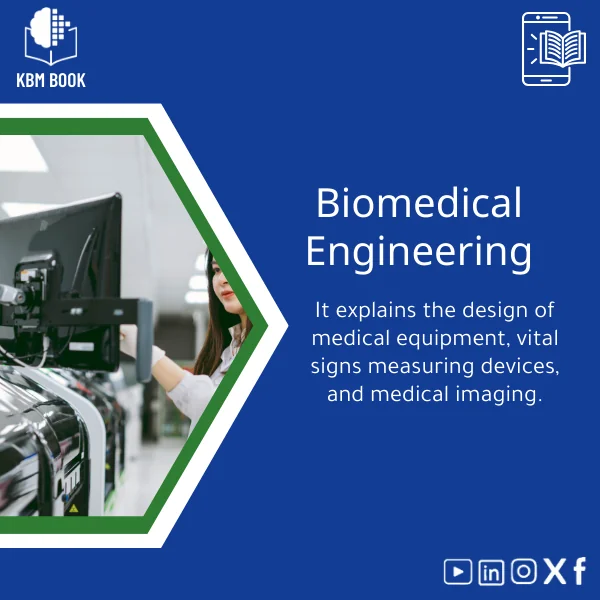
Medical Devices Engineering Guide for Biomedical Applications
Original price was: 349.00 $.279.00 $Current price is: 279.00 $.
A structured, searchable knowledge base for medical devices engineering — from biosignals and instrumentation to imaging systems and regulatory-ready design practices. Built as hierarchical Knowledge Base Modules (KBMs) for students, researchers, and professionals who need fast access to accurate, usable engineering content.
Key benefits & value for buyers
This medical devices engineering KBM transforms scattered technical knowledge into a compact, usable database. It reduces research time, minimizes errors during design and verification, and provides a repeatable structure teams can adopt immediately.
Core practical advantages
- Speed: Find validated signal-processing blocks, measurement equations, and sampling guidelines in seconds.
- Reliability: Content organized to avoid contradictions and redundant material found in textbooks and web articles.
- Actionability: Design-ready artifacts — block diagrams, test protocols, and documentation templates — that you can copy into projects.
- Interoperability: Export modules to your LMS, Git repo, or data analysis tools for immediate use.
Use cases & real-life scenarios
Academic study and assignments
Students use the KBM as a compact biomedical engineering textbook: core principles of biosignals, sensors, and imaging are arranged by learning path. Instead of flipping several books, students follow a sequential module from concept to lab exercise.
Research and prototyping
Researchers access validated signal-conditioning topologies, noise budgets, and imaging pipelines to prototype devices faster. Example datasets and test protocols reduce time spent creating verification plans.
Product development and regulatory readiness
Engineering teams map design outputs to verification steps using the KBM’s regulatory mapping. This reduces rework during audits and shortens time to clinical evaluation.
Who is this product for?
Medical Devices Engineering Guide is designed for:
- Undergraduate and graduate biomedical engineering students preparing projects or theses.
- Researchers in universities and labs needing reliable engineering templates.
- R&D engineers and product teams developing medical equipment and looking for repeatable design artifacts.
- Clinical engineers and QA staff who must link device specs to verification evidence.
How to choose the right KBM package
KBMs are digital modules with different depth levels. Choose based on your role and goals:
- Introductory level: Core principles, essential formulas, and starter lab exercises — ideal for students.
- Professional level: Complete design templates, test cases, and example datasets — good for project work and prototypes.
- Comprehensive level: Full regulatory mapping, integration scripts, and system-level BOMs — for teams preparing devices for clinical use.
If unsure, start with the Professional level: it covers most research and early product development needs and can be extended later.
Quick comparison with typical alternatives
Consider three typical approaches and why a KBM can be more effective:
- Traditional textbooks: Deep but linear and not easily searchable; KBMs are modular and queryable for rapid retrieval.
- Online articles and forums: Fast but inconsistent and fragmented; KBMs provide curated, validated content with traceable sources.
- Video courses: Good for concept learning but poor for integration into workflows; KBMs include reusable templates and data exports for direct use in projects.
Best practices & tips to get maximum value
- Integrate early: Import relevant JSON modules into your project repository at project kickoff to standardize terminology and verification steps.
- Use templates verbatim then adapt: Start with provided test protocols and tailor only necessary parameters to save time and maintain traceability.
- Link to documentation: Use the KBM’s regulatory mapping to build a traceability matrix that auditors can follow.
- Keep a change-log: When modifying KBM modules, document changes so future team members understand rationale and evidence.
Common mistakes when buying or using similar resources — and how to avoid them
- Buying incomplete references: Avoid modules that only cover theory. Choose KBMs that include practical templates and verification steps.
- Over-customizing at once: Resist heavy customizations before validating baseline templates in a pilot project.
- Ignoring export formats: Ensure the KBM supports formats you can import into your tools (CSV/JSON/SQL).
- Assuming one-size-fits-all: Match the KBM depth (intro/professional/comprehensive) to your project stage.
Product specifications
- Title: Medical Devices Engineering Guide for Biomedical Applications
- Format: Downloadable KBM package — JSON, CSV, printable PDF modules, SQL schema
- Content scope: Biosignals, sensors, instrumentation, imaging chains, signal processing, device-level design, verification & regulatory mapping
- Compatibility: Import-ready for common tools (MATLAB, Python, SQL databases, LMS)
- License: Single-user or team license options (commercial use allowed — see license file in package)
- Delivery: Instant digital download after purchase
FAQ
Is this a medical devices engineering book or a database — which format will I get?
The product is a Knowledge Base Module (KBM): a structured, searchable database packaged with printable PDF chapters that read like a textbook plus exportable machine-readable files (JSON/CSV/SQL). It combines the depth of a biomedical engineering textbook with the usability of a database.
Can I use the templates for commercial device development?
Yes. The KBM includes templates and verification artifacts suitable for commercial R&D. Licensing options are provided in the package; choose a team or commercial license if needed for multiple users or product commercialization.
How current is the regulatory guidance included?
The KBM maps common regulatory concepts and verification practices. It is regularly updated to reflect current best practices, but you should always cross-check the final regulatory submission requirements with regional authorities. KBM provides traceable references to the guidance used.
What if the KBM doesn’t match my specific device type?
KBMs are modular. If a module lacks device-specific details, use the provided templates and adapt parameters for your device. For teams, the comprehensive level includes system-level examples and extension patterns for uncommon device classes.
Ready to shorten development time and reduce risk?
The Medical Devices Engineering Guide is built to be used — not just read. If you need a practical, structured reference for medical devices engineering that integrates with your workflow, start with a KBM.
Instant download. Includes JSON/CSV/SQL exports, printable chapters, and templates. Secure your copy and start integrating reliable biomedical engineering knowledge into your projects today.
Related products

Comprehensive Evolutionary Biology Book on Natural Selection

Comprehensive Microbiology Book on Bacteria, Viruses, and Fungi

Comprehensive Nuclear Physics Book on Structure and Radioactivity

General Biology Book: A Guide to Cells, Genetics & Taxonomy
General Physics Book: Fundamentals of Force, Motion, Energy

Inorganic Chemistry Guide: Bonding and Crystal Solids
A structured, searchable Knowledge Base Module (KBM) that converts inorganic chemistry fundamentals and advanced topics—bonding models, lattice structures, defects, and solid-state properties—into a practical digital reference for students, researchers, and professionals who need fast, reliable answers without wading through textbooks.

Introductory General Chemistry Book on Matter and Reactions
A structured, searchable Knowledge Base Module (KBM) that converts core general chemistry concepts — matter, elements, reactions, stoichiometry and molarity — into a hierarchical reference you can query, teach from, or integrate into study workflows. Ideal as a concise General Chemistry book alternative for students, researchers, and professionals who need accurate, practical chemistry knowledge fast.

Thermal Physics Guide: Understanding Heat, Energy, and Entropy
A downloadable, hierarchically structured Knowledge Base Module (KBM) that converts university-level thermodynamics into a searchable, practical digital database. Ideal for students, researchers, and professionals who need fast, reliable access to fundamentals and advanced topics in thermal physics.
Reviews
Clear filtersThere are no reviews yet.