


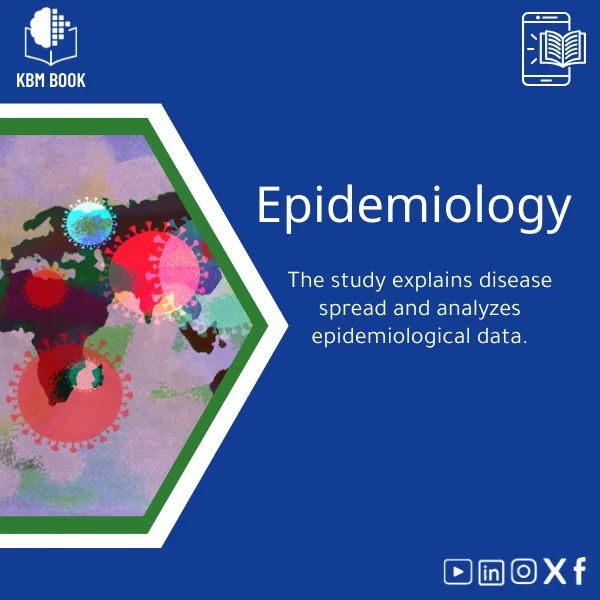
Epidemiology Guide to Disease Spread and Data Analysis
Original price was: 179.00 $.139.00 $Current price is: 139.00 $.
A structured, searchable Knowledge Base Module (KBM) that turns epidemiology theory into practical tools:
clear definitions, hierarchical concepts, reproducible data workflows, and ready-to-use templates for students,
researchers, and health professionals who need fast access to reliable epidemiology reference material.
Key benefits & value for the buyer
This Epidemiology KBM reframes “epidemiology” from a dense subject into a layered, retrievable
toolset. Each module maps concepts (incidence, prevalence, odds ratio, sensitivity/specificity),
workflows (data cleaning, outbreak curve construction, R/Python scripts), and interpretation notes
into a consistent structure so you spend fewer hours searching and more time analyzing.
Features translated into practical benefits
- Hierarchical structure: Start at a high-level concept and drill to code or citations without switching resources.
- Template-driven analysis: Reproducible scripts and example datasets accelerate assignments and reports.
- Evidence mapping: Quick reference links to primary sources reduce literature search time.
- Portable files: Downloadable formats (PDF summary + machine-readable KB) fit both coursework and lab pipelines.
Use cases & real-life scenarios
How students, researchers, and professionals apply this epidemiology book PDF and KBM in daily work:
For students
Follow structured modules to master “basics of epidemiology” before exams. Use step-by-step examples to complete assignments with reproducible outputs.
For researchers
Import analysis templates into your workflow to standardize case-control or cohort study analyses. Use evidence-linked summaries to write methods sections quickly.
For public health professionals
During outbreaks, use the KBM to construct epidemic curves, calculate attack rates, and generate briefings with minimal setup time.
Who is this product for?
Designed specifically for students, researchers, and professionals who need a reliable, structured
reference for epidemiology and disease data analysis. If you search for “epidemiology book pdf”,
want to “learn epidemiology” practically, or require a “medical epidemiology reference” to embed into
training or research pipelines, this KBM is for you.
How to choose the right KBM for your needs
Compare your goals against these selection points:
- Learning vs. implementing: Choose the full KBM if you need both conceptual explanations and runnable templates. Choose the summary PDF if you only need a compact study aid.
- Software compatibility: Confirm included code supports R or Python depending on your environment.
- Depth required: Introductory modules cover “basics of epidemiology”; advanced modules include modeling, survival analysis, and reproducible pipelines.
Quick comparison with typical alternatives
Unlike a single textbook or scattered articles, this KBM provides:
- Searchable, hierarchical knowledge vs. linear chapters.
- Actionable templates and datasets vs. theoretical descriptions only.
- Compact exportable files for integration with research workflows vs. static PDFs.
Best practices & tips to get maximum value
- Start with the “Fundamentals” module to align terminology before using templates.
- Import example datasets into your local environment and run scripts line-by-line to learn the pipeline.
- Use evidence-linked citations when drafting methods to save literature review time.
- Keep the KBM as a living file: replace example datasets with your data and document changes for reproducibility.
Common mistakes when buying or using epidemiology resources — and how to avoid them
- Mistake: Buying resources that are either too theoretical or only code-heavy. Fix: Choose a balanced KBM (concepts + templates).
- Mistake: Ignoring software compatibility. Fix: Check included formats (R/Python/CSV) before purchase.
- Mistake: Treating single examples as universal. Fix: Use the KBM as a framework and customize for your population and measures.
Product specifications
- Product type: Knowledge Base Module (KBM) — Epidemiology
- Formats included: PDF summary, JSON/CSV knowledge export, R and Python script templates
- Structure: Hierarchical modules — Fundamentals, Study Design, Measures & Interpretation, Modeling, Outbreak Response
- Filesize: Compact summary PDF (~6–20 pages depending on edition) + structured KB (10–50 MB depending on included datasets)
- Languages: English (primary); Arabic interface notes available in select modules
- License: Single-user digital license with optional institutional licensing
- Delivery: Immediate download after purchase (ZIP file)
- Updates: Minor corrections included; major updates available as paid upgrades
Frequently asked questions
Can I use the templates with my own datasets?
Yes. Templates are provided with example CSVs and annotated scripts. Replace the example data with your datasets and follow the inline comments. The KBM is designed for reuse and adaptation in research workflows.
Is this an epidemiology book PDF or an interactive database?
Both. You receive a concise epidemiology book PDF for quick study plus the structured KBM files (searchable JSON/CSV and runnable scripts) so you can use it as a reference or integrate it into analysis pipelines.
Which software does the KBM support?
Included scripts are provided in R (tidyverse) and Python (pandas, statsmodels). Data files are standard CSV. Instructions are included for running on local machines or cloud notebooks.
What if I need an institutional license or bulk access?
Contact KBMBook support for institutional licensing and multi-user bundles. The KBM is commonly licensed for course packs and departmental research groups.
Ready to structure your epidemiology knowledge?
Get a practical, research-ready epidemiology KBM that combines the clarity of an epidemiology book PDF with the power of searchable, reproducible analysis templates.
Immediate download and hands-on examples let you start applying methods the same day.
Related products

Atomic Physics Guide: Understanding Atomic and Electron Properties
Knowledge Base — Atomic/Electron Properties & Electromagnetic Interactions. A structured, searchable KBM for students, researchers, and professionals who need an authoritative atomic physics reference that organizes concepts, formulas, experiments, and practical applications from basics of atomic physics to advanced electron properties.
Biochemistry Book: Understanding Chemical Processes in Living Systems
Biological Anthropology Study Guide on Human Evolution

Classical Mechanics Guide: Newton’s Laws and Dynamics
A searchable, hierarchical Knowledge Base Module (KBM) that turns classical mechanics into a practical, ready-to-use reference for fast problem solving, lecture preparation, and applied engineering. Designed for students, researchers, and professionals who need precise access to Newton’s laws, rotational motion, and applied dynamics without the noise of textbooks.

Inorganic Chemistry Guide: Bonding and Crystal Solids
A structured, searchable Knowledge Base Module (KBM) that converts inorganic chemistry fundamentals and advanced topics—bonding models, lattice structures, defects, and solid-state properties—into a practical digital reference for students, researchers, and professionals who need fast, reliable answers without wading through textbooks.

Introductory General Chemistry Book on Matter and Reactions
A structured, searchable Knowledge Base Module (KBM) that converts core general chemistry concepts — matter, elements, reactions, stoichiometry and molarity — into a hierarchical reference you can query, teach from, or integrate into study workflows. Ideal as a concise General Chemistry book alternative for students, researchers, and professionals who need accurate, practical chemistry knowledge fast.
Organic Chemistry Guide: Carbon Chains and Reactions
Physical Chemistry Guide: Energy, Thermodynamics & Interactions
A structured Knowledge Base Module (KBM) for Physical Chemistry that converts core theory, worked examples, and applied datasets into a searchable, hierarchical database — ideal for students, researchers, and professionals who need fast, reliable access to chemical thermodynamics basics and molecular interaction models.
Reviews
Clear filtersThere are no reviews yet.