


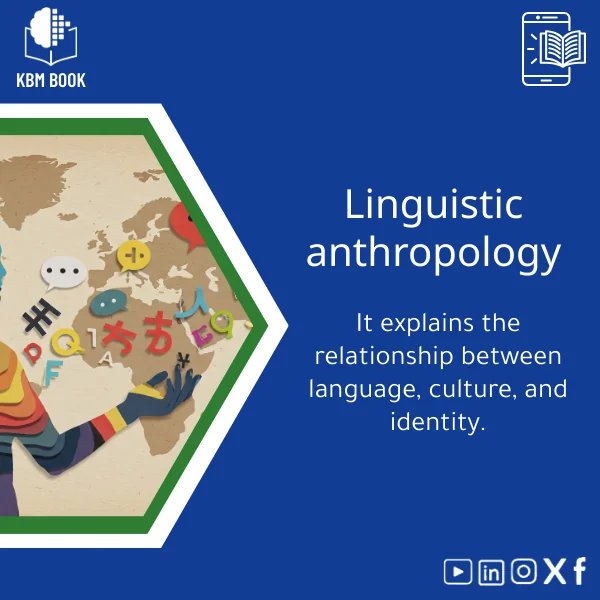
Linguistic Anthropology: Understanding Language and Culture Guide
Original price was: 179.00 $.139.00 $Current price is: 139.00 $.
A searchable, hierarchical knowledge base that turns linguistic anthropology — the study of language, culture, and identity — into a practical reference for students, researchers, and professionals who need fast, reliable answers and structured learning paths.
Key benefits & value for the buyer
This Linguistic Anthropology KBM translates academic complexity into actionable knowledge. Rather than sifting through books and scattered articles, you get:
- Speed: Precise entries and cross-referenced nodes let you answer research questions in minutes.
- Depth without redundancy: Each module covers theory, methods, and applied examples without repetition.
- Reliability: Curated literature summaries and annotated bibliographies point to primary sources for citation.
- Reusability: Exportable snippets and checklists you can drop directly into notes, lecture slides, or grant proposals.
For anyone who needs a compact social sciences reference on language, culture and identity, this KBM is designed to be both a learning path and a practical toolkit.
Use cases & real-life scenarios
For students
Prepare essays and exams quickly: use the KBM’s “concept-practice” nodes to revise phonology examples, methodological distinctions, and key case studies with linked citations for fast bibliography building.
For researchers
When designing fieldwork, consult the KBM’s methodological checklists (participant observation, recording ethics, transcription conventions) and sample codebooks to shorten planning time and reduce avoidable errors.
For professionals & trainers
Use the KBM as a class syllabus backbone or workshop guide. Each module can be used as a one-session lesson plan with learning outcomes, discussion prompts, and recommended readings.
Who is this product for?
- Undergraduate and graduate students studying linguistic anthropology, sociolinguistics, or related social sciences.
- Researchers preparing literature reviews, fieldwork protocols, or interdisciplinary studies.
- Academics and trainers who need a structured resource to build lectures and modules.
- Professionals in language policy, cultural heritage, or community research requiring an evidence-based reference.
How to choose the right KBM variant
KBM modules are typically offered in tiered depth. Choose based on your immediate need:
- Introductory KBM: Core concepts and essential readings — best for coursework and quick onboarding.
- Comprehensive KBM: Full literature summaries, methods, and case studies — ideal for thesis work and extended research.
- Applied KBM: Practical templates, field guides, and data examples — recommended for practitioners and trainers.
If unsure, start with the comprehensive KBM for broad coverage; use the module index to focus on applied or introductory submodules as needed.
Quick comparison with typical alternatives
Common options include textbooks, journal articles, and scattered online resources. Compared to those:
- Textbooks: thorough but linear — the KBM is modular and searchable for targeted queries.
- Journal articles: deep but narrow — the KBM synthesizes multiple studies and points to originals for verification.
- Free web sources: variable quality — the KBM offers curated, structured content with academic references.
In short, this linguistic anthropology book in KBM format acts as a bridge between breadth and usability: deep enough for scholarship, organized for rapid access.
Best practices & tips to get maximum value
- Start with the module map to identify the smallest node that answers your question — this saves time over reading chapters end-to-end.
- Use exported checklists before fieldwork to ensure ethical and methodological compliance.
- Integrate KBM citations directly into reference managers — each node includes standard bibliographic metadata.
- Revisit cross-references: many insights appear where theory and method nodes intersect.
Common mistakes when buying/using similar products and how to avoid them
Buyers often expect a single linear “book” and are disappointed by modular formats. To avoid mismatch:
- Clarify your goal: quick answers vs. step-by-step course design — choose the KBM depth accordingly.
- Don’t assume completeness on niche topics; check the module index for coverage of specific languages or regions.
- Avoid formats that aren’t compatible with your workflow — preview file types before purchase.
Product specifications
- Title: Linguistic Anthropology: Understanding Language and Culture Guide
- Format: Knowledge Base Module (hierarchical database + exportable files)
- Typical file types: searchable CSV/Excel extracts, JSON, PDF summaries, and SQLite snapshot for local search
- Language: English
- Depth: Introductory → Advanced modules (full literature summaries, methods, case studies)
- Use notes: Designed for academic citation, fieldwork planning, classroom syllabus design
- Delivery: Instant digital download after purchase
Frequently asked questions
Is this a book or a database? How do I use it in assignments?
This product is a Knowledge Base Module (KBM): a structured, searchable database complemented by PDF summaries and exportable snippets. Use module nodes and provided bibliographic entries for citations; export checklists and templates for assignments and fieldwork reports.
What formats are included and will they work with my software?
The KBM includes common export formats (CSV/Excel, JSON, PDF, and a lightweight SQLite snapshot) compatible with reference managers, spreadsheet software, and local search tools. If you require a different format, contact support for conversion options.
How reliable is the bibliography and are sources cited properly?
Each module includes curated bibliographies with links to primary sources where possible. Summaries point to landmark studies and recent reviews to help you verify and expand research. Use the bibliographic metadata for accurate citations.
What if I buy it and realize I need a different module depth?
KBMBook provides previews of module indices and sample nodes so you can confirm coverage before purchasing. If you need a different depth after purchase, check available upgrade or bundle options on the product page.
Ready to get reliable, structured knowledge?
Transform how you study, teach, and research language, culture and identity. Download a KBM designed for practical use — fast lookup, curated references, and ready-to-use templates.
Instant digital delivery. Compatible with academic workflows and field research. Secure checkout on KBMBook.
Related products
Analytical Chemistry Book: Qualitative and Quantitative Methods Guide
Astrophysics Book: Understanding Stars, Galaxies, and Dark Energy
A searchable, hierarchical Knowledge Base Module (KBM) that converts astrophysics and cosmology into a practical, exam-ready and research-ready reference. Designed for students, researchers, and professionals who need immediate access to reliable explanations, equations, and data models for stars, galaxies, and dark energy.
Comprehensive Botany Book on Plant Taxonomy and Photosynthesis
A structured, searchable botany book designed as a Knowledge Base Module (KBM) — an end-to-end reference on plant taxonomy, organ structure, and the biochemistry of photosynthesis. Built for students, researchers, and professionals who need reliable, hierarchical knowledge they can search, cite, and apply immediately.
Comprehensive Evolutionary Biology Book on Natural Selection
Comprehensive Genetics Book: DNA, Mendelian Genetics & Engineering
A structured, searchable knowledge base module (KBM) that turns genetics theory and practice into an immediately usable digital reference — from DNA structure to Mendelian genetics and contemporary genetic engineering techniques — optimized for students, researchers, and professionals who need reliable answers fast.

Modern Physics Book: Quantum, Relativity, and Tech Applications Guide
A structured, searchable Knowledge Base Module (KBM) that turns modern physics — quantum mechanics, special & general relativity, and contemporary technological applications — into a hierarchical, practical reference for students, researchers, and professionals who need quick, reliable access to advanced concepts and formulas.

Reviews
Clear filtersThere are no reviews yet.