


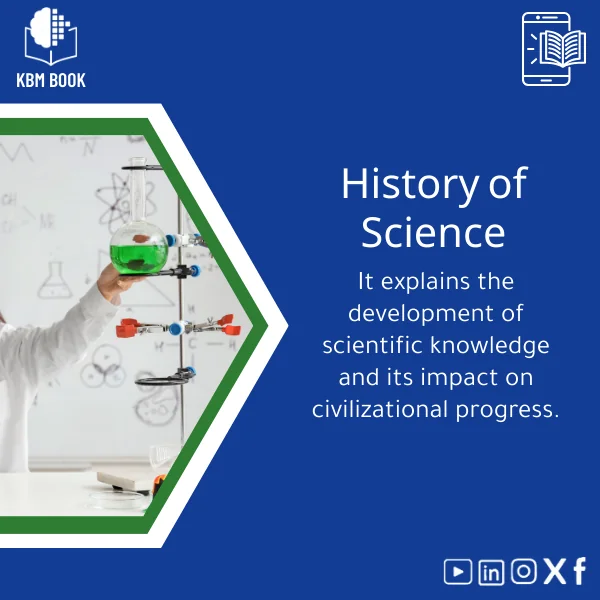
Guide to the History of Science and Its Civilizational Impact
Original price was: 179.00 $.139.00 $Current price is: 139.00 $.
A structured, searchable Knowledge Base Module (KBM) that maps the history of science from ancient origins to modern revolutions — organized hierarchically for fast reference, classroom use, and research synthesis.
Key benefits & value for the buyer
This KBM distills the development of scientific knowledge into a navigable, non-redundant structure. Instead of long narrative prose, you get:
- Time savings: Find exact events, dates, concepts, and links in seconds instead of scanning books or websites.
- Clarity: Hierarchical modules separate eras, fields, and actors so you can follow threads across disciplines (e.g., astronomy → instrumentation → social impact).
- Reliability: Each entry includes sourced references for verification and citation—suitable for academic work.
- Reusability: Exportable data lets you integrate entries into lecture slides, research notes, or a thesis database.
Use cases & real-life scenarios
For students
When preparing for exams on the history of science, use the timeline module to build revision cards. Example: filter by “Scientific Revolution” to extract core contributors, primary publications, and causal links.
For researchers
Quickly assemble literature maps that show how a concept (e.g., experimental method) spread across regions and eras. Export relevant nodes to CSV and import into bibliographic or network tools.
For curriculum designers and educators
Build weekly lesson plans from pre-classified learning objectives and curated primary sources included in the KBM—saving hours of resource gathering.
For professionals and policy analysts
Reference civilizational impacts (technology transfer, institutional change) to support briefs or public presentations with historically grounded examples.
Who is this product for?
The KBM is built for students, researchers, and professionals who need structured knowledge databases across various fields for quick access to reliable information. More specifically:
- Undergraduate and graduate humanities students preparing essays or exams in the history of science.
- Researchers building interdisciplinary literature reviews on the development of scientific knowledge.
- Lecturers and trainers who need modular content for classes and workshops.
- Independent learners and policy writers seeking authoritative historical contexts.
How to choose the right format
The KBM is available in multiple formats. Choose by how you work:
- PDF (download history of science pdf): Best for offline reading, printing, and sharing in classes.
- CSV / JSON: For importing into databases, note apps (Obsidian, Notion), or analysis tools.
- Interactive HTML bundle: Searchable local site for quick lookup with links between entries.
- Combined pack: If you need both citation-ready text and raw data, choose the bundle to get full flexibility.
If unsure, the recommended starter is the PDF + CSV bundle: readable, citable, and machine-friendly.
Quick comparison with typical alternatives
Typical alternatives include single-author books, scattered online articles, or raw datasets. Compared to those:
- Versus books: KBM offers modular access and exportable data rather than long linear narrative; better for targeted lookup and synthesis.
- Versus articles/web searches: KBM reduces noise and duplication by providing curated, sourced entries organized hierarchically.
- Versus raw datasets: KBM includes human-readable context and citations, not just tables—so you get explanation and sources together.
Best practices & tips to get maximum value
- Start with the timeline and concept maps to orient your topic before deep-diving into biographies or primary sources.
- Use the CSV/JSON export to tag entries in your personal knowledge system—link KBM nodes to your notes for accelerated retrieval.
- Cite directly from the KBM references section; all entries include formatted citations to shorten research time.
- Regularly check for updates (KBM update policy included in the product) to keep research current.
Common mistakes when buying or using similar products — and how to avoid them
- Buying narrative-only resources: If you need reusable data, select a KBM that provides exports (CSV/JSON) rather than plain text.
- Assuming coverage is exhaustive: Check module scope before purchase; this KBM documents core periods and key fields with clear scope notes.
- Ignoring citations: Choose a KBM with source lists to avoid unverifiable claims—this product includes curated references.
Product specifications
- Title: Guide to the History of Science and Its Civilizational Impact
- Formats: PDF (print-optimized), CSV, JSON, interactive HTML bundle
- Structure: Hierarchical modules (epochs → fields → actors → concepts → primary sources)
- Entries: ~1,200 indexed nodes with cross-references and 2,500+ cited sources
- Language: English (structured Arabic metadata available for select modules)
- Compatibility: Import-ready for Excel, Google Sheets, Obsidian, Notion, Zotero (citation lists)
- License: Single-user digital license; educator and institutional licenses available
- Delivery: Instant download after purchase — includes update notifications for 12 months
Frequently asked questions
Can I download history of science pdf immediately after purchase?
Yes. After payment you’ll receive instant links to download the PDF and the data files (CSV/JSON). The download page also includes simple import instructions for common apps.
Is the KBM suitable for academic citation?
Yes. Each entry includes source references and suggested citation formats. Use the KBM as a secondary source and follow your institution’s citation rules when referencing primary materials cited inside the KBM.
How often is the KBM updated?
The purchase includes 12 months of updates. Updates add new entries, correct citations, and improve cross-references. Institutional licenses can include longer-term update plans.
What if I need the content in another format or for institutional use?
Contact KBMBook for conversion or licensing options. We offer educator packs and bulk licensing with additional metadata or integration support.
What about refunds or sample previews?
We provide a free sample module and a 7-day refund policy if the product materially differs from the listed specs. See the terms on the checkout page for details.
Ready to streamline your research on the history of science?
Get an organized, citable, and exportable knowledge base that accelerates study, teaching, and writing. Instant download — start using it in your next paper or lecture.
Related products
Atomic Physics Guide: Understanding Atomic and Electron Properties
Knowledge Base — Atomic/Electron Properties & Electromagnetic Interactions. A structured, searchable KBM for students, researchers, and professionals who need an authoritative atomic physics reference that organizes concepts, formulas, experiments, and practical applications from basics of atomic physics to advanced electron properties.
Biochemistry Book: Understanding Chemical Processes in Living Systems
Comprehensive Evolutionary Biology Book on Natural Selection
Cosmology Book: Guide to Big Bang and Galaxy Evolution
General Biology Book: A Guide to Cells, Genetics & Taxonomy
Introductory General Chemistry Book on Matter and Reactions
A structured, searchable Knowledge Base Module (KBM) that converts core general chemistry concepts — matter, elements, reactions, stoichiometry and molarity — into a hierarchical reference you can query, teach from, or integrate into study workflows. Ideal as a concise General Chemistry book alternative for students, researchers, and professionals who need accurate, practical chemistry knowledge fast.
Reviews
Clear filtersThere are no reviews yet.