


Comparative Religious Studies: A Comprehensive Guide
Original price was: 349.00 $.279.00 $Current price is: 279.00 $.
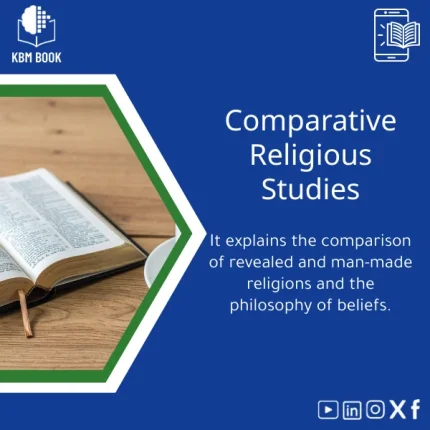
A searchable, hierarchical Knowledge Base Module (KBM) that turns comparative religion into a practical research and teaching tool—covering Abrahamic and non‑Abrahamic religions, belief systems, philosophies, and comparative methodologies for quick reference and reliable citation.
Key benefits & value for the buyer
This KBM translates the field of Comparative Religious Studies into a practical, digital research asset. Each feature is designed to deliver measurable time savings and better outputs:
- Faster research: pre-indexed topics and cross-references reduce literature scanning from hours to minutes.
- Higher-quality citations: annotated bibliographies and primary-source links improve academic reliability.
- Scalable learning: modular design supports stepwise curriculum building—from introductory definitions to advanced philosophical debates in the philosophy of religious beliefs.
- Practical deliverables: ready-made lecture outlines, exam question banks, and comparative matrices for reports or presentations.
Use cases & real-life scenarios
For a humanities student
Prepare a literature review on Abrahamic and non‑Abrahamic religions: find compact summaries, major contested points, and a prioritized reading list to support thesis chapters.
For a researcher
Assemble comparative matrices for journal submission—compare ritual practices, conceptions of the divine, and ethical frameworks across traditions with linked primary sources ready for citation.
For a lecturer or trainer
Build a 10‑week course using the module’s lesson templates, slide outlines, and assessment items; evaluate students with rubric examples that align to learning outcomes.
For policy analysts & multicultural teams
Use the KBM to brief stakeholders on religious literacy, reduce cultural risk in project planning, and draft inclusive communication strategies informed by doctrinal and social differences.
Who is this product for?
Comparative Religious Studies is tailored for:
- Undergraduate and graduate students seeking a concise, reliable knowledge base for coursework and theses.
- Academic researchers who need structured comparative frameworks and quick access to primary and secondary sources.
- Instructors and curriculum designers building modules on religion, ethics, or intercultural studies.
- Professionals—policy analysts, HR specialists, NGO staff—requiring actionable religious literacy tools.
How to choose the right format & depth
The KBM is offered with selectable depth levels and formats depending on your use:
- Introductory — concise definitions, timelines, and beginner reading lists (best for undergraduates).
- Intermediate — comparative matrices, case studies, and teaching materials (best for lecturers and MA students).
- Advanced — full annotated bibliography, primary-text cross-indexes, and research templates (best for doctoral researchers and professionals).
- Formats — searchable Excel/CSV, structured JSON export, and printable PDF summaries for quick distribution.
Choose the depth that matches your project timeline—upgrade options are available if you need additional modules later.
Quick comparison with typical alternatives
Unlike single-author textbooks or static articles, this KBM offers:
- Hierarchical structure: topic → subtopic → evidence, which reduces duplication and helps you build work incrementally.
- Searchability: instant lookup and exportable subsections for direct insertion into papers or presentations.
- Interactivity: cross-references and matrices designed for comparative analysis, not just passive reading.
Best practices & tips to get maximum value
- Start with the module index to map topics to your project scope—use the “Compare” matrices to identify gaps fast.
- Export only the sections you need into a working document to keep focus and reduce clutter.
- Cross-check primary-source links before final submission; use the annotated bibliography to justify source selection.
- If teaching, adapt the lesson templates and assessment rubrics rather than creating new materials from scratch—this saves preparation time.
Common mistakes when buying/using similar products and how to avoid them
- Mistake: Buying a single-format PDF. Fix: Choose a KBM with exportable data so you can reformat and search your content.
- Mistake: Overloading your project with unfiltered sources. Fix: Use the module’s prioritized readings and annotated notes to pick the most relevant works.
- Mistake: Skipping cross-cultural context. Fix: Use the comparative matrices to include social and historical variables, not just doctrinal text.
Product specifications
- Product type: Knowledge Base Module (KBM) — Comparative Religious Studies
- Content scope: Abrahamic and non‑Abrahamic religions, ritual practices, theology, ethics, philosophy of religious beliefs, case studies, timelines.
- Included assets: hierarchical taxonomy, comparative matrices, annotated bibliography, lecture templates, assessment rubrics, exportable CSV/JSON, printable PDFs.
- Formats: Searchable Excel/CSV, structured JSON, PDF summary pack.
- Licence: Single-user academic/commercial use (see purchase page for license terms).
- Delivery: Immediate digital download after purchase.
- Usage notes: Optimised for research, teaching, and policy briefing; compatible with common reference managers.
FAQ
Is this KBM suitable for citation in academic work?
Yes. The module includes citation-ready references and links to original sources. Always verify primary-source links and follow your institution’s citation style when referencing materials from the KBM.
What formats are included and can I export to my reference manager?
The KBM includes exportable CSV/JSON and printable PDFs. Bibliographic entries are formatted for quick import into common reference managers—export procedures are documented in the download package.
How does this differ from a comparative religion book?
Unlike a linear book, this product is a structured, searchable database of modular units: you can extract, compare, and reuse parts (matrices, lesson plans, bibliographies) without reading end-to-end.
What if I need more depth after purchase?
Upgrade paths and add-on modules are available for expanded case studies, region-specific material, or additional teaching resources—details are on the product page.
Is the content peer-reviewed?
The KBM is compiled from academically reputable sources and includes annotated references. It is curated for academic use but is not a formal peer-reviewed monograph; users should consult primary scholarship where required.
Get the KBM and speed up your work
Convert hours of searching into minutes of targeted work. Whether you’re drafting a thesis, preparing lectures, or producing policy briefings, this KBM gives you the structured foundation to work faster and with greater confidence.
Related products
Classical Mechanics Guide: Newton’s Laws and Dynamics
A searchable, hierarchical Knowledge Base Module (KBM) that turns classical mechanics into a practical, ready-to-use reference for fast problem solving, lecture preparation, and applied engineering. Designed for students, researchers, and professionals who need precise access to Newton’s laws, rotational motion, and applied dynamics without the noise of textbooks.
Comprehensive Botany Book on Plant Taxonomy and Photosynthesis
A structured, searchable botany book designed as a Knowledge Base Module (KBM) — an end-to-end reference on plant taxonomy, organ structure, and the biochemistry of photosynthesis. Built for students, researchers, and professionals who need reliable, hierarchical knowledge they can search, cite, and apply immediately.
Comprehensive Genetics Book: DNA, Mendelian Genetics & Engineering
A structured, searchable knowledge base module (KBM) that turns genetics theory and practice into an immediately usable digital reference — from DNA structure to Mendelian genetics and contemporary genetic engineering techniques — optimized for students, researchers, and professionals who need reliable answers fast.
Comprehensive Microbiology Book on Bacteria, Viruses, and Fungi
General and Special Relativity Book on Einstein’s Theory
A structured, searchable Knowledge Base Module (KBM) that converts Einstein's General and Special Relativity into a clear, hierarchical reference: formulas, derivations, worked examples, practical applications (GPS, astrophysics), and a compact research bibliography — ready to download and integrate into study, teaching, or research workflows.
General Biology Book: A Guide to Cells, Genetics & Taxonomy

Inorganic Chemistry Guide: Bonding and Crystal Solids
A structured, searchable Knowledge Base Module (KBM) that converts inorganic chemistry fundamentals and advanced topics—bonding models, lattice structures, defects, and solid-state properties—into a practical digital reference for students, researchers, and professionals who need fast, reliable answers without wading through textbooks.
Reviews
Clear filtersThere are no reviews yet.