


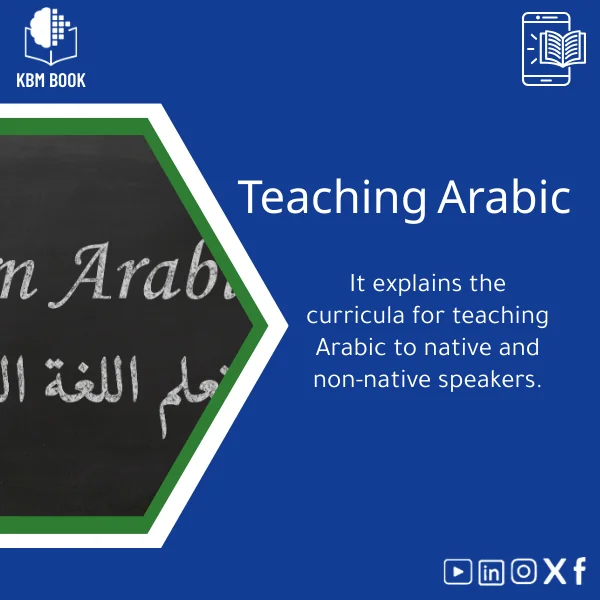
Arabic Language Teaching Guide for Native and Non-Native Speakers
Original price was: 179.00 $.139.00 $Current price is: 139.00 $.
A structured, searchable Knowledge Base Module (KBM) that converts Arabic language teaching theory and practice into a hierarchical, ready-to-use curriculum: lesson plans, assessment rubrics, pedagogy notes, and searchable reference entries for both native and non-native contexts.
Key benefits & value for the buyer
This KBM translates the principles of Arabic language teaching into a practical, re-usable digital asset. Instead of long narrative textbooks or scattered articles, you receive a tightly organized knowledge database that saves time, reduces planning overhead, and standardizes instruction across classes and contexts.
What you gain
- Speed: Locate teaching templates, rules, and exercises in seconds using the indexed structure.
- Consistency: Apply the same assessment rubrics and learning outcomes across cohorts.
- Depth: Each module includes theory, examples, common errors, and remediation steps—useful for both researchers and practitioners.
- Flexibility: Exportable assets let you adapt content for curriculum alignment, research coding, or classroom delivery.
Use cases & real-life scenarios
The KBM supports multiple daily workflows. Below are concrete scenarios that show how professionals and students benefit.
Scenario: University instructor preparing a semester
Build a 12-week syllabus in two hours: pick modules for phonetics, morphology, syntax, and communicative tasks; attach assessment rubrics; export weekly lesson packs compatible with your LMS.
Scenario: Language center training non-native adults
Use the non-native track to focus on pronunciation drills, high-frequency vocabulary lists, and task-based activities with teaching notes tailored to adult learners’ needs and cultural contexts.
Scenario: Researcher coding learner errors
Extract categorized error types and annotated examples for quantitative analysis. The KBM’s taxonomy speeds up coding and improves inter-rater reliability.
Who is this product for?
The KBM is designed for students, researchers, and professionals who need structured knowledge databases for quick access to reliable information about Arabic language teaching. Typical users:
- University lecturers and course designers
- Language school trainers and tutors
- Graduate researchers in applied linguistics
- Educational technologists integrating Arabic curricula into LMS
- Self-directed learners who want a systematic roadmap
How to choose the right KBM edition
Editions differ by depth and scope. Choose based on your primary goal:
- Introductory Edition: Best for foundations and short courses—concise lesson plans, essential grammar, basic assessment.
- Professional Edition: Full curriculum with advanced modules, teacher notes, and exportable assessment rubrics—recommended for institutions.
- Research Pack: Includes extended corpora examples, error taxonomies, and data export formats (CSV/JSON) for analysis.
If unsure, start with the Professional Edition: it balances usability and depth and can be filtered to act like the Introductory Edition.
Quick comparison with typical alternatives
When deciding between this KBM and traditional materials, consider these points:
- Textbooks: Narrative depth but slow to search and adapt; KBM is modular and searchable for quick lesson building.
- Online articles / blogs: Useful for single topics but inconsistent and often lacking assessment tools; KBM provides a consistent taxonomy and ready assets.
- Commercial course platforms: May lock you into a fixed path; KBM exports let you reuse content freely within your institution or research.
Best practices & tips to get maximum value
- Map the KBM modules to your curriculum objectives before you begin—use the provided learning outcomes for alignment.
- Start with core modules (phonology, basic grammar, vocabulary) and layer on communicative tasks for the non-native path.
- Use the assessment templates as-is for reliability, or adapt rubrics for local grading scales and accreditation requirements.
- Import examples into your LMS and tag resources by proficiency level for fast retrieval during lesson prep.
Common mistakes when buying or using similar products — and how to avoid them
- Mistake: Buying narrative resources without exportable assets. Fix: Choose a KBM with export options and reusable templates.
- Mistake: Over-customizing before testing. Fix: Pilot core modules for a term, collect data, then adapt.
- Mistake: Ignoring alignment to proficiency frameworks. Fix: Use the KBM’s mapped learning outcomes to CEFR-like levels or institutional standards.
Product specifications
- Product type: Knowledge Base Module (KBM) — digital download
- Languages included: Arabic (Modern Standard), pedagogical notes in English
- Formats: PDF (readable), CSV & JSON (exportable indexes), editable DOCX templates
- Scope: Introductory to advanced modules — phonology, morphology, syntax, discourse, sociolinguistics, assessment
- Delivery: Immediate download after purchase; includes README and integration notes
- License: Single-institution or single-user license options (see product page for details)
- Updates: Periodic updates with errata and pedagogical improvements (update policy included)
Frequently asked questions
Can I adapt the KBM for different syllabi and export to my LMS?
Is this suitable for both native Arabic speakers and non-native learners?
What if I need research-ready data (error corpora, tagged examples)?
Are updates included with purchase?
Ready to standardize your Arabic language teaching?
Convert scattered knowledge into an organized, searchable curriculum. Purchase the KBM today and start building consistent courses, reliable assessments, and research-quality datasets.
Still unsure? Download the sample module (free preview available on the product page) to verify fit before purchasing.
Related products
Biochemistry Book: Understanding Chemical Processes in Living Systems
Classical Mechanics Guide: Newton’s Laws and Dynamics
A searchable, hierarchical Knowledge Base Module (KBM) that turns classical mechanics into a practical, ready-to-use reference for fast problem solving, lecture preparation, and applied engineering. Designed for students, researchers, and professionals who need precise access to Newton’s laws, rotational motion, and applied dynamics without the noise of textbooks.
Comprehensive Genetics Book: DNA, Mendelian Genetics & Engineering
A structured, searchable knowledge base module (KBM) that turns genetics theory and practice into an immediately usable digital reference — from DNA structure to Mendelian genetics and contemporary genetic engineering techniques — optimized for students, researchers, and professionals who need reliable answers fast.
Comprehensive Nuclear Physics Book on Structure and Radioactivity

General and Special Relativity Book on Einstein’s Theory
A structured, searchable Knowledge Base Module (KBM) that converts Einstein's General and Special Relativity into a clear, hierarchical reference: formulas, derivations, worked examples, practical applications (GPS, astrophysics), and a compact research bibliography — ready to download and integrate into study, teaching, or research workflows.
General Biology Book: A Guide to Cells, Genetics & Taxonomy

Quantum Mechanics: A Beginner’s Guide to Superposition and Waves
Thermal Physics Guide: Understanding Heat, Energy, and Entropy
A downloadable, hierarchically structured Knowledge Base Module (KBM) that converts university-level thermodynamics into a searchable, practical digital database. Ideal for students, researchers, and professionals who need fast, reliable access to fundamentals and advanced topics in thermal physics.
Reviews
Clear filtersThere are no reviews yet.