


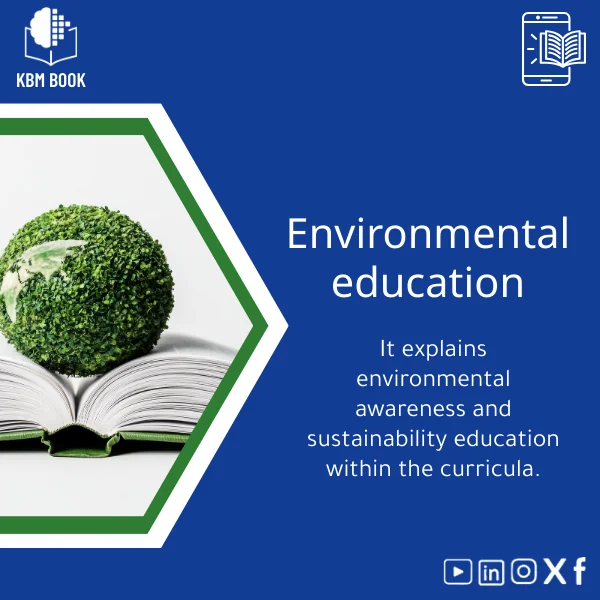
Environmental Education Guide for Sustainability Literacy
Original price was: 179.00 $.139.00 $Current price is: 139.00 $.
A hierarchical, searchable knowledge base module (KBM) that transforms environmental education into a practical, curriculum-ready digital tool — ideal for students, researchers, and professionals who need reliable environmental literacy resources fast.
Key benefits & value for buyers
This Environmental Education KBM is designed to convert fragmented content into a single, reliable reference. Each feature is built to deliver a measurable outcome:
- Faster research: hierarchical indexing reduces search time — find definitions, case studies, or data in seconds.
- Ready-to-use lessons: plug-and-play lesson plans and assessment rubrics accelerate curriculum development for sustainability education in curriculum.
- Academic rigor: every node cites primary sources, improving credibility for research and citations.
- Practical application: templates for community projects, policy briefs, and sustainability audits help professionals implement what they learn.
- Editable & exportable: content can be extracted to PDF, slides, or LMS-friendly formats — including an environmental education book PDF export option.
In short: save hours of synthesis and produce structured outputs that can be taught, referenced, and applied.
Use cases & real-life scenarios
1. University instructor — building a module
An instructor uses the KBM to assemble a 12-week syllabus on environmental literacy for students. They export weekly reading lists, select assessment rubrics, and embed case-study datasets for in-class analysis.
2. Graduate researcher — literature mapping
A researcher imports the KBM’s bibliographic nodes into reference software, identifies gaps in empirical studies on urban sustainability, and generates a literature review outline in hours instead of weeks.
3. Sustainability officer — policy brief
A sustainability professional extracts templates for stakeholder analysis and adapts a policy brief that references best practices and measurable indicators from the KBM.
Who is this product for?
The KBM is tailored for:
- Students seeking structured environmental literacy resources and an environmental education book PDF for study.
- Researchers requiring a curated, citation-ready knowledge map.
- Teachers and curriculum designers integrating sustainability education in curriculum.
- Professionals implementing sustainability projects, audits, or policy recommendations.
How to choose the right KBM format
This product is available as a master KBM with multiple export formats. Choose based on how you plan to use it:
- PDF export: Choose if you need a printable environmental education book PDF for distribution or offline study.
- Editable XML/CSV: Choose if you want to import nodes into an LMS or data analysis tools.
- Interactive JSON: Best for developers and digital trainers who will integrate the KBM into apps or internal knowledge portals.
Each format preserves hierarchical structure and citations; select licensing terms at checkout for single-user or institutional access.
Quick comparison with typical alternatives
Compared to a textbook, scattered PDFs, or ad-hoc lecture notes:
- Versus textbooks: KBM is modular and search-first, not linear — faster to navigate for specific queries.
- Versus single PDFs: Many PDFs lack structure and metadata; KBM provides indexed nodes, learning objectives, and export options.
- Versus online articles: KBM aggregates validated sources with consistent taxonomy, reducing duplication and contradictory information.
Best practices & tips to get maximum value
- Start with the mapped learning outcomes — match KBM nodes to your syllabus before exporting materials.
- Use the search and filter features to extract case studies relevant to your region or field.
- Customize rubrics and export as PDFs for student handouts to ensure consistent assessment.
- Keep a local copy of exported files and link to the KBM changelog to track updates.
Common mistakes when buying or using similar products — and how to avoid them
- Mistake: Buying a generic PDF and expecting modular reuse. Fix: Choose the KBM for structured nodes and exportable formats.
- Mistake: Assuming all sources are current. Fix: Use the KBM’s update log and date-filter when extracting research citations.
- Mistake: Over-customizing without preserving source links. Fix: Maintain citation metadata when editing or exporting content.
Product specifications
- Type: Digital Knowledge Base Module (KBM) — Environmental Education
- Files included: Master KBM (JSON), Export templates (PDF, XML, CSV), Lesson and assessment templates (DOCX)
- Language: English (structured Arabic metadata available on request)
- Coverage: Environmental literacy principles, pedagogy, curriculum mapping, case studies, datasets, assessment rubrics
- License: Single-user and institutional license options at checkout
- Compatibility: LMS importable, citation-ready for academic referencing
- Delivery: Immediate digital download after purchase
FAQ
Can I get an environmental education book PDF version?
Yes. The KBM includes a ready-to-export PDF formatted as an environmental education book. Use the PDF for handouts, libraries, or offline study. The master KBM remains editable for updates and custom-export needs.
How current is the content, and are updates provided?
The KBM compiles recent peer-reviewed sources and practitioner reports. Buyers receive access to a changelog; minor updates are included for a defined maintenance period depending on the license. Institutional buyers may request extended update plans.
Is this suitable for curriculum accreditation or research citations?
Yes. Each module contains learning outcomes aligned to common frameworks and citation-ready references for research. However, curriculum accreditation requires local alignment — the KBM provides mapping tools to adapt content to local standards.
I’m concerned about price and value — why buy a KBM instead of free online resources?
Free resources often require substantial time to verify, organize, and adapt. The KBM saves time with pre-mapped, peer-referenced content, export templates, and pedagogical tools — reducing preparation time and improving reliability. Consider the cost in hours saved and the improved consistency of outputs.
Ready to add structured environmental knowledge to your workflow?
Start building curriculum, conducting research, or producing policy work with a KBM designed for practical use. Immediate download, multiple export formats, and clear licensing options.
Related products
Biochemistry Book: Understanding Chemical Processes in Living Systems
Classical Mechanics Guide: Newton’s Laws and Dynamics
A searchable, hierarchical Knowledge Base Module (KBM) that turns classical mechanics into a practical, ready-to-use reference for fast problem solving, lecture preparation, and applied engineering. Designed for students, researchers, and professionals who need precise access to Newton’s laws, rotational motion, and applied dynamics without the noise of textbooks.
Comprehensive Nuclear Physics Book on Structure and Radioactivity
General Biology Book: A Guide to Cells, Genetics & Taxonomy
General Physics Book: Fundamentals of Force, Motion, Energy
Introductory General Chemistry Book on Matter and Reactions
A structured, searchable Knowledge Base Module (KBM) that converts core general chemistry concepts — matter, elements, reactions, stoichiometry and molarity — into a hierarchical reference you can query, teach from, or integrate into study workflows. Ideal as a concise General Chemistry book alternative for students, researchers, and professionals who need accurate, practical chemistry knowledge fast.
Molecular Biology Guide: Transcription, Translation & Repair
Physical Chemistry Guide: Energy, Thermodynamics & Interactions
A structured Knowledge Base Module (KBM) for Physical Chemistry that converts core theory, worked examples, and applied datasets into a searchable, hierarchical database — ideal for students, researchers, and professionals who need fast, reliable access to chemical thermodynamics basics and molecular interaction models.
Reviews
Clear filtersThere are no reviews yet.