


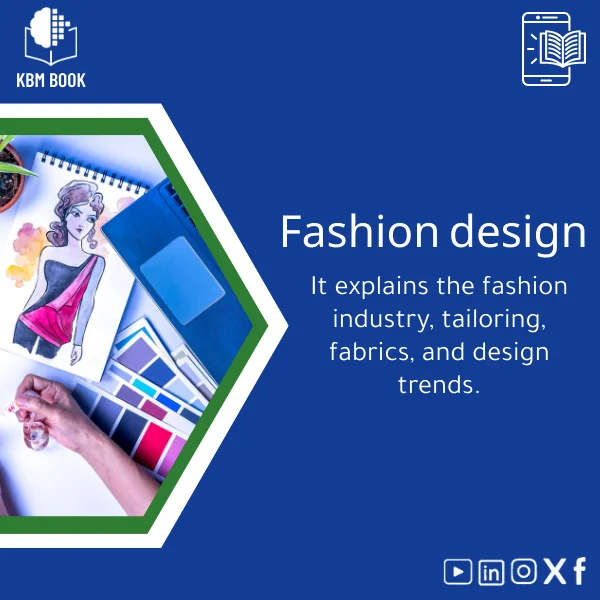
Fashion Design Course: Tailoring, Fabrics, and Trends Guide
Original price was: 159.00 $.119.00 $Current price is: 119.00 $.
A structured, searchable knowledge base for fashion design: step-by-step modules covering tailoring techniques, fabric science, pattern drafting, and trend analysis — designed so students, researchers, and professionals can find reliable, practical answers fast.
Key benefits & value for the buyer
This fashion design KBM converts fragmented learning materials into a single, structured resource. Each module is a compact, indexed database entry designed to answer specific questions quickly — for example: “Which fabrics are best for winter tailored coats?” or “How to grade a pattern from size 34 to 44.” The KBM reduces search time, prevents rework, and improves design accuracy.
Feature → Benefit
- Hierarchical modules (Basics → Intermediate → Advanced) → Saves time; you can jump to the exact depth you need.
- Multiple formats (SQLite, JSON, CSV, PDF summaries) → Integrates with research tools, LMS, or offline study.
- Practical templates & checklists → Apply immediately in studio or classroom settings.
- Trend analysis section with annotated sources → Make evidence-based collection decisions and assignments.
Use cases & real-life scenarios
The KBM is built for immediate, practical use. Below are typical workflows that show value in everyday situations.
In-class instruction
Instructors use the KBM as a curriculum backbone: assign specific modules for weekly labs (e.g., “Tailoring—Lining & Interfacing”), share step-by-step sewing sequences, and grade students consistently using the included checklists.
Studio & freelance work
Freelancers consult the fabrics matrix to recommend textile choices to clients, use grading rules to alter patterns without distortion, and reference care labels/finish options when creating production specs.
Research & thesis projects
Researchers extract cited trend datasets and historical comparisons directly from the KBM for literature reviews, and export data tables to analyze seasonality or material performance.
Who is this product for?
This KBM is targeted to students, researchers, and professionals who need reliable, structured knowledge on fashion design. If you need quick access to verified techniques, reproducible workflows, or an organized repository for teaching and research, this product delivers.
- Fashion design students learning tailoring, pattern making, and fabrics.
- Academic researchers compiling datasets on trends and materials.
- Professional designers or small labels looking for dependable production checklists and templates.
- Training coordinators and educators who need reusable course materials.
How to choose the right edition
We offer structured editions to match different needs and budgets. Choose based on depth, file format mix, and intended use.
- Compact (Starter) — Core concepts, quick-check PDFs, and CSV tables. Ideal if you want concise references or are just learning fashion design basics.
- Comprehensive (Standard) — All Compact content + full JSON/CSV datasets, pattern templates, and grading tables. Recommended for students and freelancers.
- Professional (Extended) — All Standard content + SQLite database, export-ready production sheets, trend analytics, and classroom packet. Best for educators and supply chains.
If unsure, the Standard edition fits most learners and professionals; it balances price with practical depth.
Quick comparison with typical alternatives
Consider three common alternatives: textbooks, scattered articles, and video tutorials. Here’s how the KBM differs.
- Textbooks — Deep but static; hard to query. KBM: searchable, modular, and exportable for research or production use.
- Articles & blogs — Fragmented, variable quality. KBM: curated, referenced, and structured to avoid repetition and misinformation.
- Video tutorials — Great for demonstration but poor for data extraction. KBM: pairs instructions with downloadable templates and data for practical application.
Best practices & tips to get maximum value
- Integrate the JSON/CSV exports with your LMS or research tools to automate citation and grading.
- Use the pattern templates and grading tables on real muslin trials to validate fit before production.
- Run the trend datasets against your sales data to test seasonal assumptions and make informed collection decisions.
- Bookmark frequently used modules in the SQLite version to speed recurrent lookups in studio workflows.
Common mistakes when buying/using similar products and how to avoid them
- Buying a single-format resource: Avoid PDFs-only collections; look for exportable data (CSV/JSON) if you plan to analyze or integrate content.
- Relying on unreferenced tips: Choose resources with citations and source notes to ensure methods are industry-standard.
- Skipping practical validation: Always test templates and grading with a sample garment before committing to production.
Product specifications
- Product type: Digital Knowledge Base Module (KBM) — Fashion Design
- Contents: Modules on tailoring, fabrics, pattern drafting, grading, trend analysis, production specs, and classroom packets
- Formats included: SQLite, JSON, CSV, XLSX, PDF reference guide
- File size: Compact ~25 MB | Standard ~120 MB | Professional ~350 MB (approx.)
- Languages: English (primary); Arabic metadata & labels available in select modules
- Delivery: Instant download after purchase; includes license for educational and professional use (see license file)
- Compatibility: Works with common database viewers, Excel, and most LMS platforms
FAQ
What formats do I get and can I import them into my tools?
The KBM is available in SQLite, JSON, CSV, XLSX, and PDF. These formats are intentionally chosen so you can import into Excel, R, Python, LMS systems, or your preferred research tools without custom conversion.
Is the content suitable for professional production specs?
Yes. The Professional edition contains production-ready checklists, spec sheets, and exportable data used for sample room and small-batch production. Always validate with a sample run and local suppliers.
How often is the trend data updated?
Trend modules include a snapshot and methodology with update notes. Professional subscribers receive periodic updates; individual purchases include one major update window described in the license.
Can I use this KBM for classroom distribution?
Yes. Licensing permits use in educational settings; choose the Professional edition for full classroom packets and multi-user deployment notes. See included license for distribution limits.
Ready to streamline your fashion design workflow?
Choose the edition that fits your needs and get an immediately downloadable, structured knowledge base that turns knowledge into usable assets for study, research, and production.
Need a recommendation? If you are a student or early professional, the Standard edition is the best balance of depth and price. Professional users and educators should consider the Extended edition for full integration and classroom-ready materials.
Related products
Analytical Chemistry Book: Qualitative and Quantitative Methods Guide
Astronomy Observational Techniques Guide for Celestial Motion

Astrophysics Book: Understanding Stars, Galaxies, and Dark Energy
A searchable, hierarchical Knowledge Base Module (KBM) that converts astrophysics and cosmology into a practical, exam-ready and research-ready reference. Designed for students, researchers, and professionals who need immediate access to reliable explanations, equations, and data models for stars, galaxies, and dark energy.

Comprehensive Evolutionary Biology Book on Natural Selection

General and Special Relativity Book on Einstein’s Theory
A structured, searchable Knowledge Base Module (KBM) that converts Einstein's General and Special Relativity into a clear, hierarchical reference: formulas, derivations, worked examples, practical applications (GPS, astrophysics), and a compact research bibliography — ready to download and integrate into study, teaching, or research workflows.
Introductory General Chemistry Book on Matter and Reactions
A structured, searchable Knowledge Base Module (KBM) that converts core general chemistry concepts — matter, elements, reactions, stoichiometry and molarity — into a hierarchical reference you can query, teach from, or integrate into study workflows. Ideal as a concise General Chemistry book alternative for students, researchers, and professionals who need accurate, practical chemistry knowledge fast.

Quantum Mechanics: A Beginner’s Guide to Superposition and Waves
Thermal Physics Guide: Understanding Heat, Energy, and Entropy
A downloadable, hierarchically structured Knowledge Base Module (KBM) that converts university-level thermodynamics into a searchable, practical digital database. Ideal for students, researchers, and professionals who need fast, reliable access to fundamentals and advanced topics in thermal physics.

Reviews
Clear filtersThere are no reviews yet.