


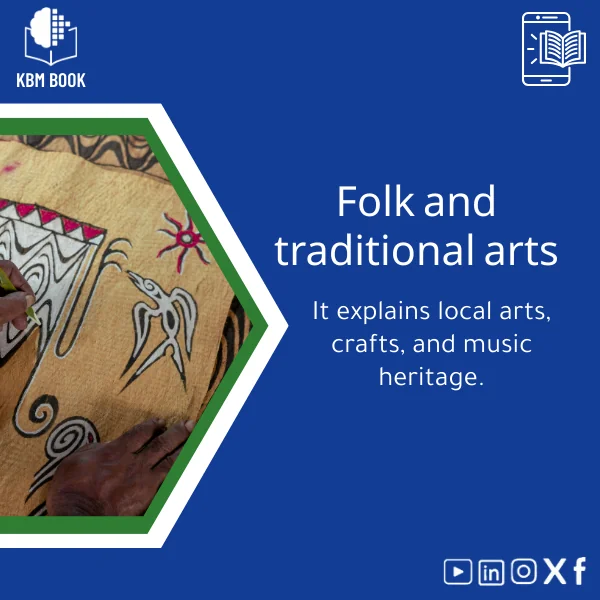
Folk and Heritage Arts Guide to Crafts and Music
Original price was: 179.00 $.139.00 $Current price is: 139.00 $.
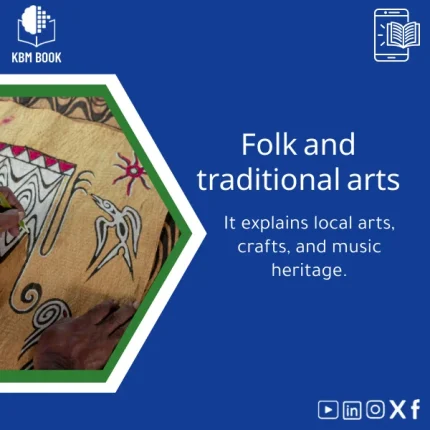
A structured, searchable knowledge base for folk and heritage arts — organized modules that bring traditional crafts, music forms, terminology, techniques, and references into a single, practical resource for students, researchers, and cultural professionals.
Key benefits & value for students, researchers, and professionals
This KBM turns scattered material on folk and heritage arts into a dependable reference. Rather than reading multiple books or websites, you get:
- Time savings: Pre-organized topics and a clear taxonomy reduce search time for facts, definitions, and source citations.
- Reliability: Entries built from curated sources and field studies minimize inconsistent or duplicated information common online.
- Modular learning: Use single modules for focused study (e.g., “Traditional Weaving Techniques”) or combine modules for a curriculum.
- Actionable outputs: Ready-to-use lesson plans, interview templates for fieldwork, and sample archival records help you apply knowledge immediately.
Use cases & real-life scenarios
Classroom and curriculum design
An arts lecturer assembles a 6-week unit on regional folk music using the music modules: definitions, notation examples, instrument profiles, and listening-guides — all citation-ready for slides and handouts.
Field research and ethnography
A graduate student preparing for field interviews exports interview templates and audio reference lists from the KBM to capture instruments and song structures consistently across sites.
Cultural preservation & museum use
Museum educators use the crafts modules to create catalog entries and public-facing labels, pulling verified technique descriptions and provenance notes to accompany exhibits.
Professional development & workshops
Trainers and cultural NGOs build workshop outlines from the stepwise craft techniques and sourcing notes, ensuring hands-on sessions are technically accurate and culturally sensitive.
Who is this product for?
The KBM is tailored to:
- Students studying ethnomusicology, cultural heritage, or visual arts who need compact, authoritative references.
- Researchers compiling literature reviews or preparing fieldwork who require structured, citable information.
- Professionals—museum curators, cultural program managers, workshop facilitators—who need practical documentation and teaching resources.
How to choose the right module or capacity
This is a digital knowledge base; selection depends on scope and depth you need:
- Introductory overview: Choose the “Regional Surveys” module for broad context and quick orientation.
- Technical skill focus: Choose craft-specific modules (weaving, pottery, metalwork) for step-by-step techniques and materials lists.
- Music study: Choose music modules for notation examples, audio references, and instrument profiles.
- Combined use: Combine modules when preparing curricula, theses, or exhibitions to get both context and technical detail.
Quick comparison with typical alternatives
Compare this KBM against common approaches:
- Many books/articles: Good depth but fragmented; KBM centralizes and cross-references to avoid duplication.
- Single textbooks: Often academic and static; KBM’s modular structure lets you extract only what you need and update content faster.
- Online forums and blogs: Fast but inconsistent; KBM provides curated, referenced content suitable for citation and teaching.
Best practices & tips to get maximum value
- Start with the taxonomy map to understand how modules interlink before extracting content.
- Use citation-ready fields when building course materials to maintain academic rigor.
- Export small subsets for fieldwork (e.g., instrument profiles + interview templates) to keep mobile use lightweight.
- Cross-reference oral history notes with bibliography entries to validate provenance claims.
Common mistakes when buying or using similar products — and how to avoid them
- Buying a generic book expecting modular data: Choose KBM if you need structured, exportable entries rather than linear narrative.
- Assuming one module covers everything: Heritage arts are interdisciplinary—combine modules for full context.
- Failing to check licensing: Verify usage rights for educational vs. commercial projects; this KBM includes clear licensing notes for each module.
Product specifications
- Product type: Digital Knowledge Base Module (KBM) — Folk and Heritage Arts
- Formats included: Interactive viewer, PDF export, CSV/JSON excerpts for import into research tools
- Content scope: Crafts, music genres, instruments, techniques, terminology, bibliographies, field templates
- Coverage: Regional surveys + specialty modules (craft techniques, music notation, oral history templates)
- Language: English (with references to original-language sources where applicable)
- Delivery: Instant download after purchase — single-user license for educational/professional use (license terms provided on download)
- Usage notes: Suitable for course creation, research, archiving, or exhibition preparation
Frequently asked questions
What formats and file types are provided?
The KBM includes an interactive viewer for quick browsing, downloadable PDF summaries, and structured CSV/JSON exports for selected modules so you can import content into spreadsheets or research tools.
Can I cite entries in academic work?
Yes — entries include suggested citations and bibliographies. Use the citation fields provided in each module for consistent referencing in papers and theses.
Is the content updated or versioned?
KBMBook maintains version notes for each KBM. Purchasing a module gives you access to the current release; information about future updates and upgrade policies is included with the download.
What about licensing for workshops or commercial projects?
The standard purchase includes a single-user license for educational and professional use. If you plan to use content commercially or across an organization, contact KBMBook for extended licensing options.
Ready to integrate reliable folk and heritage arts knowledge into your work?
Get structured, citation-ready modules that save research time and raise the quality of teaching, exhibitions, and fieldwork. Purchase now and download instantly.
Related products
Analytical Chemistry Book: Qualitative and Quantitative Methods Guide
Atomic Physics Guide: Understanding Atomic and Electron Properties
Knowledge Base — Atomic/Electron Properties & Electromagnetic Interactions. A structured, searchable KBM for students, researchers, and professionals who need an authoritative atomic physics reference that organizes concepts, formulas, experiments, and practical applications from basics of atomic physics to advanced electron properties.
Comprehensive Microbiology Book on Bacteria, Viruses, and Fungi
Cosmology Book: Guide to Big Bang and Galaxy Evolution
General Physics Book: Fundamentals of Force, Motion, Energy

Introductory General Chemistry Book on Matter and Reactions
A structured, searchable Knowledge Base Module (KBM) that converts core general chemistry concepts — matter, elements, reactions, stoichiometry and molarity — into a hierarchical reference you can query, teach from, or integrate into study workflows. Ideal as a concise General Chemistry book alternative for students, researchers, and professionals who need accurate, practical chemistry knowledge fast.
Modern Physics Book: Quantum, Relativity, and Tech Applications Guide
A structured, searchable Knowledge Base Module (KBM) that turns modern physics — quantum mechanics, special & general relativity, and contemporary technological applications — into a hierarchical, practical reference for students, researchers, and professionals who need quick, reliable access to advanced concepts and formulas.
Reviews
Clear filtersThere are no reviews yet.