


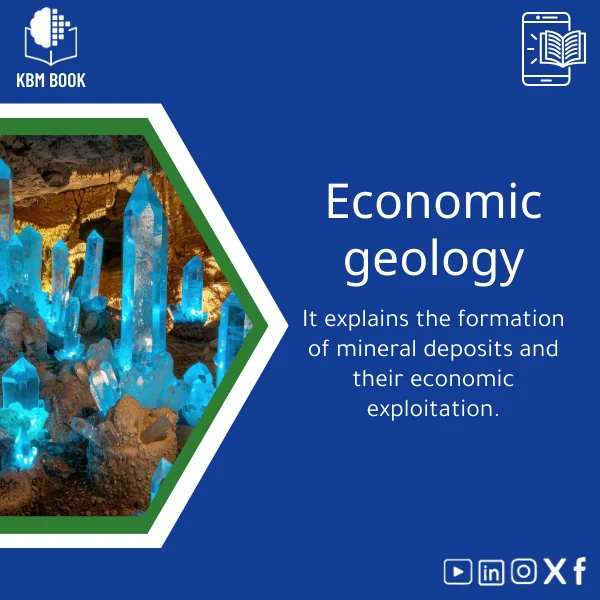
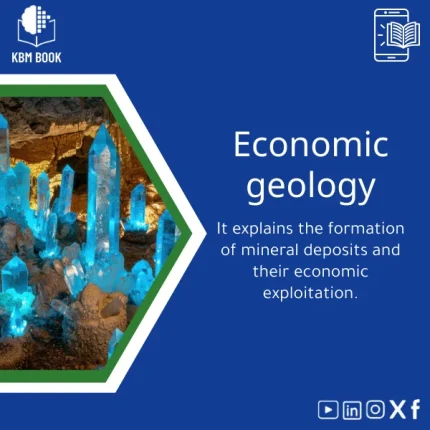
Economic Geology Guide: Ore-Deposit Formation and Exploitation
Original price was: 199.00 $.159.00 $Current price is: 159.00 $.
A structured, searchable Knowledge Base Module (KBM) that turns Economic Geology into a practical tool:
step-by-step frameworks, classification trees, and data-ready records for fast, reliable decisions on ore deposits and mineral economics.
Key benefits & value for students, researchers, and professionals
This Economic Geology KBM converts dispersed literature and disparate notes into a compact, validated reference you can query in seconds.
Instead of flipping through multiple textbooks or PDFs, you get a single hierarchical map that links:
- Deposit models → Exploration criteria: Know which lithologies, structures, and geochemical signatures to prioritise in the field.
- Sampling to valuation: From sampling protocols to grade-tonnage relationships and cut-off calculations ready to adapt to your project data.
- Decision-ready exports: Tables and templates designed for direct import into GIS, spreadsheet models, or teaching slides.
Benefit in practice: reduce research time by hours per topic, standardize reporting formats, and improve reproducibility across studies or student assignments.
Use cases & real-life scenarios
Undergraduate and graduate coursework
Instructors use the KBM to assemble lecture modules quickly — pick a deposit type (e.g., volcanogenic massive sulfide), export the classification tree and build a focused lecture in minutes.
Students use the included exam-style checklists and concise model summaries to revise efficiently.
Fieldwork and exploration teams
Geologists carry exportable sampling protocols and field identification keys on tablets. During reconnaissance, teams tag observations to the KBM categories, then export attribute tables for immediate input to GIS and grade-estimation workflows.
Research and economic assessment
Researchers benefit from curated references, paragenetic sequences with bibliography links, and built-in grade-tonnage models for preliminary economic screening of prospects.
Who is this product for?
The KBM is designed for those who need rapid, reliable synthesis of Economic Geology knowledge:
- Geology and Earth science students preparing assignments, theses, and exams.
- Academic and industry researchers needing structured literature syntheses and reproducible datasets.
- Exploration geologists, resource evaluators, and mining engineers requiring templates and economic calculators.
- Instructors and trainers creating hands-on modules and lab exercises.
How to choose the right format & scope
KBMBook provides the Economic Geology KBM in multiple delivery formats. Choose based on how you intend to use it:
- PDF (readable): Best for quick academic reading and printing summaries.
- Searchable KBM (recommended): Full database with hierarchical taxonomy, CSV/JSON exports and template files — ideal for researchers and field teams who need data integration.
- Light package: Essentials pack with core deposit models and sampling protocols — suitable for students and single-course use.
If unsure, select the searchable KBM: it offers the most flexibility and future-proofing (imports to GIS/spreadsheets, incremental updates).
Quick comparison with typical alternatives
How this KBM stacks up against books, scattered PDFs, or online articles:
- Vs textbooks: More modular and searchable; textbooks are narrative-rich but harder to extract structured data from.
- Vs article collections: Articles provide depth but require manual synthesis; the KBM synthesizes evidence and provides ready-to-use templates.
- Vs courses: Courses teach process and skills; the KBM supplies a reusable knowledge core you can plug into courses or workflows.
Best practices & tips to get maximum value
- Start with the deposit classification tree to orient your field strategy.
- Use the export templates to standardize sampling logs before field deployment.
- Integrate the grade-tonnage models into a preliminary economic spreadsheet to establish realistic cutoffs early.
- Save and version control KBM exports to maintain traceability across projects or student cohorts.
- Review the included bibliography sections for primary literature and supplement the KBM selectively for niche deposit types.
Common mistakes when buying/using geology resources — and how to avoid them
- Mistake: Buying a long PDF that is not searchable or structured. Fix: Choose the searchable KBM for data exports.
- Mistake: Assuming one resource covers every deposit nuance. Fix: Use the KBM as a core and supplement with targeted papers for rare deposit classes.
- Mistake: Ignoring sampling protocols and QC checks. Fix: Adopt the included templates to reduce field errors and improve data quality.
Product specifications
- Format: Searchable KBM (primary), with PDF and CSV/JSON export options.
- Contents: Hierarchical deposit classification, mineralogy keys, paragenesis timelines, sampling templates, grade-tonnage models, economic cutoff calculators, annotated bibliography.
- File size: Approx. 75–250 MB depending on chosen package (light, standard, full).
- Language: English (structured labels and export-ready metadata).
- Compatibility: Import-ready for Excel, QGIS, common database managers; printable PDFs for teaching.
- License: Single-user digital license with institutional upgrade options available.
- Updates: Minor updates provided for one year; option to subscribe for extended update support.
FAQ
Is this an Economic Geology book or a database? Which format should I get?
Will the module cover the specific ore-deposit types in my region?
How does the KBM help with economic evaluation?
What if I need multiple licenses for a research group or class?
Ready to turn Economic Geology knowledge into practical tools?
Download the Economic Geology KBM and gain a searchable, exportable reference that saves research time and standardizes field and economic workflows.
Choose the version that fits your needs (light, standard, full) and start integrating structured geology data into your projects today.
Questions about package selection or licensing? Contact KBMBook support for guidance before purchase.
Related products
Astronomy Observational Techniques Guide for Celestial Motion
Biological Anthropology Study Guide on Human Evolution
Cell Biology Guide: Structure, Division, and Transport Insights
Comprehensive Microbiology Book on Bacteria, Viruses, and Fungi
General and Special Relativity Book on Einstein’s Theory
A structured, searchable Knowledge Base Module (KBM) that converts Einstein's General and Special Relativity into a clear, hierarchical reference: formulas, derivations, worked examples, practical applications (GPS, astrophysics), and a compact research bibliography — ready to download and integrate into study, teaching, or research workflows.
Inorganic Chemistry Guide: Bonding and Crystal Solids
A structured, searchable Knowledge Base Module (KBM) that converts inorganic chemistry fundamentals and advanced topics—bonding models, lattice structures, defects, and solid-state properties—into a practical digital reference for students, researchers, and professionals who need fast, reliable answers without wading through textbooks.
Reviews
Clear filtersThere are no reviews yet.