


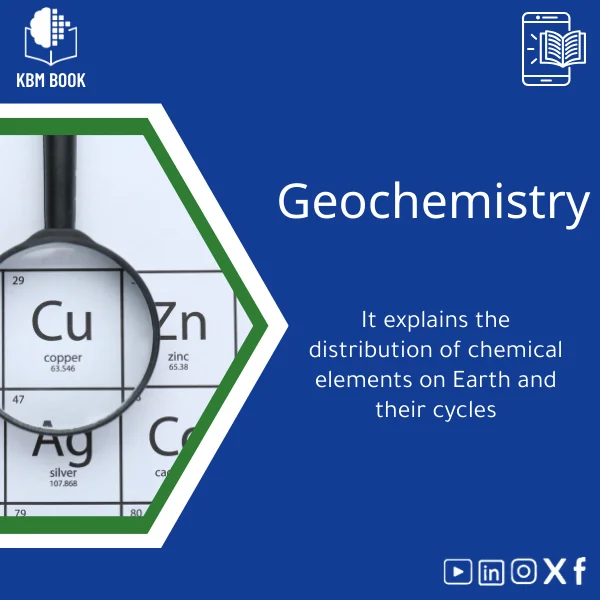
Geochemistry: Guide to Element Distribution and Cycles
Original price was: 179.00 $.139.00 $Current price is: 139.00 $.
A structured, searchable knowledge base that converts geochemistry fundamentals and applied workflows into a hierarchical, practical database — ideal for students, researchers, and professionals who need fast, reliable access to element distribution and biogeochemical cycle data.
Key benefits & value for the buyer
This Geochemistry KBM translates dense scientific content into a usable, searchable structure so you spend less time hunting references and more time solving problems. Each feature below is tied to an outcome:
Structured knowledge — faster decisions
Hierarchical modules organize concepts from “basics of geochemistry” to advanced process models. Result: quicker literature reviews, exam prep, and report writing.
Reliable, referenced content
Modules include standard reference values, typical concentration ranges, and citations for further reading — useful for lab QC, environmental assessments, and thesis literature sections.
Portable formats for multiple workflows
Delivered as a readable geochemistry textbook PDF plus exportable tables and database snippets for integration with spreadsheets or GIS. Use it as “geochemistry textbook pdf” for study or as a data source in analyses.
Use cases & real-life scenarios
How the KBM is applied day-to-day:
- Undergraduate study: Follow the “introduction to geochemistry” module to build a course outline, then export figures and tables for assignments.
- Research planning: Use the element distribution maps and cycle summaries to select sampling targets and anticipate geochemical signatures.
- Environmental consulting: Quickly retrieve regulatory-relevant concentration ranges and pathway diagrams for client reports.
- Teaching: Use modular lesson components and printable diagrams to assemble lectures or lab handouts.
Example: A graduate student preparing a chapter on copper mobility can pull concentration ranges, redox reaction chains, mobility controls, and a short annotated bibliography in minutes — not days.
Who is this product for?
Designed specifically for:
- Students learning geochemistry fundamentals — clear pathways from basics to applied topics.
- Researchers who need quick reference material and standardized tables for element budgets and cycle models.
- Environmental professionals and consultants who require dependable, cited values and process checklists.
- Instructors and trainers building structured courses or lab exercises.
How to choose the right format
KBMBook delivers the Geochemistry KBM in multiple formats. Choose based on how you work:
- PDF (book-style): Best for reading, printing lecture slides, and offline study — includes the full textbook-style narrative and annotated diagrams.
- CSV/Excel exports: Ideal for researchers and consultants who need tables of element concentrations and metadata to import into analysis pipelines.
- JSON/SQLite snippets: For developers and advanced users wanting to integrate the KBM into web apps or GIS projects.
If you use the content primarily for assignments and exams, start with the PDF. If you plan to run numerical analyses or map distributions, select the CSV/JSON options.
Quick comparison with typical alternatives
How the Geochemistry KBM compares to single-topic PDFs, textbooks, or scattered notes:
- Single-topic PDFs: Often narrow. KBM offers breadth plus hierarchical organization so related concepts are linked rather than siloed.
- Traditional textbooks: Rich narrative but static. KBM pairs text with machine-readable tables and modular extracts for reuse.
- Personal notes: Rapid but inconsistent. KBM is curated, referenced, and standardized for reproducible use.
Best practices & tips to get maximum value
- Start with the “Fundamentals” module to align terminology and units across your team or course.
- Use the exportable tables for initial data screening before committing to fieldwork or lab methods.
- Integrate JSON/SQLite snippets into your lab’s data pipeline for consistent metadata capture.
- Keep the PDF as a teaching handout and use the database extracts for reproducible analysis scripts.
Common mistakes when buying/using geochemistry resources — and how to avoid them
- Mistake: Buying a single-format file that can’t be integrated into analysis pipelines. Fix: Choose the KBM bundle with both PDF and export formats.
- Mistake: Relying on uncited tables. Fix: Use KBM’s referenced values and bibliography for traceability.
- Mistake: Ignoring units and standard conditions. Fix: Follow the KBM’s standardized unit conventions and conversion notes.
Product specifications
- Product type: Digital Knowledge Base Module (KBM) — Geochemistry
- Formats included: PDF (readable guide), CSV/Excel exports, JSON/SQLite snippets
- Scope: Element distribution, major biogeochemical cycles, redox pathways, standard concentration ranges, mapping layers, and annotated bibliography
- File size: PDF ≈ 12–25 MB (depending on included figures); data exports ~1–10 MB
- License: Single-user commercial & academic use (details provided at checkout)
- Compatibility: Viewable on desktop and mobile PDF readers; CSV/JSON compatible with common analysis tools (Excel, R, Python, QGIS)
- Delivery: Instant download after purchase
FAQ
Can I get this as a geochemistry textbook PDF only?
Yes. You can purchase the PDF-only option for reading and printing. We recommend the bundle (PDF + exports) if you plan to run analyses or reuse tables in research.
How current is the data and are sources cited?
The KBM compiles contemporary, peer-reviewed references and standard handbooks. Each module includes citation pointers so you can verify and follow up on original sources.
Is the content suitable for environmental geochemistry applications?
Yes. The KBM includes a dedicated environmental geochemistry section with contamination pathways, mobility controls, and regulatory-relevant concentration ranges.
Can I integrate the data with GIS or analysis scripts?
Absolutely. Export formats (CSV/JSON/SQLite) are provided precisely for integration with GIS (QGIS/ArcGIS) and scripting environments (Python, R).
What if I need multiple licenses for a research group?
Group and institutional licenses are available. Contact support via the store checkout page to request a quote tailored to your team size and intended use.
Ready to stop searching and start working?
Download a complete geochemistry knowledge base that acts as both a concise “geochemistry textbook pdf” and a reusable data source. Instant delivery, multiple formats, and clear citations make this KBM a practical alternative to scattered references.
Not sure? Check the format options at checkout — PDF-only, data bundle, or full developer bundle for integration.
Related products
Analytical Chemistry Book: Qualitative and Quantitative Methods Guide
Cell Biology Guide: Structure, Division, and Transport Insights
Classical Mechanics Guide: Newton’s Laws and Dynamics
A searchable, hierarchical Knowledge Base Module (KBM) that turns classical mechanics into a practical, ready-to-use reference for fast problem solving, lecture preparation, and applied engineering. Designed for students, researchers, and professionals who need precise access to Newton’s laws, rotational motion, and applied dynamics without the noise of textbooks.
Comprehensive Nuclear Physics Book on Structure and Radioactivity
Cosmology Book: Guide to Big Bang and Galaxy Evolution
Inorganic Chemistry Guide: Bonding and Crystal Solids
A structured, searchable Knowledge Base Module (KBM) that converts inorganic chemistry fundamentals and advanced topics—bonding models, lattice structures, defects, and solid-state properties—into a practical digital reference for students, researchers, and professionals who need fast, reliable answers without wading through textbooks.
Molecular Biology Guide: Transcription, Translation & Repair
Thermal Physics Guide: Understanding Heat, Energy, and Entropy
A downloadable, hierarchically structured Knowledge Base Module (KBM) that converts university-level thermodynamics into a searchable, practical digital database. Ideal for students, researchers, and professionals who need fast, reliable access to fundamentals and advanced topics in thermal physics.
Reviews
Clear filtersThere are no reviews yet.