


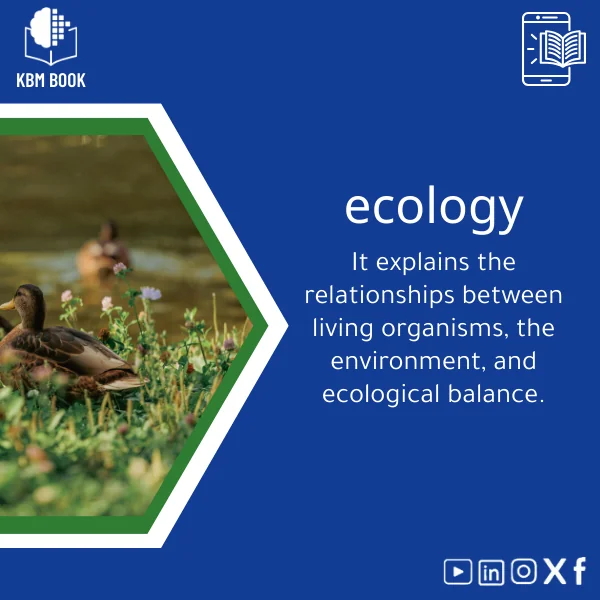
Ecology Guide to Organism-Environment Relations
Original price was: 139.00 $.99.00 $Current price is: 99.00 $.
A structured, searchable Knowledge Base Module (KBM) that converts core Ecology concepts—organism–environment relations and ecological balance—into a hierarchical, practical reference for students, researchers, and professionals who need fast, reliable access to ecological knowledge.
Key benefits & value for students, researchers, and professionals
This KBM translates the broad field of Ecology into a precise, reusable reference. Instead of a linear textbook, you get a modular knowledge graph that accelerates learning, reduces duplication, and supports practical work.
What you gain
- Time savings: Rapid answers for assignment questions, model selection, or citation snippets—no more scanning multiple books.
- Reliable structure: Each topic includes definitions, theoretical context, standard equations (e.g., logistic growth, Lotka–Volterra), and applied notes.
- Reusability: Import sections into notes, slide decks, or analysis scripts via JSON/CSV.
- Depth without noise: Focused coverage of organism–environment relations and ecological balance—comprehensive yet curated.
Use cases & real-life scenarios
Below are common workflows where the Ecology KBM reduces friction and improves outcomes.
For a university student
Preparing for exams? Use the kb to generate a study outline: core concepts, sample calculations, and a tailored list of primary literature. Export the “population dynamics” node as a PDF for quick revision.
For a researcher
Writing a methods section? Pull standardized sampling protocols and widely accepted assumptions. Copy example R/ Python-ready data templates from the CSV pack to speed up reproducible analyses.
For an environmental practitioner
Designing a restoration plan? Access disturbance regime summaries, ecosystem service valuation references, and concise decision-support checklists to inform stakeholder reports.
Who is this product for?
The Ecology Guide is tailored to:
- Undergraduate and graduate students looking for an accessible ecology textbook pdf alternative that’s searchable and exportable.
- Researchers who need a compact ecology reference with model summaries and citation-ready excerpts.
- Environmental consultants and field biologists who require quick access to protocols and decision frameworks.
- Lecturers preparing course modules and labs who want reusable lesson plans and question banks.
How to choose the right format & level
The KBM is offered in multiple formats—choose based on how you work:
- ecology textbook pdf: Best for reading and printing; includes a condensed textbook-style guide and full table of contents.
- SQLite/JSON/CSV: Ideal for researchers and developers who need to query the database or integrate it into scripts and apps.
- Annotated slides & lesson outlines: For instructors and trainers.
If you primarily read on paper or tablet, pick the PDF-first bundle. If you run analyses or build educational tools, choose the developer bundle (JSON + SQLite).
Quick comparison with traditional alternatives
Traditional textbooks offer narrative depth but are linear and slow to search. Academic articles are narrow and require synthesis. The KBM bridges these gaps by providing:
- Immediate, searchable access to concepts and protocols.
- Exportable, machine-readable formats for reuse.
- Cross-referenced nodes that connect theory with applied methods.
For many users, the KBM replaces the need to flip between a printed ecology book and dozens of PDFs—saving time and reducing errors.
Best practices & tips to get maximum value
- Start with the index node “Organism–Environment Relations” to understand the KBM hierarchy, then expand into specialist nodes as needed.
- Use the CSV/JSON exports to create custom flashcards or integrate key definitions into your LMS.
- When conducting fieldwork, export the sampling protocol section as a standalone PDF to ensure consistent methods across teams.
- Keep a local SQLite copy to enable offline searches during remote field trips.
Common mistakes when choosing ecology resources—and how to avoid them
- Mistake: Choosing a single-format resource. Fix: Pick a bundle that matches your primary workflow (reading vs. analysis).
- Mistake: Over-relying on summaries without checking primary sources. Fix: Use the KBM’s annotated references to access original papers quickly.
- Mistake: Buying generic material that isn’t structured. Fix: Choose structured KBMs like this one that map concepts hierarchically for faster retrieval.
Product specifications
- Title: Ecology Guide to Organism-Environment Relations
- Formats included: PDF (print-ready), SQLite database, JSON export, CSV tables, annotated slide deck (PPTX)
- Coverage: foundational theory, population & community ecology, ecosystem processes, disturbance & resilience, applied protocols
- Size: approximately 120+ content nodes; PDF equivalent ~220 pages (condensed layout)
- License: single-user commercial license with educator discount options (see purchase page)
- Delivery: instant download after purchase; includes README with import instructions
- Support: 30-day email support for installation and format questions
Frequently asked questions
Can I get the content as a simple ecology textbook pdf?
Is the KBM suitable for advanced (graduate-level) research?
How is this different from a regular “basics of ecology book”?
What about updates and corrections?
Ready to get structured, searchable knowledge for Ecology?
Choose the bundle that fits your workflow (PDF-first for reading; developer bundle for data work). Instant download and straightforward import instructions will have you up and running in minutes.
Need multiple seats for a lab or classroom? Contact support for institutional licensing options before purchasing.
Related products
Astrophysics Book: Understanding Stars, Galaxies, and Dark Energy
A searchable, hierarchical Knowledge Base Module (KBM) that converts astrophysics and cosmology into a practical, exam-ready and research-ready reference. Designed for students, researchers, and professionals who need immediate access to reliable explanations, equations, and data models for stars, galaxies, and dark energy.
Cell Biology Guide: Structure, Division, and Transport Insights
Inorganic Chemistry Guide: Bonding and Crystal Solids
A structured, searchable Knowledge Base Module (KBM) that converts inorganic chemistry fundamentals and advanced topics—bonding models, lattice structures, defects, and solid-state properties—into a practical digital reference for students, researchers, and professionals who need fast, reliable answers without wading through textbooks.
Modern Physics Book: Quantum, Relativity, and Tech Applications Guide
A structured, searchable Knowledge Base Module (KBM) that turns modern physics — quantum mechanics, special & general relativity, and contemporary technological applications — into a hierarchical, practical reference for students, researchers, and professionals who need quick, reliable access to advanced concepts and formulas.
Molecular Biology Guide: Transcription, Translation & Repair
Organic Chemistry Guide: Carbon Chains and Reactions
Thermal Physics Guide: Understanding Heat, Energy, and Entropy
A downloadable, hierarchically structured Knowledge Base Module (KBM) that converts university-level thermodynamics into a searchable, practical digital database. Ideal for students, researchers, and professionals who need fast, reliable access to fundamentals and advanced topics in thermal physics.
Reviews
Clear filtersThere are no reviews yet.