


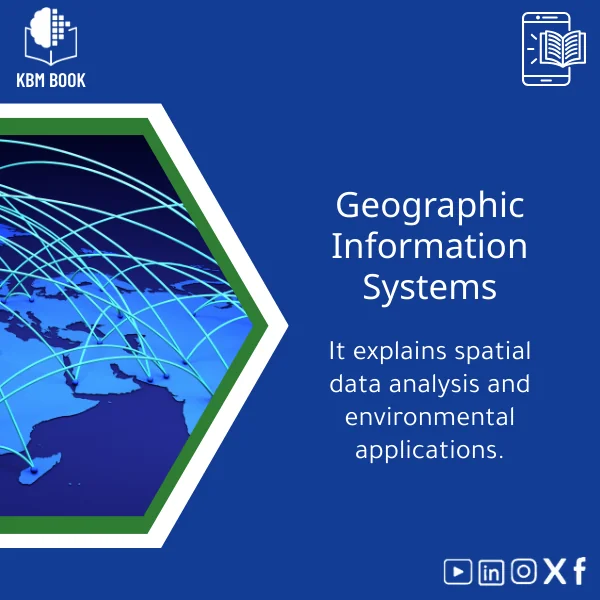
Geographic Information Systems Guide for Spatial Data Analysis
Original price was: 179.00 $.139.00 $Current price is: 139.00 $.
A structured, searchable Knowledge Base Module (KBM) that converts Geographic Information Systems (GIS) theory into practical, reusable datasets, workflows, and checklists for students, researchers, and professionals working with spatial data and environmental applications.
Key benefits & value for the buyer
This KBM transforms Geographic Information Systems knowledge into a practical toolkit. Instead of reading scattered articles or bulky textbooks, you get a compact, hierarchical database that:
- Reduces time-to-insight with pre-built queries, templates, and documented workflows for spatial data analysis.
- Increases reproducibility—every workflow includes input samples, code snippets (Python/R), and expected outputs.
- Supports learning and teaching by structuring content from GIS basics to advanced environmental GIS applications.
- Improves project accuracy—standardized procedures for projections, accuracy assessment, and geoprocessing best practices.
Benefit-focused features are mapped to outcomes: faster assignments, more robust research results, and scalable professional workflows for consultancy or field projects.
Use cases & real-life scenarios
University coursework and labs
Instructors use the KBM to create lab assignments: students load provided shapefiles, complete a coordinate reprojection task, run spatial joins, and reproduce a land-cover change analysis using supplied scripts.
Environmental impact assessment (EIA)
Consultants extract the relevant module—habitat mapping, buffer analysis, and raster suitability modelling—use the KBM’s checklists to ensure regulatory requirements are met, and apply the packaged scripts to generate reproducible maps and reports.
Academic research
Researchers accelerate literature review and methods sections by referencing standardized procedures from the KBM and using sample datasets to validate new spatial models before scaling to full datasets.
Urban planning & resource management
Planners apply spatial data analysis workflows for accessibility mapping, service-area calculations, and population density modeling with ready-made geoprocessing sequences and exportable outputs.
Who is this product for?
The KBM is designed for students, university labs, researchers, GIS analysts, environmental consultants, and educators who need reliable, structured guidance in Geographic Information Systems. Specific profiles:
- Undergraduate/graduate students learning GIS basics and spatial statistics.
- Researchers needing reproducible spatial workflows for journal submissions.
- Professionals who require quick access to environmental GIS applications (EIA, hydrology, biodiversity mapping).
- Trainers preparing practical exercises and assessments for GIS courses.
How to choose the right edition
The KBM is available in modular editions. Choose based on your workflow and tools:
- Starter (GIS basics): Best if you need core concepts, projection handling, coordinate systems, and basic vector/raster operations.
- Applied (Environmental GIS applications): Includes habitat modelling, erosion mapping, hydrological analysis, species distribution examples.
- Complete (Full KBM): All modules plus extended datasets, advanced scripts, and classroom-ready assignments.
File format preferences: each edition lists included formats (GeoPackage, Shapefile, GeoJSON, raster TIFF, CSV, Python & R script files). If you use a specific GIS platform (QGIS, ArcGIS, R, Python), select the edition that includes scripts and sample data compatible with those tools.
Quick comparison with typical alternatives
Compared to traditional textbooks or scattered online tutorials, this KBM emphasizes structured, reusable content:
- Textbooks: deep theory but rarely provide packaged, executable datasets and scripts.
- Online tutorials: often fragmented, limited reproducibility, and lack a unified taxonomy.
- This KBM: hierarchical modules, downloadable datasets, documented code, and search-ready entries for fast retrieval.
If your priority is applied work and reproducible outcomes (not just reading), the KBM is the more practical, time-saving choice.
Best practices & tips to get maximum value
- Start with the “GIS basics” module to align coordinate systems and metadata standards before running analyses.
- Use the provided sample datasets to validate scripts in your local environment, then scale to your real data.
- Follow the KBM’s reproducibility checklist when preparing figures and tables for publication.
- Leverage the exportable query templates to build repeatable QA/QC routines for project handover.
Common mistakes when buying/using GIS resources and how to avoid them
- Buying raw theory-only material: Avoid if you need practical deliverables—choose modules with scripts and datasets.
- Skipping projection checks: The KBM includes step-by-step reprojection guidance to prevent common mapping errors.
- Not testing on sample data: Always run provided examples first to confirm compatibility with your tools.
- Ignoring metadata: Use the KBM’s metadata templates to ensure data provenance and reuse compliance.
Product specifications
- Product type: Knowledge Base Module (KBM) — Geographic Information Systems
- Content format: Hierarchical database + downloadable assets (GeoPackage, Shapefile, GeoJSON, GeoTIFF, CSV)
- Code & scripts: Python (GeoPandas, Rasterio), R (sf, raster), QGIS processing models
- Documentation: PDF manual + inline annotated workflows
- Language: English (documentation); metadata templates available in Arabic upon request
- License: Single-user commercial license with optional site-license upgrades
- Delivery: Instant download (zip archive) after purchase; includes update policy notes
Frequently asked questions
What software do I need to use the KBM?
You need at minimum a GIS viewer such as QGIS (free) for vector and raster inspection. For scripts, Python 3.8+ with GeoPandas and Rasterio or R with sf/raster packages is recommended. The KBM includes step-by-step setup instructions and alternative command examples for each platform.
Is the data ready for publication or only for teaching?
Included sample datasets are suitable for method validation, teaching, and demonstration. For publication, replace sample data with your project data; the KBM provides metadata and QA/QC templates to help make your outputs publication-ready.
How often is the KBM updated?
The KBM is versioned. Minor updates (bug fixes, script tweaks) are released periodically; major content expansions are announced with release notes. Your purchase includes access to updates for the edition you buy as specified in the license.
Can I use the KBM for commercial projects?
Yes — the standard single-user commercial license permits use in professional projects. For team or institutional use, site-license options are available. Consult the license file included in the download for full terms.
Ready to standardize your GIS workflows?
Purchase the Geographic Information Systems KBM and get immediate access to structured content, sample datasets, and reproducible scripts that save time and improve results.
Secure checkout · Instant download · Includes documentation and examples for QGIS, Python, and R.
Related products
Astrophysics Book: Understanding Stars, Galaxies, and Dark Energy
A searchable, hierarchical Knowledge Base Module (KBM) that converts astrophysics and cosmology into a practical, exam-ready and research-ready reference. Designed for students, researchers, and professionals who need immediate access to reliable explanations, equations, and data models for stars, galaxies, and dark energy.
Biochemistry Book: Understanding Chemical Processes in Living Systems
Biological Anthropology Study Guide on Human Evolution
Comprehensive Genetics Book: DNA, Mendelian Genetics & Engineering
A structured, searchable knowledge base module (KBM) that turns genetics theory and practice into an immediately usable digital reference — from DNA structure to Mendelian genetics and contemporary genetic engineering techniques — optimized for students, researchers, and professionals who need reliable answers fast.
General and Special Relativity Book on Einstein’s Theory
A structured, searchable Knowledge Base Module (KBM) that converts Einstein's General and Special Relativity into a clear, hierarchical reference: formulas, derivations, worked examples, practical applications (GPS, astrophysics), and a compact research bibliography — ready to download and integrate into study, teaching, or research workflows.
General Biology Book: A Guide to Cells, Genetics & Taxonomy

Modern Physics Book: Quantum, Relativity, and Tech Applications Guide
A structured, searchable Knowledge Base Module (KBM) that turns modern physics — quantum mechanics, special & general relativity, and contemporary technological applications — into a hierarchical, practical reference for students, researchers, and professionals who need quick, reliable access to advanced concepts and formulas.
Thermal Physics Guide: Understanding Heat, Energy, and Entropy
A downloadable, hierarchically structured Knowledge Base Module (KBM) that converts university-level thermodynamics into a searchable, practical digital database. Ideal for students, researchers, and professionals who need fast, reliable access to fundamentals and advanced topics in thermal physics.
Reviews
Clear filtersThere are no reviews yet.