


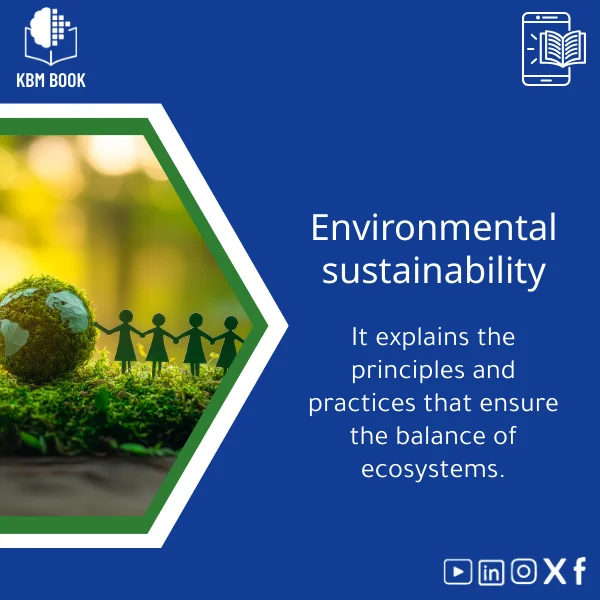
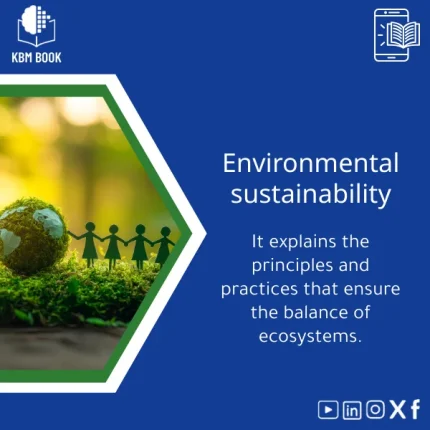
Environmental Sustainability Guide for Ecosystem Balance
Original price was: 159.00 $.119.00 $Current price is: 119.00 $.
A compact, searchable Knowledge Base Module (KBM) that converts core Environmental Sustainability theory and ecosystem balance principles into an immediately usable, hierarchical digital reference — ideal for students, researchers, and professionals who need fast, accurate answers and practical frameworks.
Key benefits & value for the buyer
This KBM transforms “Environmental Sustainability” from scattered readings into a curated, searchable toolkit. Instead of juggling articles and textbooks, you get:
- Time savings: Indexed entries and cross-linked sections reduce literature search time for assignments and reports.
- Practical decision support: Ready-to-use assessment matrices and mitigation options for common ecosystem pressures.
- Consistency and rigor: Standardized definitions and measurement methods help align field data and classroom exercises.
- Reusable structure: Hierarchical modules that can be exported, shared, or incorporated into teaching materials and lab protocols.
Use cases & real-life scenarios
Case: Undergraduate research project
A student preparing a term project on wetland restoration uses the KBM to extract ecosystem balance principles, follows the monitoring checklist, and imports indicator definitions into a spreadsheet for data collection — reducing proposal time from weeks to days.
Case: Environmental consultant
A practitioner building an environmental impact assessment reuses the KBM’s risk matrix and mitigation catalog to produce consistent recommendations tailored to a client site. The consultant exports the CSV index into their reporting software for traceable references.
Case: Lecturer or trainer
An instructor organizes a module on sustainability metrics by mapping KBM sections into weekly lessons; students access the PDF for reading and the JSON index for assignment data exercises.
Who is this product for?
This KBM is built for those who require structured, authoritative content on ecosystem balance:
- Environmental science students who need a reliable study reference and templates for fieldwork.
- Researchers seeking a compact, citable summary of ecosystem balance principles and indicators.
- Professionals (consultants, policy analysts, conservation practitioners) who want applied frameworks and reproducible methods.
- Trainers and program designers assembling teaching materials from verified, non-redundant modules.
How to choose the right format & depth
KBMBook delivers the Environmental Sustainability Guide in layered outputs so you can pick what fits your workflow:
- Searchable PDF: Full guide for reading, printing, and citing — best if you want a fixed, portable copy.
- CSV / JSON index: Machine-readable entries (terms, indicators, references) — choose this for data integration and scripting.
- Combined package: PDF + CSV + quick-start checklist — recommended for teaching and professional use.
Choose based on how you’ll use the KBM: personal study (PDF), research/data integration (CSV/JSON), or classroom/consulting (combined).
Quick comparison with typical alternatives
Unlike single-topic textbooks or fragmented articles, this KBM is organized to be immediately actionable. Typical alternatives:
- Textbooks: Deep but linear — harder to extract checklists and workflows quickly.
- Journal articles: Specific and technical — require synthesis; KBM provides that synthesis as a structured reference.
- Online articles and blogs: Convenient but inconsistent — KBM removes duplication and verifies definitions across the module.
If you need curated, cross-referenced knowledge that plugs into workflows, a KBM is the most efficient option.
Best practices & tips to get maximum value
- Start with the quick-start checklist to map the KBM to your project scope.
- Use the CSV/JSON index to populate lab sheets and simplify indicator calculation.
- Customize the mitigation catalog by tagging entries relevant to your biome or policy context.
- Keep the PDF as your authoritative reference for citations and teaching handouts.
Common mistakes when buying/using similar products and how to avoid them
- Buying generic compilations: Avoid sources that aggregate without structure — demand hierarchical, cross-referenced content.
- Ignoring file formats: Check that the KBM provides CSV/JSON if you plan to integrate with data tools.
- Assuming one-size-fits-all: Look for modules that separate conceptual theory from applied protocols so you can adapt rather than overwrite local practices.
- Skipping citations: Choose products that include references so you can verify methods and include citations in academic work.
Product specifications
- Title: Environmental Sustainability Guide for Ecosystem Balance
- Format: Searchable PDF + CSV index + JSON export (combined package available)
- Structure: Hierarchical KBM with modules, submodules, indicators, workflows, and reference links
- Entries: Over 1,200 indexed entries covering definitions, indicators, monitoring protocols, and mitigation options
- Languages: English (content structure ready for translation)
- Usage notes: Licensed for personal, academic, and internal professional use; redistribution requires a commercial license
- Delivery: Instant digital download after purchase
Frequently asked questions
What file formats are included and how do I integrate them into my workflow?
The standard package includes a searchable PDF for reading and citation and a machine-readable CSV and JSON index that lists entries, indicators, and references. Import the CSV into spreadsheets or statistical software; load the JSON into data pipelines or reference managers. Instructions and a quick-start guide are included.
Is the content peer-reviewed or evidence-based?
The KBM synthesizes widely accepted ecosystem balance principles and common metrics. Each module links to primary sources and published indicators so you can verify methods. It is curated for accuracy, not presented as original peer-reviewed research; for research citations, use the linked primary sources.
Can I use the KBM for teaching or in a paid consultancy?
Personal, academic, and internal professional use are permitted. If you plan to redistribute materials, include KBM content inside a paid product, or deliver it to clients, please select a commercial license at checkout. Contact KBMBook for multi-user or institutional licensing.
What if the KBM doesn’t meet my needs?
Check the product preview and specifications before purchase. If the content is demonstrably different from the description, KBMBook offers a refund policy within a defined period — review the store’s purchase terms for specifics.
Ready to get structured, usable knowledge on Environmental Sustainability?
Download a KBM designed to move you from concepts to practice faster — whether you need an environmental sustainability book alternative, want to buy environmental sustainability PDF content, or need concise ecosystem balance principles to apply immediately.
Instant download. Includes searchable PDF + CSV/JSON index. Secure checkout from KBMBook.
Related products
Comprehensive Evolutionary Biology Book on Natural Selection
Comprehensive Genetics Book: DNA, Mendelian Genetics & Engineering
A structured, searchable knowledge base module (KBM) that turns genetics theory and practice into an immediately usable digital reference — from DNA structure to Mendelian genetics and contemporary genetic engineering techniques — optimized for students, researchers, and professionals who need reliable answers fast.


Reviews
Clear filtersThere are no reviews yet.