


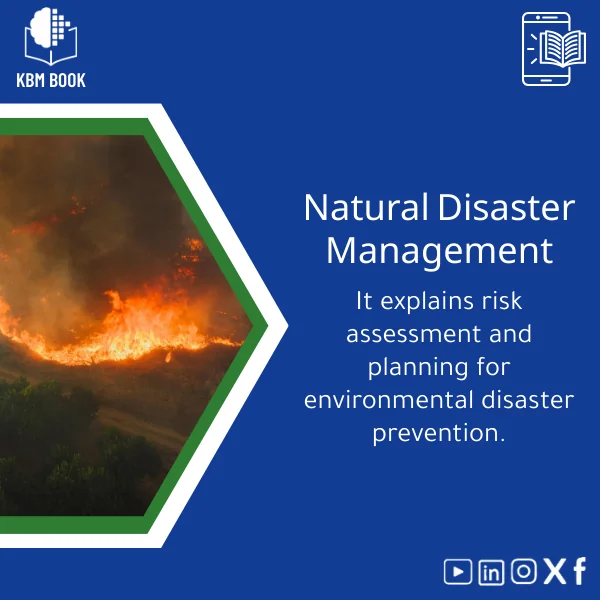
Natural Disaster Management Guide for Risk Assessment & Prevention
Original price was: 199.00 $.159.00 $Current price is: 159.00 $.
A structured knowledge base module for Natural Disaster Management that converts environmental risk assessment and disaster prevention planning into a searchable, hierarchical KBM — designed for students, researchers, and professionals who need fast access to reliable, actionable guidance.
Key benefits & value for the buyer
This Natural Disaster Management KBM translates broad academic literature and professional standards into a compact, immediately usable database. Instead of sifting through lengthy books or isolated articles, you get:
- Time savings: Fast search across definitions, protocols, and templates — ideal when time is critical during planning or research.
- Consistency: A single structured source reduces contradictions between documents and ensures standardized language for reports.
- Actionable outputs: Ready-to-use checklists, risk matrices, stakeholder maps, and sample SOPs you can customize and deploy.
- Academic rigor: Each module includes references and suggested readings for citation and deeper study.
Use cases & real-life scenarios
For students and researchers
Use the KBM as a baseline for literature reviews, to structure methodology chapters, or to extract validated risk-assessment metrics for empirical work. Example: a master’s student uses the KBM risk matrix and appendix of case studies to build a comparative analysis of flood response systems.
For practitioners and planners
Emergency managers and municipal planners download templates to run rapid hazard assessments, adapt prevention plans, or train staff. Example: a local government uses the stakeholder mapping and prioritized mitigation list to allocate funds before the rainy season.
For trainers and consultants
Use modules as course modules or workshop handouts. Example: a consultant prepares a half-day workshop using the KBM’s decision-tree flow and practical exercises for community resilience planning.
Who is this product for?
This Natural Disaster Management KBM is built for:
- Earth science and disaster management students needing structured study aids and citations.
- Researchers requiring clean, referenced datasets and standardized definitions.
- Practitioners — emergency planners, NGO field officers, municipal engineers — who need fast, reliable templates and checklists.
- Trainers and educators designing curricula or professional development modules.
How to choose the right KBM scope
Not all KBMs are used the same way. Choose by intended depth:
- Overview module: Core definitions, high-level frameworks, and one-page checklists — ideal for beginners and coursework.
- Operational module: Full templates, SOPs, mapping tools, and sample budgets — best for planners and field teams.
- Advanced research module: Extended literature lists, comparative case datasets, and reproducible assessment algorithms — for researchers and PhD students.
Tip: Start with the overview if unsure; upgrade to operational when you need deployable outputs.
Quick comparison with typical alternatives
Typical alternatives include textbooks, scattered PDFs, and academic articles. Compared to those, this Natural Disaster Management KBM offers:
- Faster lookup than books (searchable, indexed modules).
- More actionable templates than academic articles (checklists, SOPs, data schemas).
- Better integration than isolated PDFs (consistent taxonomy across topics).
Objection — “Aren’t books cheaper?” Consider the cost of time lost consolidating sources; this KBM saves hours of research and reduces implementation errors.
Best practices & tips to get maximum value
- Start with the taxonomy page to match terminology with your institution’s forms.
- Use the built-in risk matrix template and populate it with local data for rapid prioritization.
- Customize the SOPs before deployment and run a table-top exercise using the workshop guides.
- Keep a change log when you adapt templates — the KBM’s structure makes version control simple.
Common mistakes when buying/using similar products and how to avoid them
- Mistake: Buying a single, narrow checklist and expecting full coverage. Fix: Choose a KBM with clearly labeled scope and modules for gaps.
- Mistake: Using templates without localization. Fix: Adapt hazard probabilities and stakeholder lists to local context before finalizing plans.
- Mistake: Assuming academic rigor means practical usability. Fix: Select the operational module for deployable outputs.
Product specifications
- Format: Downloadable structured KBM (CSV, JSON, searchable PDF, and printable templates)
- Contents: Taxonomy, risk matrices, SOPs, checklists, decision trees, mapping templates, case-study summaries, and bibliography
- Level: Overview / Operational / Advanced (choose when purchasing)
- Languages: English (primary); Arabic annotations included in selected modules
- Usage notes: Licensed for individual use; institutional bulk-license options available via KBMBook
FAQ
Is this a textbook or a database? Which should I pick if I need references?
Will the templates work for my country/region?
How is quality and accuracy ensured?
Can I share the KBM with my team?
Ready to organize your disaster planning and research?
Acquire a concise, actionable Natural Disaster Management KBM that saves time, standardizes procedures, and gives you deployable templates backed by references.
Need a tailored package or institutional license? Contact KBMBook for custom bundles and classroom packs.
Related products
Classical Mechanics Guide: Newton’s Laws and Dynamics
A searchable, hierarchical Knowledge Base Module (KBM) that turns classical mechanics into a practical, ready-to-use reference for fast problem solving, lecture preparation, and applied engineering. Designed for students, researchers, and professionals who need precise access to Newton’s laws, rotational motion, and applied dynamics without the noise of textbooks.

Comprehensive Evolutionary Biology Book on Natural Selection
Comprehensive Genetics Book: DNA, Mendelian Genetics & Engineering
A structured, searchable knowledge base module (KBM) that turns genetics theory and practice into an immediately usable digital reference — from DNA structure to Mendelian genetics and contemporary genetic engineering techniques — optimized for students, researchers, and professionals who need reliable answers fast.

Materials Physics Guide: Understanding Solid-State Properties

Molecular Biology Guide: Transcription, Translation & Repair
Organic Chemistry Guide: Carbon Chains and Reactions
Physical Chemistry Guide: Energy, Thermodynamics & Interactions
A structured Knowledge Base Module (KBM) for Physical Chemistry that converts core theory, worked examples, and applied datasets into a searchable, hierarchical database — ideal for students, researchers, and professionals who need fast, reliable access to chemical thermodynamics basics and molecular interaction models.
Reviews
Clear filtersThere are no reviews yet.