


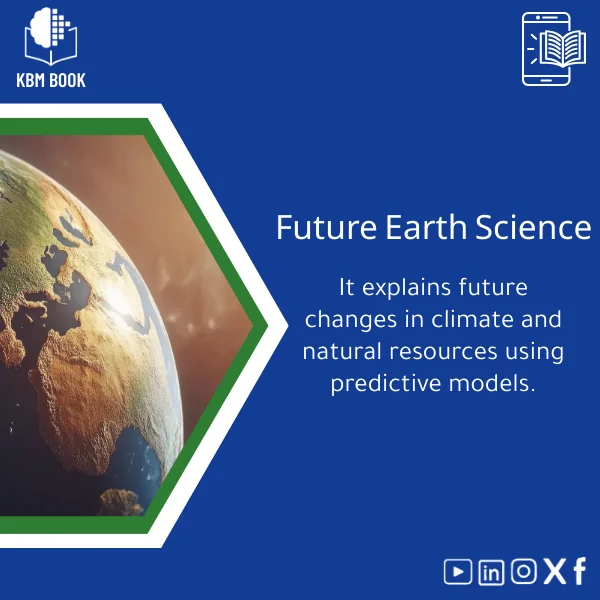
Future Earth Science Predictive Modeling Guide
Original price was: 349.00 $.279.00 $Current price is: 279.00 $.
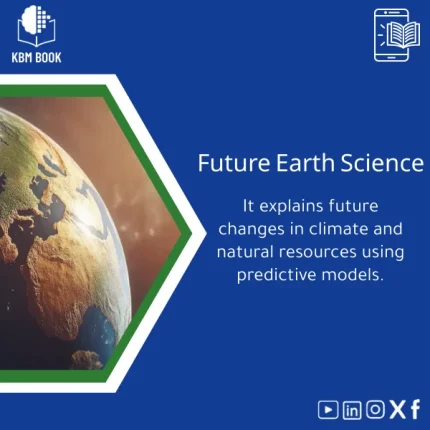
A structured, searchable Knowledge Base Module (KBM) for future earth science: step-by-step predictive modeling of climate change and natural resources, designed for students, researchers, and professionals who need fast, reliable answers and reproducible workflows.
Key benefits & value for students, researchers, and professionals
The Future Earth Science Predictive Modeling Guide converts complex domain knowledge into a compact, actionable KBM. Instead of reading scattered papers or lengthy textbooks, users get a layered, searchable database that saves time and reduces error-prone rework.
Features translated into outcomes
- Hierarchical organization: follow a clear learning path from theory to model implementation — shortens onboarding and accelerates project timelines.
- Reusable model templates: pre-configured R/Python notebooks and parameter sets help you reproduce published scenarios and adapt them to local data.
- Provenance & citations: every dataset and algorithm includes source references to support reproducibility and academic use.
- Compact manual & quick-reference tables: ideal when you need a concise answer in the field, classroom, or meeting.
Use cases & real-life scenarios
Student: coursework and thesis
Use the KBM to learn model selection, run baseline climate projections, and export calibrated results for thesis chapters. Example: a master’s student uses the provided regional hydrology module and Jupyter notebooks to compare two downscaling methods in three weeks, producing reproducible figures for the defense.
Researcher: fast prototyping
Researchers can prototype scenarios (RCP/SSP) by adapting scenario templates and parameter sets, then benchmarking model outputs against observational datasets included in the KBM.
Professional: policy and reporting
Environmental consultants, resource managers, and planners use the exportable tables and slide templates to prepare impact assessments, risk matrices, and policy briefs with documented assumptions.
Who is this product for?
The KBM is optimized for:
- Undergraduate and graduate students studying climate science, hydrology, or resource management.
- Academics and applied researchers needing reproducible workflows in future earth science research.
- Practitioners and consultants preparing evidence-based reports on climate change and natural resources.
- Instructors looking for modular teaching materials and exercises.
How to choose the right format, capacity, and license
This is a digital KBM — choose based on how you will use the content:
- Individual license (single user): choose this if you need the KBM for coursework or personal research.
- Lab/department license: recommended for teaching or shared projects; allows multiple seats and centralized updates.
- Format choice: download the full bundle (Jupyter notebooks + CSV/JSON datasets + PDF manual) for development; choose the lighter “PDF + CSV” option if you primarily need references and tables.
If you’re unsure which license fits your team size, contact KBMBook support for a custom quote — investing in the proper license prevents later re-purchase and preserves reproducibility across collaborators.
Quick comparison with typical alternatives
Alternatives: textbooks, single research papers, raw open datasets, or curated code repositories. How the KBM differs:
- Textbooks: deep on theory but often lack executable workflows and reproducible datasets.
- Single papers: narrow scope and require stitching multiple sources to build a working model.
- Raw datasets/repositories: useful but unorganized; the KBM layers interpretation, code, and metadata on top for immediate use.
The KBM strikes a balance: scholarly rigor plus practical templates so you can “run” knowledge, not just read it.
Best practices & tips to get maximum value
- Start with the “Getting Started” notebook and run baseline examples to verify your environment.
- Use the included test datasets to validate models before applying local data.
- Keep the provenance records — export the citation block when you publish or report results.
- Adapt, don’t rewrite: modify parameter files in small steps and document changes in the provided changelog template.
Common mistakes when buying or using similar products — and how to avoid them
- Buying incomplete bundles: avoid cheaper options that lack code or raw data — they slow progress. Choose the full bundle when reproducibility matters.
- Skipping provenance checks: always inspect source citations included in the KBM to ensure methods match your needs.
- Assuming one-size-fits-all parameters: recalibrate models to local observations; the KBM provides calibration guides to help.
Product specifications
- Title: Future Earth Science Predictive Modeling Guide (KBM)
- Category: Earth & Environmental Sciences Section
- Formats included: PDF manual, Jupyter notebooks (.ipynb), CSV & JSON datasets, sample R scripts.
- Language: English (structured terminology consistent with Arabic KBM cataloging)
- Delivery: instant download (ZIP package) after purchase
- Compatibility: Python 3.8+ (recommended), R 4.0+ (optional), common GIS libraries supported
- License options: Individual, Lab/Department, Commercial
- Updates: one year of content updates included with purchase
FAQ
Can I download a sample before I buy (download future earth science pdf)?
Yes. KBMBook provides a free sample PDF and one demo notebook to inspect structure and quality. The sample demonstrates table formats, citation style, and a short runnable example. Use it to confirm the KBM fits your workflows.
Does the KBM include raw observational datasets for climate change and natural resources?
The bundle includes curated, documented datasets for demonstrations and validation. Where large external datasets are required, we provide reproducible links and scripts to retrieve and preprocess them, together with checksums and provenance metadata.
How often is the content updated and how do I get updates?
Purchases include one year of updates. KBMBook publishes periodic revisions for method improvements and new templates; you receive update notifications and a downloadable patch package.
Is this suitable as a course textbook replacement?
The KBM is designed to complement or replace parts of a textbook when instructors want interactive, reproducible material. It contains lecture-ready slides, exercises, and grading rubrics to integrate into a syllabus.
Ready to work with future earth science models?
Get the Future Earth Science Predictive Modeling Guide and move from reading to running models today. The KBM saves weeks of setup and gives you a reproducible foundation for classroom, research, or consulting work.
Immediate download • Includes code, datasets, and one year of updates • Choose the license that fits your team
Related products
Analytical Chemistry Book: Qualitative and Quantitative Methods Guide
Astronomy Observational Techniques Guide for Celestial Motion
Atomic Physics Guide: Understanding Atomic and Electron Properties
Knowledge Base — Atomic/Electron Properties & Electromagnetic Interactions. A structured, searchable KBM for students, researchers, and professionals who need an authoritative atomic physics reference that organizes concepts, formulas, experiments, and practical applications from basics of atomic physics to advanced electron properties.
Biochemistry Book: Understanding Chemical Processes in Living Systems
Comprehensive Microbiology Book on Bacteria, Viruses, and Fungi
Electromagnetism Book: A Comprehensive Guide to Fields and Circuits
General and Special Relativity Book on Einstein’s Theory
A structured, searchable Knowledge Base Module (KBM) that converts Einstein's General and Special Relativity into a clear, hierarchical reference: formulas, derivations, worked examples, practical applications (GPS, astrophysics), and a compact research bibliography — ready to download and integrate into study, teaching, or research workflows.
Reviews
Clear filtersThere are no reviews yet.