


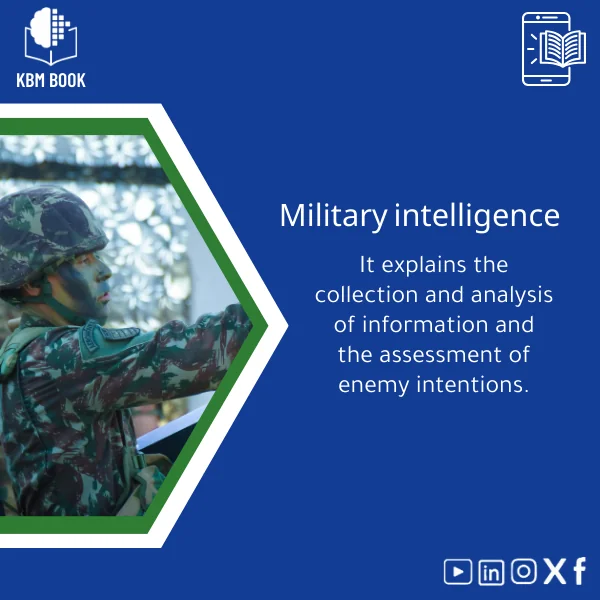
Military Intelligence Guide for Collection and Analysis
Original price was: 179.00 $.139.00 $Current price is: 139.00 $.
A structured, searchable Knowledge Base Module (KBM) that converts the essentials of military intelligence — collection methods, processing workflows, analysis techniques, and adversary intent assessment — into a step-by-step, practical reference for students, researchers, and professionals.
Key benefits & value for the buyer
This KBM transforms disparate doctrine, open-source methods, and analytic best practices into a compact, consistently organized reference. Instead of flipping through books or scattered articles, you get a hierarchical, non-redundant knowledge structure that:
- Reduces time to answer: find collection techniques, indicator templates, or analytic approaches in seconds.
- Supports learning and teaching: modular flow from fundamentals to professional practice makes lesson planning and revision efficient.
- Improves analytic rigor: built-in checklists and hypothesis frameworks reduce bias and streamline adversary intent assessments.
- Integrates with workflows: table exports and a searchable file let you import lists (targets, collection assets, evidence types) into your systems.
Use the “Military Intelligence” KBM as a working reference for assignments, research papers, briefings, or operational planning — not just as a reading resource.
Use cases & real-life scenarios
Scenario: Student preparing a course exam
Use the basics of military intelligence module to review definitions, key collection disciplines (HUMINT, SIGINT, IMINT, OSINT), and standard analytic frameworks. Export the timeline templates and practice applying hypothesis matrices to sample vignettes.
Scenario: Researcher compiling literature on adversary intent
The KBM’s cross-referenced entries and citation-ready source lists accelerate literature reviews. Use the built-in taxonomy to tag findings by actor, capability, and intent indicators — then export tables for your paper or database.
Scenario: Analyst designing a collection plan
Follow the stepwise collection planning template, choose assets mapped to information requirements, and apply analytic validation checks before submitting tasking orders — all within the KBM’s structured modules.
Who is this product for?
This KBM is tailored to:
- Students studying military intelligence or security studies who need concise, exam-ready references.
- Researchers who require structured taxonomies and exportable data for analysis and publication.
- Professionals (analysts, collection managers, instructors) who need fast access to templates and validated procedures.
How to choose the right version
KBMBook offers several delivery formats and editions. Select based on how you will use the content:
- Reference edition (PDF + searchable index) — best for reading, teaching, and printing.
- Integration edition (CSV/JSON exports + offline KB file) — best for importing lists, building databases, or connecting to analytic tools.
- Complete edition (all formats + update access) — best for instructors and teams who want ongoing revisions and templates.
If your priority is quick study and reference, the Reference edition is sufficient. If you plan to embed the KBM into a tool or research dataset, choose the Integration or Complete edition.
Quick comparison with typical alternatives
Traditional books and isolated articles provide depth but are linear and hard to search. This KBM:
- Is organized hierarchically for fast lookup, not linear reading.
- Contains templates and export-ready tables; books rarely include ready-to-use spreadsheets.
- Is modular and updateable — you can replace or extend modules without reprinting an entire book.
Best practices & tips to get maximum value
- Start with the Fundamentals module to align terminology before moving to advanced analytic frameworks.
- Use the collection-plan template in field exercises to validate feasibility and resource needs.
- Tag exported tables with your project codes to keep evidence and indicators consistent across reports.
- Pair the KBM with case studies from your curriculum to practice adversary intent assessment using the provided checklists.
Common mistakes when buying or using similar products — and how to avoid them
- Mistake: Buying a single-format manual that can’t be integrated. Fix: Choose an edition with exports if you plan to use data in tools.
- Mistake: Assuming one source replaces training. Fix: Use the KBM as a practical reference alongside exercises and mentorship.
- Mistake: Ignoring update policies. Fix: Select the edition with update access if you need evolving doctrine or fresh OSINT practices.
Product specifications
- Title: Military Intelligence Guide for Collection and Analysis
- Category: Military & Security Sciences Section
- Formats included: PDF (reference), Offline searchable KB file, CSV/JSON exports, XLSX templates
- Modules: Fundamentals, Collection Disciplines, Processing & Fusion, Analytic Techniques, Adversary Intent Assessment, Templates & Checklists
- Language: English
- Delivery: Digital download after purchase — immediate access
- Usage notes: Suitable for academic, training, and professional reference — adapt content to local classification rules and operational security policies before operational use.
Frequently asked questions
Is this a military intelligence book PDF or a database?
The KBM is provided as a layered package: a PDF reference for reading, plus exportable tables and an offline searchable KB file suitable for import into databases. It is designed to be both readable and machine-friendly.
How current is the content, and are updates included?
Each edition states its update policy. The Complete edition includes periodic updates and patch notes. All content emphasizes foundational methods and widely accepted analytic practices; operational standards should be cross-checked with current doctrine where required.
Can I use the templates in my research or classroom?
Yes. Templates and checklists are provided for academic and instructional use. Please follow citation guidelines included in the KBM and respect any local restrictions on redistribution.
Is this suitable for non-military security analysts?
Absolutely. The KBM focuses on universal collection and analytic techniques that apply across defense, security studies, law enforcement, and open-source research.
Ready to get structured, usable Military Intelligence knowledge?
Choose the edition that fits your workflow and gain immediate access to a professionally organized intelligence KBM designed for study, research, and operational planning.
Need help choosing the right edition? Contact KBMBook support for a short consultation before purchase — we’ll recommend the best package for students, researchers, or professional teams.
Related products
Analytical Chemistry Book: Qualitative and Quantitative Methods Guide
Astrophysics Book: Understanding Stars, Galaxies, and Dark Energy
A searchable, hierarchical Knowledge Base Module (KBM) that converts astrophysics and cosmology into a practical, exam-ready and research-ready reference. Designed for students, researchers, and professionals who need immediate access to reliable explanations, equations, and data models for stars, galaxies, and dark energy.
Cell Biology Guide: Structure, Division, and Transport Insights
Cosmology Book: Guide to Big Bang and Galaxy Evolution
Electromagnetism Book: A Comprehensive Guide to Fields and Circuits
Introductory General Chemistry Book on Matter and Reactions
A structured, searchable Knowledge Base Module (KBM) that converts core general chemistry concepts — matter, elements, reactions, stoichiometry and molarity — into a hierarchical reference you can query, teach from, or integrate into study workflows. Ideal as a concise General Chemistry book alternative for students, researchers, and professionals who need accurate, practical chemistry knowledge fast.
Materials Physics Guide: Understanding Solid-State Properties
Physical Chemistry Guide: Energy, Thermodynamics & Interactions
A structured Knowledge Base Module (KBM) for Physical Chemistry that converts core theory, worked examples, and applied datasets into a searchable, hierarchical database — ideal for students, researchers, and professionals who need fast, reliable access to chemical thermodynamics basics and molecular interaction models.
Reviews
Clear filtersThere are no reviews yet.