


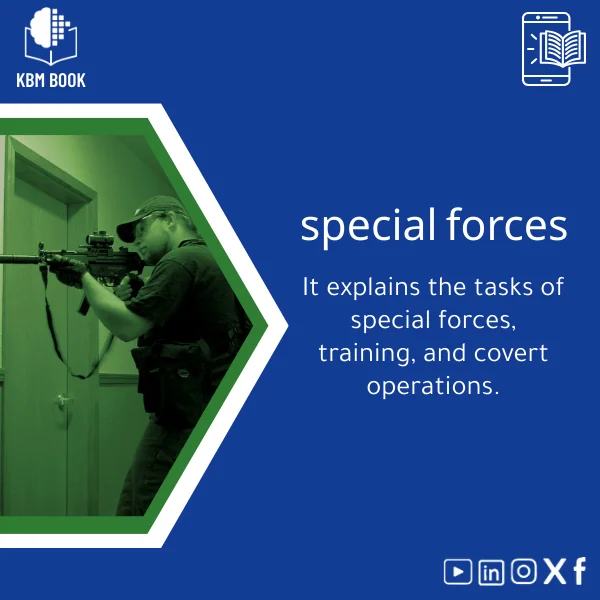
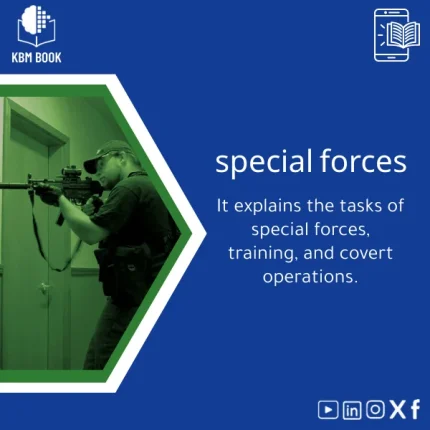
Special Forces Book on Roles, Training, and Operations
Original price was: 139.00 $.99.00 $Current price is: 99.00 $.
A structured, searchable Special Forces book (Knowledge Base Module) that turns fragmented military literature into a hierarchical, practical database — ideal for students, researchers, and professionals who need fast, reliable access to elite unit roles, training curricula, tactics, and operational planning.
Key benefits & value for the buyer
The Special Forces book is built as a Knowledge Base Module (KBM) — not a traditional book. That design yields concrete advantages:
- Speed: Lookup modules by role, doctrine, or operation type in seconds — reduces research time for papers, briefs, and lesson planning.
- Clarity: Hierarchical structure separates tactics, training, and administrative roles so you avoid conflated or redundant material.
- Reliability: Each entry cites primary sources and analyses; footnotes and a curated bibliography support academic and professional use.
- Reusability: Exportable tables, templates, and checklists make it easy to integrate content into slides, reports, and training syllabi.
- Scalability: Update-friendly format lets you add new case studies or local doctrinal notes without reworking the whole KBM.
Use cases & real-life scenarios
Academic research
Use the KBM as a primary reference to map the development of special operations doctrine across time, extract citations for literature reviews, and gather datasets (unit composition, mission types) for quantitative analysis.
Training & curriculum development
Instructors can pull modular training blocks (e.g., small-unit tactics, CQB fundamentals, advanced reconnaissance) to assemble a bespoke syllabus matched to skill levels and available resources.
Operational analysis & policy work
Analysts and planners can use the operational case studies and after-action summaries to model risks, test contingency plans, and draft policy recommendations with quick cross-referencing of doctrine and tactics.
Who is this product for?
The primary audience includes:
- Students of military science and security studies needing structured study materials.
- Researchers conducting comparative doctrine, tactics, or capability studies.
- Professionals — trainers, analysts, policy advisors — requiring reliable, retrievable references.
- Authors and curriculum designers who want modular content to adapt for courses or manuals.
How to choose the right edition & format
This KBM comes in multiple formats. Choose according to how you work:
- PDF (annotated): Best for deep reading, citation, and printing.
- Interactive bundle (Markdown + SQLite): Best for researchers who need to query the database and export subsets.
- CSV / JSON extracts: Best for data analysis and integrating tables into reports or models.
If you need to integrate content into learning management systems or editing platforms, pick the interactive bundle. If you only need a readable reference, PDF is sufficient.
Quick comparison with typical alternatives
Compared with single-author books or scattered articles, the KBM approach reduces repetition and organizes material by function and operational context. Compared with video courses, a KBM is faster to search and better for extracting citations and templates. Unlike classified or proprietary manuals, this product focuses on open-source doctrine, historical case studies, and analytical frameworks suitable for study and training.
Best practices & tips to get maximum value
- Start with the module index — identify the exact role or operation type before deep reading.
- Use CSV/JSON extracts for comparative charts (e.g., mission types vs. success factors).
- Annotate the Markdown bundle with local doctrinal notes to create an evolving institutional KBM.
- Cite the bibliography provided to support academic work; export bibliographic entries for reference managers.
Common mistakes when buying/using similar products and how to avoid them
- Mistake: Buying a single narrative book expecting searchable data.
Fix: Choose a KBM for structured access and data exports. - Mistake: Assuming all operational details are open-source.
Fix: Use the KBM for doctrine, history, and analysis; do not expect classified tactics. - Mistake: Skipping bibliography checks.
Fix: Review referenced sources to verify applicability to your region or curriculum.
Product specifications
- Format: KBM (interactive bundle) including Markdown chapters, SQLite database, annotated PDF, CSV/JSON exports.
- Language: English (with Arabic metadata and descriptions where applicable).
- Size: ~320 modules & entries; bibliography of 250+ sources; 120+ annotated case studies.
- License: Standard single-user digital license (commercial use allowed for training/internal use; redistribution restricted).
- Compatibility: Works with common DB tools, Markdown editors, and PDF readers. No special software required for PDF/CSV.
- Delivery: Instant digital download after purchase; includes update notes and version history.
FAQ
Is the content academic and citable for research papers?
Yes. Each module includes citations and a curated bibliography. Use the annotated PDF for direct citations; bibliographic entries are exportable for reference managers (BibTeX, RIS).
What formats do you provide and can I extract data for analysis?
The KBM includes an annotated PDF, a Markdown + SQLite interactive bundle, and CSV/JSON exports. The CSV/JSON files are designed for use in Excel, R, Python, or other analysis tools.
Is any content classified or operationally sensitive?
No. The product compiles open-source doctrine, historical case studies, and academic analyses. It does not include classified or restricted operational instructions.
What is your refund or update policy?
Digital purchases include access to minor updates and version notes. Refunds are handled case-by-case; contact support if the files are defective or the purchase was accidental.
Ready to save research time and improve training quality?
Download a professional Special Forces book in KBM format that converts scattered material into a searchable, reusable knowledge base. Trusted by students, researchers, and practitioners who need clear, citation-ready content.
Related products
Atomic Physics Guide: Understanding Atomic and Electron Properties
Knowledge Base — Atomic/Electron Properties & Electromagnetic Interactions. A structured, searchable KBM for students, researchers, and professionals who need an authoritative atomic physics reference that organizes concepts, formulas, experiments, and practical applications from basics of atomic physics to advanced electron properties.
Biochemistry Book: Understanding Chemical Processes in Living Systems
Biological Anthropology Study Guide on Human Evolution
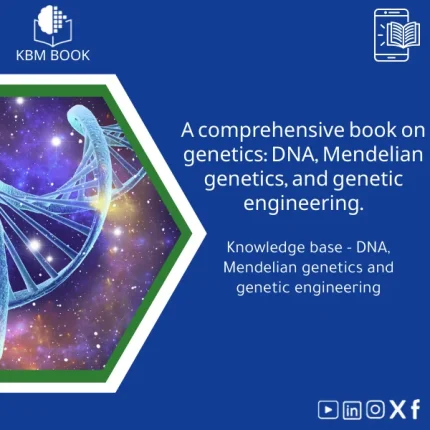
Comprehensive Genetics Book: DNA, Mendelian Genetics & Engineering
A structured, searchable knowledge base module (KBM) that turns genetics theory and practice into an immediately usable digital reference — from DNA structure to Mendelian genetics and contemporary genetic engineering techniques — optimized for students, researchers, and professionals who need reliable answers fast.
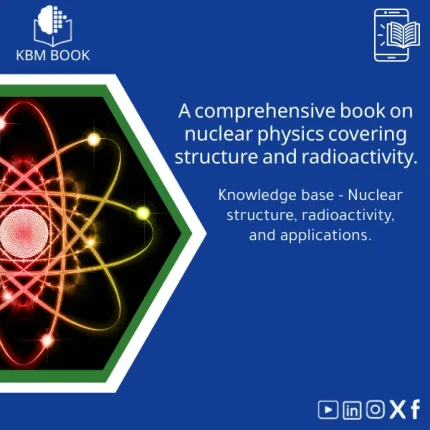
Comprehensive Nuclear Physics Book on Structure and Radioactivity

Materials Physics Guide: Understanding Solid-State Properties
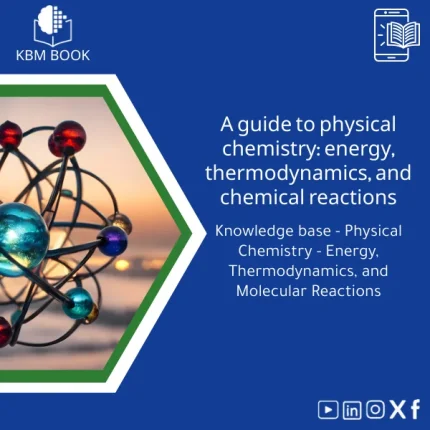
Physical Chemistry Guide: Energy, Thermodynamics & Interactions
A structured Knowledge Base Module (KBM) for Physical Chemistry that converts core theory, worked examples, and applied datasets into a searchable, hierarchical database — ideal for students, researchers, and professionals who need fast, reliable access to chemical thermodynamics basics and molecular interaction models.

Thermal Physics Guide: Understanding Heat, Energy, and Entropy
A downloadable, hierarchically structured Knowledge Base Module (KBM) that converts university-level thermodynamics into a searchable, practical digital database. Ideal for students, researchers, and professionals who need fast, reliable access to fundamentals and advanced topics in thermal physics.
Reviews
Clear filtersThere are no reviews yet.