


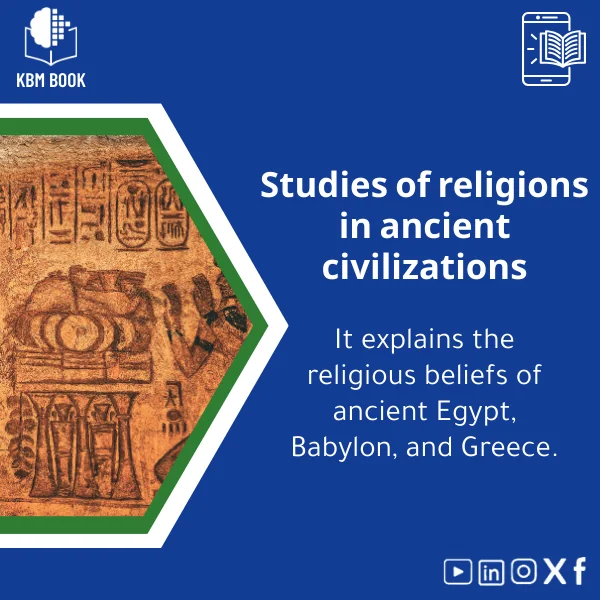
Religions in Ancient Civilizations Studies Guide
Original price was: 179.00 $.139.00 $Current price is: 139.00 $.
A fully structured Knowledge Base Module (KBM) that maps religious beliefs, rituals, institutions, and comparative frameworks across ancient Egypt, Babylon, and Greece — designed for students, researchers, and professionals who need reliable, searchable, and ready-to-use content for study, teaching, or analysis.
Key benefits & value for students, researchers, and professionals
Religions in Ancient Civilizations Studies is built to reduce research friction. The KBM converts scattered literature into a concise, logically sequenced database so you can:
- Find authoritative summaries and primary-source excerpts in seconds rather than hours.
- Compare ritual types, deity functions, and institutional roles across Egypt, Babylon, and Greece with cross-referenced nodes.
- Prepare lectures, essays, or grant proposals with ready bibliographies and citation-ready extracts.
- Integrate material into digital note systems (Obsidian, Notion, Zotero) using exportable CSV/JSON tables.
In short: this KBM shifts time from searching to analysis, letting you focus on interpretation and output.
Use cases & real-life scenarios
Undergraduate student — exam revision
Use the KBM’s “rituals” and “deities” modules to produce comparison tables for exam essays. Example: quickly extract differences between Egyptian funerary spells and Greek conceptions of the afterlife for a 2,000-word comparative analysis.
Graduate researcher — literature review
Build a focused literature review by exporting source lists and primary-source excerpts for thematic coding. The KBM’s hierarchical tags let you isolate legal-religious texts from mythic narratives for targeted analysis.
Lecturer / trainer — course preparation
Assemble lecture slides from concise topic entries and suggested teaching questions. Ready-made timelines and ritual flowcharts save hours of preparation.
Heritage professional — interpretive work
Use the KBM to create visitor-facing texts or comparative panels that are accurate, sourced, and succinct.
Who is this product for?
The Religions in Ancient Civilizations Studies KBM is designed for:
- Undergraduate and postgraduate students in theology, religious studies, and ancient history.
- Academic researchers compiling comparative studies of ancient religions.
- Lecturers, curriculum designers, and trainers who need reliable module-ready content.
- Museum educators and cultural heritage professionals preparing interpretive materials.
- Policy analysts and writers requiring structured historical contexts for comparative religion reports.
How to choose the right KBM format
KBMBook delivers this module in multiple formats. Choose based on your workflow:
- CSV / Excel: Best for data analysis, coding, and import into statistical software.
- JSON: Ideal for developers and those integrating KBM with custom apps or digital humanities tools.
- PDF & structured HTML: For offline reading, citation, and classroom handouts.
- Notion / Obsidian-ready: For users who prefer linked-note workflows and active annotation.
If you need guidance choosing a format, KBMBook provides format recommendations in the product notes.
Quick comparison with typical alternatives
Compared with single books or scattered articles, this KBM offers:
- Consolidation: multiple topics, primary sources, and bibliographies in one structured file.
- Searchability: node-based indexing for instantaneous retrieval of precise information.
- Updatability: modules are designed for easy updates and additions without reformatting long manuscripts.
Compared to generic encyclopedias or lecture notes, the KBM emphasizes comparative analysis and export-ready data, making it more practical for academic workflows.
Best practices & tips to get maximum value
- Start with the index map: review top-level nodes (deities, rituals, institutions) to orient yourself.
- Use tags to filter by civilization and theme (e.g., funerary practices, temple economy).
- Export small subsets for focused tasks—don’t overload your reference manager with the entire module if you only need one topic.
- Cross-check primary-source excerpts with the original editions listed in the bibliographies before quoting.
Common mistakes when buying/using similar resources and how to avoid them
- Mistake: Buying a single-format product that doesn’t match your workflow. Fix: Choose the multi-format KBM or request the format recommendation in the product notes.
- Mistake: Treating summaries as primary sources. Fix: Use the KBM’s primary-source pointers to verify original context for critical analysis.
- Mistake: Not using tags or indexes and missing cross-civilizational links. Fix: Learn the KBM’s tagging scheme—it’s the fastest path to comparative insight.
Product specifications
- Title: Religions in Ancient Civilizations Studies (KBM)
- Coverage: Egypt, Babylon (Mesopotamia), Greece — thematic and comparative modules
- Structure: Hierarchical nodes (≈ 12 top-level themes; 150+ subtopics)
- Content types: summaries, primary-source excerpts, timelines, ritual flowcharts, bibliographies
- Formats included: CSV, JSON, PDF, structured HTML, Notion/Obsidian imports
- Language: English
- License: single-user academic / commercial use options (see checkout for licensing choices)
- Delivery: instant digital download after purchase
- Usage notes: citation-ready excerpts flagged with original references; recommended verification steps included
Frequently asked questions
Is this KBM suitable for citation in academic papers?
Yes. The KBM includes citation-ready excerpts and full bibliographic references for each primary source and secondary work cited. For publication, verify quotations with the original editions listed in the bibliography.
What formats will I receive and which format should I choose?
You will receive CSV, JSON, PDF, and structured HTML files, plus import templates for Notion/Obsidian. Choose CSV/JSON for data analysis, PDF for reading and teaching, and Notion/Obsidian for active note-taking workflows.
How often is the KBM updated?
KBMBook maintains periodic updates to correct errors and add references. Update frequency depends on user demand and new scholarship; update notes are provided with each release. Check the product page for current version history.
I’m unsure if I need a full KBM — can I preview contents?
Yes. A sample preview (index map and three sample entries) is available on the product page so you can evaluate structure and depth before purchasing.
Ready to accelerate your research?
Purchase a structured, scholarly, and export-ready KBM that turns scattered sources into usable knowledge. Whether you are preparing an essay, lecture, or a research article, this module saves time and increases accuracy.
Concerned about format or scope? The sample preview and format guidance included with purchase reduce the risk — refunds and licensing options are available according to the store policy.
Related products
Analytical Chemistry Book: Qualitative and Quantitative Methods Guide
Astrophysics Book: Understanding Stars, Galaxies, and Dark Energy
A searchable, hierarchical Knowledge Base Module (KBM) that converts astrophysics and cosmology into a practical, exam-ready and research-ready reference. Designed for students, researchers, and professionals who need immediate access to reliable explanations, equations, and data models for stars, galaxies, and dark energy.
Biochemistry Book: Understanding Chemical Processes in Living Systems
Comprehensive Botany Book on Plant Taxonomy and Photosynthesis
A structured, searchable botany book designed as a Knowledge Base Module (KBM) — an end-to-end reference on plant taxonomy, organ structure, and the biochemistry of photosynthesis. Built for students, researchers, and professionals who need reliable, hierarchical knowledge they can search, cite, and apply immediately.
Materials Physics Guide: Understanding Solid-State Properties
Modern Physics Book: Quantum, Relativity, and Tech Applications Guide
A structured, searchable Knowledge Base Module (KBM) that turns modern physics — quantum mechanics, special & general relativity, and contemporary technological applications — into a hierarchical, practical reference for students, researchers, and professionals who need quick, reliable access to advanced concepts and formulas.
Quantum Mechanics: A Beginner’s Guide to Superposition and Waves
Thermal Physics Guide: Understanding Heat, Energy, and Entropy
A downloadable, hierarchically structured Knowledge Base Module (KBM) that converts university-level thermodynamics into a searchable, practical digital database. Ideal for students, researchers, and professionals who need fast, reliable access to fundamentals and advanced topics in thermal physics.
Reviews
Clear filtersThere are no reviews yet.