


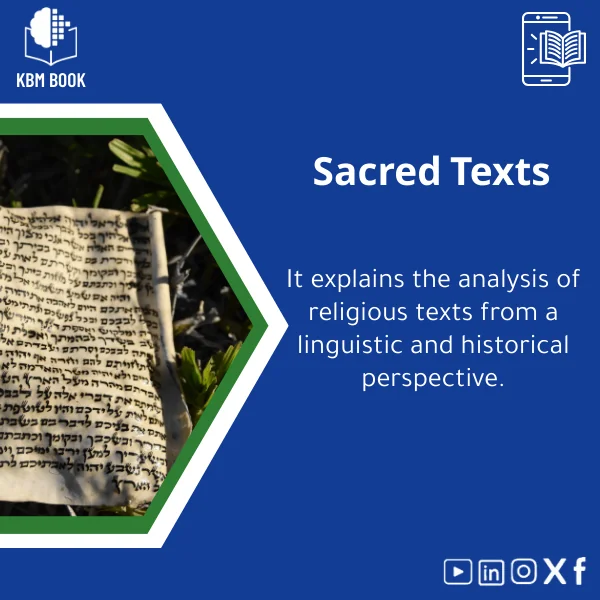
Sacred Texts Studies: Linguistic and Historical Analysis Guide
Original price was: 349.00 $.279.00 $Current price is: 279.00 $.
A hierarchical, searchable Knowledge Base Module (KBM) that converts the study of sacred scriptures into a practical, research-grade database — for students, researchers, translators, and professionals who need fast access to reliable linguistic and historical analyses of religious texts.
Key benefits & value for students, researchers, and professionals
Sacred Texts Studies transforms fragmented notes, books, and article PDFs into a compact, reliable knowledge base built for active use. It is not a single textbook — it is a composable research tool that saves hours of manual cross-referencing and reduces error in citation and interpretation.
Features translated into benefits
- Hierarchical modules: Learn step-by-step — historical context → textual traditions → linguistic features → variant analysis — so you can progress from overview to specialist detail without noise.
- Indexed concordances and lemmatization: Find occurrences of roots and key terms across corpora quickly; ideal when preparing close readings or building corpora for digital humanities work.
- Manuscript variant mapping: Compare readings, localize variant families, and cite manuscript sigla that are referenced to primary sources.
- Export-ready formats: Feed data directly into reference managers, corpus analysis software, or your own databases for reproducible research.
- Annotated bibliographies: Curated secondary literature helps you assess claims and locate critical commentary without sifting through irrelevant material.
Use cases & real-life scenarios
Undergraduate and graduate coursework
Use the KBM to prepare lectures, build reading lists, and generate handouts with clear timelines and simplified philological notes. The glossary and concordance reduce prep time for classes focused on textual variants and translation choices.
Research & thesis writing
Populate methodology sections with reproducible data exports. Quickly assemble variant tables for appendices and use the linked bibliographies to support literature reviews — all while keeping consistent citation metadata.
Translation and interfaith projects
Compare language features, semantic shifts, and editorial histories to select the most defensible translation choices. The KBM’s linguistic modules help identify idiomatic structures and historical sense changes.
Professional reference
Clergy, archivists, and heritage professionals can use timelines and manuscript indexes to validate provenance claims and to prepare public-facing summaries or exhibit notes grounded in primary evidence.
Who is this product for?
- Undergraduate and graduate students in theology, religious studies, linguistics, or history.
- Academic researchers conducting textual criticism, comparative philology, or historical theology.
- Translators and editors working with sacred scriptures and liturgical texts.
- Professionals in archives, museums, and cultural heritage managing primary-text collections.
- Instructors and trainers who want structured modules for course design and assessment.
How to choose the right KBM version
The KBM is offered in tiered packages so you can pick what matches your workflow:
- Starter: Summary modules, glossary, and PDF extracts — best for coursework and quick reference.
- Research: Full datasets (CSV/JSON), concordances, lemmatized lists, and manuscript variant tables — ideal for theses and journal work.
- Professional: All Research features plus editable SQLite package, metadata for integration, and priority update notifications — for institutions and frequent users.
Choose by intended use: if you need exportable data for analysis, select Research or Professional. If you mainly need readable summaries and bibliographies, Starter is sufficient and most economical.
Quick comparison with typical alternatives
Compared with a single textbook or scattered PDFs, this KBM provides structured, machine-readable data and cross-referenced entries. Compared with raw databases, it adds curated scholarship, annotated bibliographies, and pedagogical sequencing (intro → method → advanced). The result: less prep, fewer gaps, and sources linked to each assertion.
Best practices & tips to get maximum value
- Start with the timeline and historical-context module to orient your readings.
- Use the concordance to export target terms into your corpus tools; lemmatized lists reduce noise.
- Cross-check module bibliographies with your institution’s holdings before citing; use the provided manuscript sigla for accurate referencing.
- For publishable work, cite both the KBM entry and the primary sources it references — the KBM is a tool, not a substitute for primary-source citation.
Common mistakes when buying or using similar products — and how to avoid them
- Mistake: Buying raw data without scholarly curation. Fix: Choose the KBM for curated modules that connect data with authoritative commentary.
- Mistake: Assuming all formats are compatible with your tools. Fix: Review format specs (CSV/JSON/SQLite/PDF) listed below before purchase.
- Mistake: Using an unordered pile of notes for citations. Fix: Use the KBM’s citation-ready exports and bibliographies to maintain consistency.
Product specifications
- Package type: Knowledge Base Module (KBM) — downloadable ZIP.
- Included formats: PDF summaries, CSV, JSON, and an editable SQLite file.
- Scope: Hierarchical modules covering historical context, philology, manuscript variants, lemmatized glossaries, concordances, and annotated bibliography.
- Entries: Multi-level nodes with cross-references and source links (indexed for quick search).
- Language: English metadata; referenced primary sources may be in original languages (Arabic, Greek, Hebrew, Syriac, Latin, etc.).
- Compatibility: Works with common corpus/DB tools and reference managers; exportable for statistical and textual analysis.
- Delivery: Instant digital download after purchase; optional institutional licensing available.
Frequently asked questions
What formats are included and will they work with my tools?
The KBM includes PDF summaries, CSV tables, JSON objects, and an editable SQLite database. These formats are standard for corpus tools, research scripts (Python/R), and reference managers. If you need a specific export, contact support for guidance.
How reliable are the sources and bibliographies?
Each module is curated from primary manuscripts and peer-reviewed secondary literature. Sources are cited at the entry level so you can verify claims and follow up on original editions and critical apparatus.
Do I get updates and how are they delivered?
Research and Professional buyers receive versioned updates and change logs. Updates are delivered as downloadable patches or new package versions; major revisions are announced to registered purchasers.
Is this a replacement for reading primary texts?
No. The KBM is a research and productivity tool that makes primary texts and their histories easier to navigate and cite. It is designed to complement — not replace — direct engagement with primary sources.
Ready to integrate authoritative Sacred Texts Studies into your workflow?
Get a structured, citation-ready KBM that saves time and raises the quality of your research and teaching materials. Choose the package that fits your work and download immediately.
Still unsure which package fits your needs? Contact support for a package comparison and sample module preview before purchase.
Related products
Astronomy Observational Techniques Guide for Celestial Motion
Astrophysics Book: Understanding Stars, Galaxies, and Dark Energy
A searchable, hierarchical Knowledge Base Module (KBM) that converts astrophysics and cosmology into a practical, exam-ready and research-ready reference. Designed for students, researchers, and professionals who need immediate access to reliable explanations, equations, and data models for stars, galaxies, and dark energy.

Reviews
Clear filtersThere are no reviews yet.