


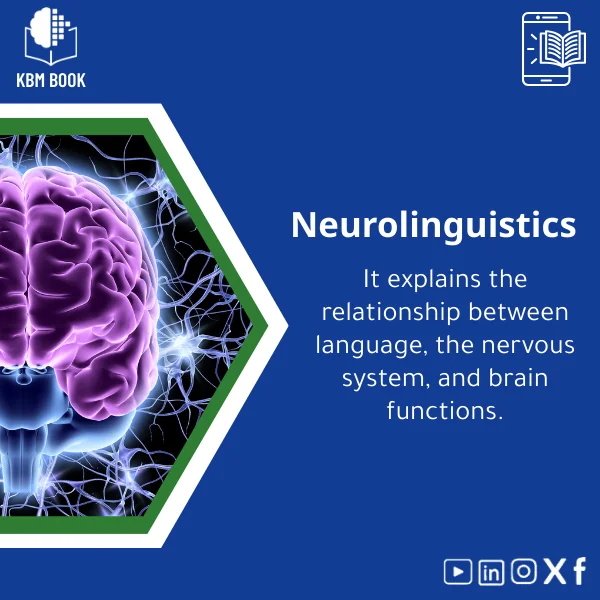
Neurolinguistics Book on Language and Brain Functions
Original price was: 199.00 $.159.00 $Current price is: 159.00 $.
A structured, research-grade knowledge base module (KBM) that organizes neurolinguistics from fundamentals to advanced applications — optimized for students, researchers, translators, and professionals who need fast, reliable access to how language and brain functions interact.
Key benefits & value for the buyer
This Neurolinguistics book is delivered as a Knowledge Base Module (KBM): a compact, searchable database that replaces scattered PDFs, lecture slides, and notes with a single structured resource. Features are translated into practical value:
- Time saved on literature review: The hierarchical layout surfaces core concepts (e.g., Broca’s/Wernicke’s, aphasia types, ERP components) and links primary studies for fast verification.
- Actionable protocols: Experiment and clinical assessment templates (EEG/ERP setup, fMRI contrasts, aphasia batteries) ready to adapt for your projects or lab courses.
- Translation & crosslingual support: Sections for translators include terminology mappings, common pitfalls, and bilingual examples — helpful for neurolinguistics for translators.
- Academic-ready citations: Each node includes suggested citation text and DOI links for inclusion in papers or student assignments.
Use cases & real-life scenarios
Undergraduate & graduate students
Convert lecture prep into revision-ready notes. Use the KBM to generate reading lists, exam flashcards, or concise summaries for assignments with references at hand.
Researchers & lab leads
Integrate the JSON export into your lab’s knowledge system to standardize protocols and replicate experiment pipelines. Quickly check reported effect sizes and neuroanatomical coordinates for meta-analyses.
Translators & clinicians
Access curated bilingual examples and clinical language assessments. Use the module to ensure accurate, evidence-based translation of clinical reports or patient-facing materials.
Who is this product for?
The Neurolinguistics book targets three overlapping groups:
- Students studying psycholinguistics, cognitive neuroscience, or translation — for coursework and exam prep.
- Researchers who need a fast reference for methods, brain regions, and experimental results.
- Professionals & translators working with language-disorder diagnostics, clinical reporting, or scientific communication.
How to choose the right format
The module is available in multiple formats to match different workflows:
- Searchable PDF — best if you want a clean, printable reference (fast to open, universal compatibility).
- Interactive KBM file + viewer — ideal for linking nodes, filtering by evidence level, and using within course platforms.
- JSON / CSV export — for researchers who will import the dataset into analysis tools, citation managers, or custom apps.
Choose the format that matches how you work: read & cite (PDF), teach & present (KBM viewer), or analyze & integrate (JSON/CSV).
Quick comparison with typical alternatives
Alternatives: single-author textbooks, review articles, or scattered lecture notes. The Neurolinguistics KBM differs in three practical ways:
- Structured vs. linear: Instead of a linear book, the KBM lets you jump between related nodes (e.g., aphasia syndromes → imaging markers → recommended tests) without re-reading chapters.
- Searchable & exportable: You can extract tables, protocols, and references directly into your workflow — no manual copying from PDFs.
- Compact and updatable: Designed as a modular DB, so future updates replace single nodes rather than entire editions.
Best practices & tips to get maximum value
- Start with the overview nodes to align terminology before diving into methods or clinical sections.
- Use the JSON export to create protocol templates for your lab or course LMS — saves setup time for each semester.
- Assign specific KBM nodes as pre-reading for students to standardize baseline knowledge.
- When translating clinical terms, consult the bilingual glossary node to maintain accuracy and consistency.
Common mistakes when buying/using similar products and how to avoid them
- Mistake: Buying long-text textbooks expecting quick lookup. Fix: Choose a structured KBM for rapid retrieval of discrete facts and protocols.
- Mistake: Ignoring metadata (study date, methods). Fix: Use the KBM’s evidence tags to filter by method and recency.
- Mistake: Failing to integrate with existing tools. Fix: Use the provided exports (JSON/CSV) to sync with citation managers and databases.
Product specifications
- Title: Neurolinguistics Book on Language and Brain Functions (KBM)
- Formats: Searchable PDF, Interactive KBM file, JSON export, CSV export
- Size: ~120 modular nodes (concepts, protocols, case studies) — equivalent to ~350 pages of curated material
- Content scope: Neuroanatomy, electrophysiology (ERP), neuroimaging (fMRI, PET), aphasia & language disorders, bilingualism, experimental paradigms
- References: Full bibliographic entries with DOIs and evidence-level tags
- Usage notes: Single-user digital license; institution-wide licensing available on request
- Delivery: Instant download after purchase
Frequently asked questions
What formats are included and which should I choose?
The package includes a searchable PDF for reading and printing, an interactive KBM file compatible with KBMBook’s viewer, and structured JSON/CSV exports for integration into research tools. Choose PDF for study, KBM for teaching, and JSON/CSV for data workflows.
Is the content suitable for citation in academic papers?
Yes. Each module includes bibliographic citations and DOI links. Use the suggested citation text in the node footer when referencing KBM content in papers or theses.
How often is the KBM updated?
The KBM is curated to include up-to-date references at release and is structured so we can provide incremental updates. Buyers will be notified of major updates and can request integration-friendly exports for updated nodes.
Can I use this for clinical practice or translation work?
The KBM provides evidence-based protocols and terminology mappings useful for clinicians and translators. It is a reference and training tool; clinical decisions should always consider local standards and professional judgment.
Ready to streamline your neurolinguistics work?
Get a research-grade, searchable neurolinguistics book that fits into your workflow — whether you’re preparing a course, running experiments, or translating clinical texts. Instant download and structured exports make adoption fast.
Related products
Astrophysics Book: Understanding Stars, Galaxies, and Dark Energy
A searchable, hierarchical Knowledge Base Module (KBM) that converts astrophysics and cosmology into a practical, exam-ready and research-ready reference. Designed for students, researchers, and professionals who need immediate access to reliable explanations, equations, and data models for stars, galaxies, and dark energy.

Atomic Physics Guide: Understanding Atomic and Electron Properties
Knowledge Base — Atomic/Electron Properties & Electromagnetic Interactions. A structured, searchable KBM for students, researchers, and professionals who need an authoritative atomic physics reference that organizes concepts, formulas, experiments, and practical applications from basics of atomic physics to advanced electron properties.
Biological Anthropology Study Guide on Human Evolution
Cell Biology Guide: Structure, Division, and Transport Insights

Classical Mechanics Guide: Newton’s Laws and Dynamics
A searchable, hierarchical Knowledge Base Module (KBM) that turns classical mechanics into a practical, ready-to-use reference for fast problem solving, lecture preparation, and applied engineering. Designed for students, researchers, and professionals who need precise access to Newton’s laws, rotational motion, and applied dynamics without the noise of textbooks.

Comprehensive Botany Book on Plant Taxonomy and Photosynthesis
A structured, searchable botany book designed as a Knowledge Base Module (KBM) — an end-to-end reference on plant taxonomy, organ structure, and the biochemistry of photosynthesis. Built for students, researchers, and professionals who need reliable, hierarchical knowledge they can search, cite, and apply immediately.

Electromagnetism Book: A Comprehensive Guide to Fields and Circuits
Physical Chemistry Guide: Energy, Thermodynamics & Interactions
A structured Knowledge Base Module (KBM) for Physical Chemistry that converts core theory, worked examples, and applied datasets into a searchable, hierarchical database — ideal for students, researchers, and professionals who need fast, reliable access to chemical thermodynamics basics and molecular interaction models.
Reviews
Clear filtersThere are no reviews yet.