


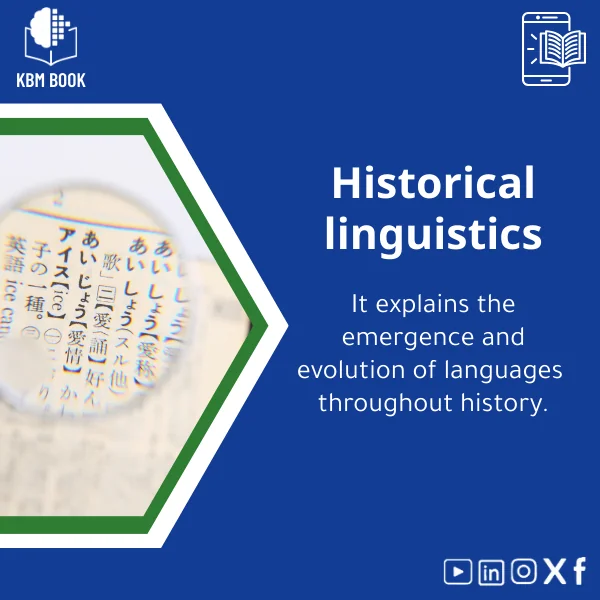
Guide to Historical Linguistics: Origins and Language Change
Original price was: 179.00 $.139.00 $Current price is: 139.00 $.
A structured, searchable knowledge-base module on historical linguistics: from language families and sound change to reconstruction methods and sociolinguistic drivers. Designed for students, researchers, and professionals who need reliable, compact, and actionable reference material for study, teaching, and applied research.
Key benefits & value for the buyer
This KBM on historical linguistics turns dispersed academic material into a compact, usable database. Unlike a traditional textbook, this module provides:
- Structured learning path: clear hierarchy from foundational concepts (language families, comparative method) to advanced topics (internal reconstruction, contact linguistics).
- Actionable examples: annotated sound change chains, step-by-step reconstructions, and worked cognate sets that you can reuse in assignments or lectures.
- Search-ready format: indexed entries and cross-references enable instant lookup of terms like “palatalization” or “Proto-Indo-European” without flipping pages.
- Reference-ready citations: curated bibliography and source pointers save research hours while ensuring academic rigor.
Result: faster preparation for exams, higher-quality literature reviews, and practical classroom materials for instructors.
Use cases & real-life scenarios
Students
Prepare essays and exams with focused revision modules (e.g., “Sound change rules — with examples”) and exportable tables for study flashcards. Use the downloadable PDF when offline.
Researchers
Rapidly identify prior reconstructions, compare cognate sets, and extract bibliographic leads. The JSON export integrates into your lab’s database or citation manager.
Language professionals & Translators
Consult historical etymologies to resolve ambiguous translations, or use case studies to inform localization choices when cultural-linguistic history matters.
Instructors
Save lecture prep time: ready-made examples, diagrams, and grouped topics allow you to build modules for semester lessons or short workshops.
Who is this product for?
The KBM suits anyone who needs reliable, organized knowledge about language history:
- Undergraduate or graduate students taking courses in historical linguistics, comparative philology, or typology.
- Researchers requiring quick access to reconstructions, sound laws, and comparative data.
- Translators, lexicographers, and language technology specialists dealing with historical forms or dialectal variation.
- Educators designing curricula or practical labs in language change and reconstruction.
How to choose the right format and level
KBM modules are offered in multiple formats and tiers. Choose based on how you work:
- Introductory PDF: best for classroom handouts and students who prefer a readable textbook-style file (searchable PDF).
- Advanced KBM (JSON / CSV): ideal for researchers and digital humanities projects that need database fields, tags, and metadata for programmatic queries.
- Combined pack: includes both PDF + structured files for teaching and integration into research workflows.
If you are unsure, select the combined pack to retain both human-readable and machine-readable options.
Quick comparison with typical alternatives
Consider how this KBM differs from common choices:
- Traditional textbooks: deep but linear; KBM provides the same depth organized for quick lookup and repurposing.
- Scholarly articles: narrow focus; KBM aggregates and indexes key results from multiple sources with clear cross-references.
- Lecture notes: useful but inconsistent; KBM is curated, standardized, and referenced for academic use.
For efficient study and practical reuse, the KBM reduces time spent locating information and increases time spent applying it.
Best practices & tips to get maximum value
- Start with the “Foundations” node to align terminology, then follow topic links for deeper methods.
- Use built-in examples as templates: replicate the reconstruction steps with your dataset to learn by doing.
- Integrate JSON exports with reference managers or your LMS to keep notes synchronized across devices.
- Use the bibliography section to expand reading selectively rather than absorbing all sources at once.
Common mistakes when buying or using similar products — and how to avoid them
- Buying a single-format resource: avoid if you plan to reuse data programmatically — choose combined formats.
- Expecting textbook-level narrative only: KBM focuses on structured entries; pair it with a narrative textbook if you need extended prose.
- Skipping verification: always cross-check reconstructions for high-stakes research; use KBM as a starting point, not the final authority.
Product specifications
- Title: Guide to Historical Linguistics — Origins and Language Change
- Category: Linguistics & Translation Sciences Section
- Formats included: Searchable PDF, JSON knowledge base, CSV export
- Length & depth: ~120 indexed entries, 30+ worked examples, 15 case studies, curated bibliography
- Compatibility: Standard PDF readers; JSON/CSV importable into Excel, R, Python, or LMS
- Usage notes: Licensed for personal, academic, and internal institutional use (see license document included in download)
- Delivery: Immediate download after purchase
Frequently asked questions
Is this a textbook or a reference database?
It is a structured knowledge base module (KBM) that combines reference entries with worked examples. Use the PDF for textbook-like reading and the JSON/CSV to query or integrate data programmatically.
Can I download a sample or preview before buying?
A preview excerpt and the table of contents are available on the product page. The preview shows representative entries and one full worked example so you can verify quality and fit.
Will this cover the specific language family I study?
The KBM focuses on comparative methods and major case studies across major families (Indo-European, Semitic, Uralic, etc.). For specialized families, the KBM provides methods and templates you can apply; check the table of contents to confirm included case studies.
What if my workflow requires another file format?
Contact support for conversion options. The combined pack covers most academic and research needs; custom exports may be available for institutional purchases.
How are updates handled?
Buyers receive minor updates for free for 12 months. Major new editions are offered at a discounted upgrade rate for previous purchasers.
Ready to access structured knowledge on language history?
Purchase the KBM and get instant access to the Guide to Historical Linguistics: Origins and Language Change — searchable, referenced, and ready for coursework, research, or teaching.
Immediate download — PDF + JSON/CSV options — 12 months of free minor updates.
Related products
Atomic Physics Guide: Understanding Atomic and Electron Properties
Knowledge Base — Atomic/Electron Properties & Electromagnetic Interactions. A structured, searchable KBM for students, researchers, and professionals who need an authoritative atomic physics reference that organizes concepts, formulas, experiments, and practical applications from basics of atomic physics to advanced electron properties.
Classical Mechanics Guide: Newton’s Laws and Dynamics
A searchable, hierarchical Knowledge Base Module (KBM) that turns classical mechanics into a practical, ready-to-use reference for fast problem solving, lecture preparation, and applied engineering. Designed for students, researchers, and professionals who need precise access to Newton’s laws, rotational motion, and applied dynamics without the noise of textbooks.
Comprehensive Genetics Book: DNA, Mendelian Genetics & Engineering
A structured, searchable knowledge base module (KBM) that turns genetics theory and practice into an immediately usable digital reference — from DNA structure to Mendelian genetics and contemporary genetic engineering techniques — optimized for students, researchers, and professionals who need reliable answers fast.
Electromagnetism Book: A Comprehensive Guide to Fields and Circuits
General and Special Relativity Book on Einstein’s Theory
A structured, searchable Knowledge Base Module (KBM) that converts Einstein's General and Special Relativity into a clear, hierarchical reference: formulas, derivations, worked examples, practical applications (GPS, astrophysics), and a compact research bibliography — ready to download and integrate into study, teaching, or research workflows.
General Biology Book: A Guide to Cells, Genetics & Taxonomy
Modern Physics Book: Quantum, Relativity, and Tech Applications Guide
A structured, searchable Knowledge Base Module (KBM) that turns modern physics — quantum mechanics, special & general relativity, and contemporary technological applications — into a hierarchical, practical reference for students, researchers, and professionals who need quick, reliable access to advanced concepts and formulas.
Reviews
Clear filtersThere are no reviews yet.