


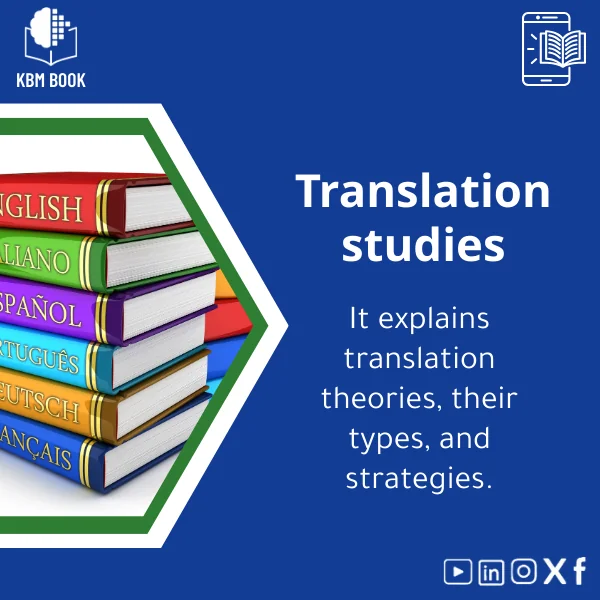
Translation Studies Guide: Theories, Types, and Strategies
Original price was: 179.00 $.139.00 $Current price is: 139.00 $.
A structured, searchable Knowledge Base Module (KBM) that organizes translation theories, classification of translation types, and practical translation strategies into a step-by-step reference — designed for students, researchers, and professionals who need fast, reliable access to translation studies knowledge.
Key benefits & value for the buyer
From theory to practice — structured for immediate use
This translation studies KBM converts scattered academic material into a coherent, hierarchical database. Instead of flipping through dense texts, you get:
- Clear definitions of core translation theories (e.g., literalism, dynamic equivalence, functionalist approaches) with cross-linked examples.
- Precise classification of translation types (technical, literary, audiovisual, machine post-editing), each with strategy checklists.
- Actionable strategies and annotated examples that you can apply to in-class assignments, research coding, or client projects.
- Time savings: quick search and export capabilities let you integrate verified content into theses, glossaries, or training modules.
Result: less time spent reconciling sources, more time applying methods and producing accurate translations or research outputs.
Use cases & real-life scenarios
Student preparing for exams or assignments
Use the KBM to generate concise study sheets: search “skopos theory” to get definitions, principal authors, classroom examples, and exam-style comparisons with equivalence theories.
Researcher building a literature review
Extract categorized bibliographic entries and summaries to populate your literature matrix. The KBM’s export features speed up citation management and thematic coding.
Professional translator or project manager
Apply the “strategy checklist” per text type: check pre-translation risk points, select techniques (e.g., transposition, explicitation), and produce consistent client glossaries.
Instructor designing a syllabus
Create modular lessons from KBM nodes: lecture notes, recommended readings, in-class activities, and assessment rubrics — all organized hierarchically for progressive learning.
Who is this product for?
This KBM is specifically built for the target audience: students, researchers, and professionals who need structured, reliable information on translation studies. It is ideal for:
- Undergraduate and graduate students studying translation studies or applied linguistics.
- Academic researchers conducting comparative theory work or building corpora.
- Professional translators, editors, and localization managers needing consistent strategies and checklists.
- Trainers and educators developing courses or professional development workshops.
How to choose the right KBM format
Not all digital knowledge products fit every workflow. Choose based on how you plan to use the content:
- Read-only reference: Use the HTML/interactive viewer when you need fast lookup on-screen.
- Integration with notes or LMS: Download CSV/Excel or Markdown exports to import into your note-taking app or course platform.
- Research & citation: Use the bibliography export and structured node metadata for accurate referencing (APA/MLA entries included).
- Collaboration: Export to shared spreadsheets for team glossaries and project handoffs.
Quick comparison with typical alternatives
KBM vs. Traditional books
Books give depth but are linear. The KBM gives the same verified concepts organized for search, extraction, and reuse — faster for applied work.
KBM vs. Journal articles
Articles are specific and technical; the KBM synthesizes multiple sources into cohesive nodes, saving you hours when compiling a review or building a syllabus.
KBM vs. Video courses
Videos are great for demonstrations but poor for rapid lookup and citation. The KBM complements courses by providing a reusable, text-based knowledge structure.
Best practices & tips to get maximum value
- Start with the taxonomy view to understand the hierarchical structure; use that as your syllabus backbone.
- Export the glossary and merge it with your project-specific terminology list before starting translation work.
- Reference the annotated examples when deciding on a strategy for a given text type — they are curated to highlight typical challenges.
- Regularly sync exported data with your citation manager to keep bibliographies consistent across projects.
Common mistakes when buying/using similar products and how to avoid them
- Mistake: Buying a resource that is too theoretical or too narrow. Fix: Choose a KBM that balances theory and practice — this product does both.
- Mistake: Failing to check export formats. Fix: Confirm compatibility with your tools (CSV, Markdown, Excel provided).
- Mistake: Using unverified online notes. Fix: Use curated KBMs with source references and annotated bibliographies.
Product specifications
- Product type: Knowledge Base Module (KBM) — Translation Studies
- Contents: 120+ hierarchical nodes (theories, types, strategies), 40+ annotated examples, curated bibliography
- Formats: Interactive HTML viewer, CSV/Excel export, Markdown export, printable PDF summary
- Language: English (with selected Arabic labels where relevant)
- License: Single-user commercial & academic license (details provided at purchase)
- Update frequency: periodic content reviews and updates; update notices included with purchase
- Usage notes: Designed for academic and professional use; citation-ready entries included
Frequently asked questions
Is this KBM suitable for beginners in translation studies?
Yes. The module is structured hierarchically, starting with fundamental concepts and building to advanced theories. Each node includes a simple definition, key readings, and practical examples to bridge theory and practice.
What file formats are included and can I export to my own tools?
The KBM includes an interactive HTML viewer and export options (CSV/Excel and Markdown). These formats are designed for import into note-taking apps, LMS platforms, and citation managers.
How current and reliable are the sources?
Content is curated from authoritative sources and peer-reviewed literature in translation studies. Each node includes references and suggested readings so you can verify and extend research. The KBM is periodically reviewed and updated.
What if the KBM doesn’t match my curriculum or project?
The KBM is modular and exportable; you can extract the nodes relevant to your curriculum or project and reorganize them. If you have specific needs, check the export options — they are designed for custom integration.
What is the refund or support policy?
Support documentation and a sample preview are available before purchase. If you encounter issues, customer support will assist with format compatibility and downloads. Full refund policies are provided at checkout.
Ready to build a reliable translation studies reference?
Download a professionally structured KBM that turns translation theories into usable knowledge. Perfect for assignments, research, and professional projects.
Instant delivery. Exportable formats. Citation-ready bibliographies. Start using it today to save time and improve accuracy in your translation work.
Related products
Astronomy Observational Techniques Guide for Celestial Motion
Atomic Physics Guide: Understanding Atomic and Electron Properties
Knowledge Base — Atomic/Electron Properties & Electromagnetic Interactions. A structured, searchable KBM for students, researchers, and professionals who need an authoritative atomic physics reference that organizes concepts, formulas, experiments, and practical applications from basics of atomic physics to advanced electron properties.
Classical Mechanics Guide: Newton’s Laws and Dynamics
A searchable, hierarchical Knowledge Base Module (KBM) that turns classical mechanics into a practical, ready-to-use reference for fast problem solving, lecture preparation, and applied engineering. Designed for students, researchers, and professionals who need precise access to Newton’s laws, rotational motion, and applied dynamics without the noise of textbooks.
Comprehensive Microbiology Book on Bacteria, Viruses, and Fungi
General and Special Relativity Book on Einstein’s Theory
A structured, searchable Knowledge Base Module (KBM) that converts Einstein's General and Special Relativity into a clear, hierarchical reference: formulas, derivations, worked examples, practical applications (GPS, astrophysics), and a compact research bibliography — ready to download and integrate into study, teaching, or research workflows.
Reviews
Clear filtersThere are no reviews yet.