


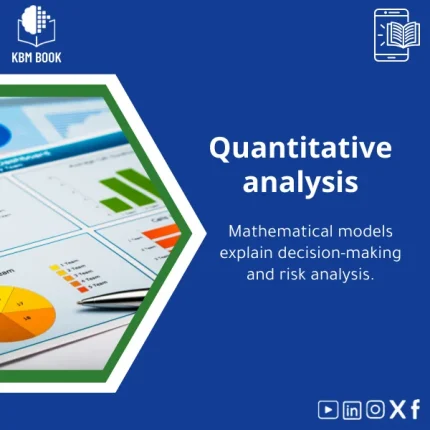
Quantitative Analysis Guide for Decision Models and Risk Management
Original price was: 349.00 $.279.00 $Current price is: 279.00 $.
A structured, hierarchical KBM for mastering Quantitative Analysis: step-by-step decision models, practical risk analysis frameworks, and searchable data modules built for students, researchers, and professionals who need reliable, reusable knowledge fast.
Key benefits & value for buyers
This Quantitative Analysis KBM converts complex theory into immediately usable assets. Instead of reading a long, unstructured textbook, you get:
- Fast access: Indexed modules for formulas, assumptions, and stepwise procedures—reduce search time from hours to minutes.
- Actionable outputs: Ready-to-run spreadsheets and example datasets that bridge theory to applied analysis.
- Teaching-ready content: Slide outlines, exercise sets, and grading rubrics for instructors and trainers.
- Transparent quality: Each module lists sources, validation cases, and recommended parameter ranges to avoid misuse.
Result: faster learning, fewer mistakes in model setup, and a repeatable framework for decision support and risk management.
Use cases & real-life scenarios
Academic study and coursework
Students use the KBM as a practical “quantitative analysis book” replacement: follow a module to implement a Markov decision process, run simulations on included datasets, and submit reproducible reports aligned with exam requirements.
Research and reproducible results
Researchers assemble model components from the KBM to build experiments, cite the KBM’s validation notes, and share exact datasets and code snippets to accelerate peer review and replication.
Professional decision support
Analysts and risk managers deploy the decision models and sensitivity tables during project scoping, portfolio optimization, and regulatory risk assessments—saving time on model construction and documentation.
Teaching and corporate training
Trainers use the modular structure to create short courses: from a one-hour primer on probability distributions to a multi-day workshop on stochastic optimization and Monte Carlo risk analysis.
Who is this product for?
Designed for the target audience—students, researchers, and professionals—this KBM suits:
- Undergraduate and graduate students seeking a concise, practical data analytics textbook alternative.
- Academic researchers who need reproducible decision models and transparent risk analyses.
- Business analysts, risk officers, and consultants who require reusable templates for quantitative decision making.
- Instructors and corporate trainers assembling structured lesson plans quickly.
How to choose the right version
Available editions are tailored to experience and use-case. Choose based on depth and file formats:
- Introductory Edition — Concept maps, essential formulas, and worked examples (best for undergraduate courses).
- Applied Edition — Full datasets, runnable spreadsheets, and model templates (ideal for practitioners and masters students).
- Professional Edition — Extended case studies, API-ready JSON modules, and training slides (designed for consultants and instructors).
Pick the edition that matches your workflow: lightweight study vs. deployable models vs. classroom-ready material.
Quick comparison with typical alternatives
Compared to traditional books and scattered online articles, this KBM offers:
- Higher utility: Downloadable, editable model files vs. static text in a book.
- Structured taxonomy: Hierarchical modules reduce duplication and make cross-topic navigation easier than unlinked chapters.
- Practical reproducibility: Datasets and templates included—no hours spent reconstructing examples from descriptions.
If your priority is applied work and quick retrieval of trustworthy models, the KBM approach delivers a better ROI than purely narrative textbooks.
Best practices & tips to get maximum value
- Start with the concept map to identify which modules you need—this avoids overwhelming breadth.
- Run the included sample datasets end-to-end before changing parameters—verify assumptions and units first.
- Use the JSON/CSV exports to integrate KBM modules into your analysis pipelines or learning management systems.
- Keep a changelog when you adapt models for projects; the KBM lists recommended validation checks for each adaptation.
Common mistakes when buying/using similar products and how to avoid them
- Buying a generic textbook expecting templates: Look for downloadable modules and runnable examples—this KBM includes both.
- Ignoring assumptions: Every model in the KBM has a dedicated assumptions block—review it before applying.
- Skipping validation: Use the provided validation cases to confirm behaviour before trusting outputs.
- No integration plan: Decide whether you need CSV, JSON, or PDF exports ahead of purchase; choose the edition that matches your ecosystem.
Product specifications
- Format: Digital download — PDF outlines, CSV datasets, JSON modules, XLSX templates
- Structure: Hierarchical KBM with 10+ main modules and 60+ submodules (concepts, formulas, examples, exercises)
- Content length: Equivalent of a 400–600 page textbook, reorganized into searchable modules
- Licensing: Single-user license (commercial use allowed for internal projects). Team and academic licenses available.
- Prerequisites: Basic probability, linear algebra, and familiarity with spreadsheets or a scripting language (Python/R)
- Delivery: Instant download after purchase; update notifications for significant revisions
Frequently asked questions
Is this a textbook or a software package?
It is a Knowledge Base Module (KBM): a structured digital resource combining textbook-like explanations with downloadable model files and datasets—not a compiled software package. You get editable templates and documentation to use in your tools.
Will the modules work with Python/R or only spreadsheets?
Modules include CSV and JSON exports for use with Python and R, plus XLSX templates for spreadsheet workflows. Code snippets and pseudocode are provided to help integrate models into scripts.
How often are updates released?
Minor corrections and clarifications are released quarterly; significant methodological updates are published with a changelog and update package. Buyers receive update notifications.
Is there a refund policy if it doesn’t meet my needs?
Yes — KBMBook offers a 14-day refund policy if the product is unused and you can show it does not match the published descriptions. Contact support for details.
Can I use the content in my courses or consulting deliverables?
Yes, the standard license permits internal and educational use. For resale, redistribution, or embedding into commercial products distributed externally, contact sales for an extended license.
Ready to speed up your quantitative decision making?
Get a searchable, reproducible KBM that replaces scattered notes, messy spreadsheets, and incomplete examples. Save hours in project setup and make decisions with documented, tested models.
Instant download — includes sample module preview so you can verify the structure before working through a full case study.
Related products
Atomic Physics Guide: Understanding Atomic and Electron Properties
Knowledge Base — Atomic/Electron Properties & Electromagnetic Interactions. A structured, searchable KBM for students, researchers, and professionals who need an authoritative atomic physics reference that organizes concepts, formulas, experiments, and practical applications from basics of atomic physics to advanced electron properties.


Reviews
Clear filtersThere are no reviews yet.