


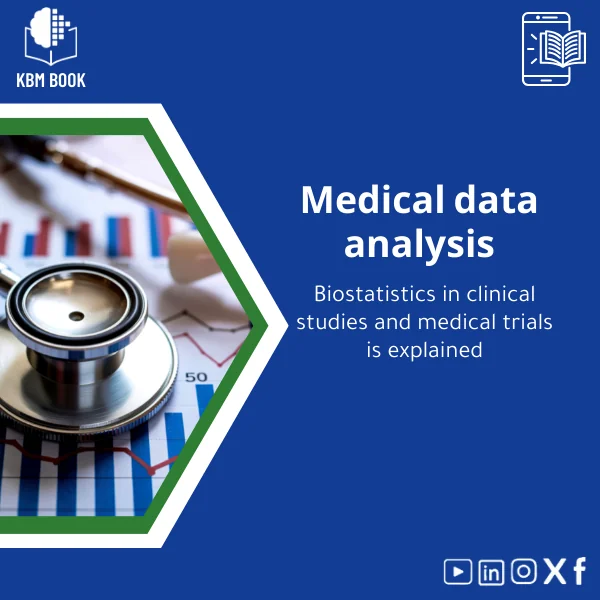
Medical Data Analysis Guide for Biostatistics in Clinical Trials
Original price was: 349.00 $.279.00 $Current price is: 279.00 $.
A structured, searchable Knowledge Base Module (KBM) that converts core biostatistics for clinical trials into a step-by-step, practical reference for Medical Data Analysis — from design and data cleaning to advanced trial-level inference and reporting.
Key benefits & value for buyers
The Medical Data Analysis KBM translates complex biostatistics in clinical studies into an organized, practical library. Each feature is designed to produce measurable time savings and reduce risk in decision-making:
- Faster problem solving: hierarchical topics let you jump from protocol questions (sample size, randomization) to analysis code or interpretation without reading whole chapters.
- Reproducible outputs: built-in templates for tables, figures, and statistical summaries reduce errors during report generation.
- Contextual learning: every method includes when-to-use guidance, assumptions checklist, and common pitfalls tied to clinical-trial examples.
- Cross-disciplinary readiness: content bridges clinical insight and data science — helpful for statisticians, clinicians, regulatory writers, and data managers.
Use cases & real-life scenarios
1. Student writing a thesis
Follow the “Design → Analysis → Reporting” module: pick the appropriate sample size formula, apply the stepwise data cleaning checklist, and use the reporting template for your results section. The KBM reduces the time needed to validate methods and format outputs.
2. Research team preparing a protocol
Use the protocol-ready subsections to select primary endpoints, specify multiplicity adjustments, and generate a skeleton statistical analysis plan (SAP) you can adapt and export.
3. Clinical data manager handling trial datasets
Apply data validation rules, missing-data strategies, and pre-written code snippets to inspect and prepare datasets for analysis, shortening handoffs and reducing queries.
4. Professional conducting medical trial data analysis
When a regulatory question arises, locate the exact method, assumptions, and reporting conventions used in similar trial types to craft defensible analyses and responses quickly.
Who is this product for?
This KBM is built for students, researchers, and professionals who need authoritative, searchable guidance on medical trial data. Typical users:
- Graduate students in biostatistics, epidemiology, or clinical research.
- Clinical trial statisticians and data scientists needing rapid access to methods and templates.
- Medical writers and regulatory specialists preparing analysis sections and responses.
- Trainers and educators building practical curricula on biostatistics in clinical studies.
How to choose the right KBM level
The KBM is modular. Choose based on your role and experience:
- Beginner: follow the “Core Concepts” modules — hypothesis testing basics, common distributions, simple regression, and introductory survival analysis.
- Intermediate: include “Applied Trial Methods” — handling missing data, ANCOVA, repeated measures, and safety summaries.
- Advanced: add “Advanced Inference” — multiplicity correction, mixed models, Bayesian approaches, and non-inferiority testing.
You can purchase the full KBM or select modules to match your immediate needs and budget.
Quick comparison with typical alternatives
How this KBM differs from textbooks, online articles, or classroom courses:
- Textbooks: deep but linear — the KBM is non-linear and searchable, with templates and code ready to use.
- Online articles: scattered and variable quality — the KBM consolidates validated methods with references and usage notes.
- Courses: teach concepts but often lack reusable templates — the KBM focuses on reusable, practical artifacts you can apply immediately.
Best practices & tips to get maximum value
- Start with the “Study Design & SAP” checklist before you open datasets — prevents wasted work and post-hoc changes.
- Use the built-in variable index and naming conventions to standardize datasets across studies.
- Adopt the reporting templates to ensure consistency between interim and final analyses.
- Leverage the code snippets as pseudo-code templates; adapt to your software stack (R/Python/SAS).
Common mistakes when buying or using similar products — and how to avoid them
- Buying a generic text: avoid resources that do not map methods to trial-specific decisions. Choose a KBM with trial-context examples.
- Over-reliance on code snippets: snippets are starting points; always validate with your data and document assumptions.
- Ignoring updates: statistical practice evolves — select KBMs with clear versioning and update notes.
Product specifications
- Format: downloadable interactive KBM (PDF index + JSON/XML/CSV module exports + HTML viewer)
- Modules: Core Concepts, Study Design, Data Management, Statistical Methods, Reporting Templates, Advanced Methods
- Approximate size: 150–250 pages of structured content equivalent, plus code snippets and templates
- Compatibility: platform-agnostic (view in browser or import data sections into standard tools)
- Included assets: variable index, SAP and report templates, example datasets (synthetic), code pseudo-examples
- License: personal and institutional licensing options (see purchase page for terms)
- Language: English (structured for global clinical research standards)
FAQ
Is this a “medical data analysis book” or an interactive database?
It is a Knowledge Base Module — a structured, searchable database designed to function like a practical book but optimized for quick lookup, reuse, and export of templates and code. You get both readable content and machine-friendly modules.
Does the KBM cover regulatory guidance and reporting conventions?
Yes. The KBM includes sections that map analysis and reporting practices to common regulatory expectations, with references and example report fragments you can adapt.
What software knowledge is required to use code snippets?
Snippets are provided as clear pseudo-code and short examples for R, Python, and SAS-style notation. Basic familiarity with your analysis environment is sufficient; the KBM emphasizes conceptual steps and practical checks over complex scripting.
How do I know this covers “biostatistics in clinical studies” relevant to my field?
The KBM organizes methods by trial type (e.g., parallel RCTs, crossover designs, survival endpoints). Review the module list and sample index (available in the preview) to confirm coverage for your specific designs.
Ready to speed up your medical trial data analysis?
Download a structured guide that turns biostatistics in clinical studies into actionable templates and searchable knowledge. Get immediate access and start applying best-practice analyses to your next study.
Prefer to preview before purchasing? A sample module and table of contents are available on the product page.
Related products

Astronomy Observational Techniques Guide for Celestial Motion

Cell Biology Guide: Structure, Division, and Transport Insights

Comprehensive Microbiology Book on Bacteria, Viruses, and Fungi

Materials Physics Guide: Understanding Solid-State Properties

Molecular Biology Guide: Transcription, Translation & Repair

Organic Chemistry Guide: Carbon Chains and Reactions

Thermal Physics Guide: Understanding Heat, Energy, and Entropy
A downloadable, hierarchically structured Knowledge Base Module (KBM) that converts university-level thermodynamics into a searchable, practical digital database. Ideal for students, researchers, and professionals who need fast, reliable access to fundamentals and advanced topics in thermal physics.

Reviews
Clear filtersThere are no reviews yet.