


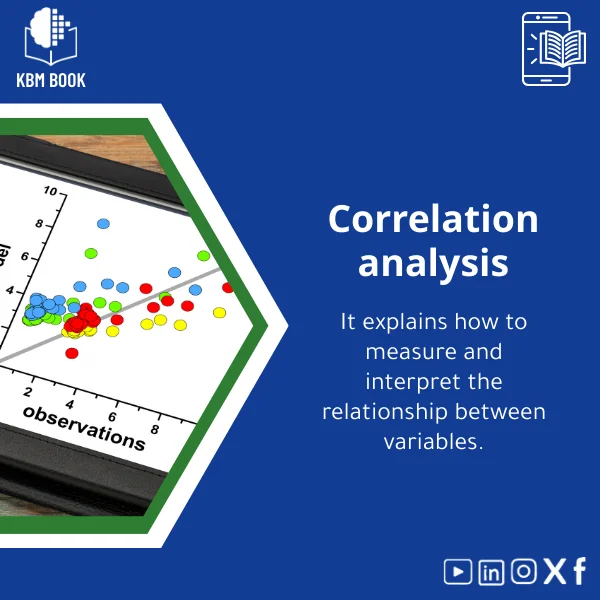
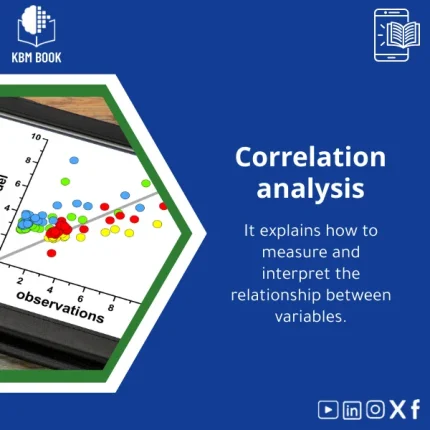
Correlation Analysis Guide for Measuring Variable Relationships
Original price was: 179.00 $.139.00 $Current price is: 139.00 $.
A compact, structured Knowledge Base Module (KBM) that transforms statistical correlation analysis into a searchable, step-by-step resource — from concept and formulas to reproducible correlation analysis examples and ready-to-use templates.
Key benefits & value for the buyer
Correlation Analysis is more than a formula set — it’s a way to turn raw variables into actionable insight. This KBM translates statistical correlation analysis into a concise, navigable knowledge base so you can:
- Save time: Replace scattered notes, lecture slides, and forum answers with one reusable source that covers assumptions, computation, interpretation, and reporting.
- Increase accuracy: Reduce mistakes with checklists for assumptions (linearity, normality, outliers), calculation steps for Pearson/Spearman/Kendall, and guidance on effect size vs. significance.
- Boost reproducibility: Use included correlation analysis examples and code snippets to reproduce results in R, Python (pandas/scipy), or SPSS.
- Teach and scale: Use the hierarchical structure to build lectures, lab exercises, or professional reports without rewriting core content.
Use cases & real-life scenarios
1. Academic research and theses
Quickly verify assumptions, select the correct correlation coefficient, and include reproducible code blocks and figures for your methods chapter. The KBM contains a full correlation analysis example: comparing survey-measured job satisfaction and performance metrics, including sample code and interpretation text for the results section.
2. Data science & exploratory analysis
Use the KBM to generate correlation matrices, handle missing data, and interpret multicollinearity before modeling. The module includes best-practice snippets for computing partial correlations and visualizing results with heatmaps.
3. Teaching & training
Trainers get reproducible slides and student exercises. Each topic is modular so you can extract a correlation analysis pdf for classroom handouts or build step-by-step labs.
Who is this product for?
This KBM is designed for students, researchers, and professionals who need reliable, well-organized material on correlation analysis — especially:
- Undergraduate and graduate students preparing reports or exams.
- Researchers writing methods and results sections requiring clear statistical explanation.
- Analysts and consultants who need quick, defensible correlations and visualizations for client deliverables.
- Instructors and trainers building hands-on statistical labs.
How to choose the right KBM for your needs
When evaluating this Correlation Analysis KBM, consider:
- Depth required: Choose this KBM if you need both conceptual explanations and practical, reproducible examples (not just a high-level summary).
- Format needs: If you need offline reference, the included correlation analysis pdf provides portable documentation. If you need code, ensure you select the package variant that includes R/Python snippets.
- Integration: This KBM is built to be copied into learning management systems or data repositories — verify the download package includes plain-text and structured files for easy integration.
Quick comparison with typical alternatives
Alternatives include textbooks, scattered online articles, or single-sample tutorials. Compared to those:
- Textbooks: More concise and directly actionable; no long chapters to wade through for simple tasks.
- Articles & blogs: Often incomplete or inconsistent; KBM provides a systematic, non-redundant structure covering all common scenarios.
- One-off scripts: Scripts may compute correlations but lack interpretation and assumption checks — this KBM includes both computation and reporting guidance.
Best practices & tips to get maximum value
- Start with the assumptions checklist before calculating coefficients; use the KBM’s quick diagnostic flow to choose Pearson vs. Spearman.
- Run the provided correlation analysis example on your dataset first to validate the workflow.
- Use the KBM’s template text for results and methods to speed up writing reproducible reports.
- Save the correlation analysis pdf locally and link it in your project documentation for consistent reporting standards.
Common mistakes when using correlation analysis and how to avoid them
- Confusing correlation with causation: The KBM includes a short decision flow to help you present findings responsibly.
- Ignoring assumptions: Use the KBM’s diagnostic checklist; many false positives come from non-linearity or outliers.
- Over-reliance on p-values: The module explains effect sizes, confidence intervals, and practical significance.
- Poor reproducibility: Follow the included code snippets and file organization template to make results reproducible.
Product specifications
- Format: Downloadable KBM bundle (searchable HTML index) + correlation analysis PDF
- Includes: Step-by-step guides, assumption checklists, correlation analysis example with sample data, R & Python scripts, visualization templates
- Language: English
- Compatibility: Any modern browser for HTML; scripts compatible with R 4.x and Python 3.8+ (pandas, scipy)
- Delivery: Instant digital download after purchase
- License: Single-user commercial and academic use (see license terms in package)
- Updates: Minor updates included for 12 months; major updates available at a discounted rate
- Support: Email support for installation and basic usage questions
FAQ
Is this KBM suitable for beginners learning correlation analysis for the first time?
Yes. The module is layered: the first section explains core concepts and visual intuition, while later sections progress to technical details and reproducible examples. Beginners can follow the guided examples; advanced users can jump to scripts and reporting templates.
Does the package include a correlation analysis pdf I can print or share?
Yes. The KBM bundle includes a downloadable correlation analysis pdf summarizing methods, formulas, assumptions, and a concise correlation analysis example ideal for handouts or appendices.
Will the scripts work with my dataset?
Scripts are written for general datasets with common formats (CSV, Excel). The KBM includes instructions for handling missing values, variable transformations, and reshaping data. If you have a specialized format, email support will advise on integration steps.
What if I need to use the KBM for a classroom or multiple users?
The standard license is for single-user commercial and academic use. If you need multi-user or institutional licensing, contact our support for volume pricing and site-license options.
Ready to accelerate your statistical workflow?
Get the Correlation Analysis KBM and replace fragmented notes with a systematic, reproducible resource. Perfect for writing methods, running exploratory data analysis, and training students.
Instant download. Includes PDF, code examples, and 12 months of minor updates. Secure checkout and email support to get you started.
Related products
Analytical Chemistry Book: Qualitative and Quantitative Methods Guide
Astronomy Observational Techniques Guide for Celestial Motion

Atomic Physics Guide: Understanding Atomic and Electron Properties
Knowledge Base — Atomic/Electron Properties & Electromagnetic Interactions. A structured, searchable KBM for students, researchers, and professionals who need an authoritative atomic physics reference that organizes concepts, formulas, experiments, and practical applications from basics of atomic physics to advanced electron properties.

Classical Mechanics Guide: Newton’s Laws and Dynamics
A searchable, hierarchical Knowledge Base Module (KBM) that turns classical mechanics into a practical, ready-to-use reference for fast problem solving, lecture preparation, and applied engineering. Designed for students, researchers, and professionals who need precise access to Newton’s laws, rotational motion, and applied dynamics without the noise of textbooks.
Comprehensive Microbiology Book on Bacteria, Viruses, and Fungi
Introductory General Chemistry Book on Matter and Reactions
A structured, searchable Knowledge Base Module (KBM) that converts core general chemistry concepts — matter, elements, reactions, stoichiometry and molarity — into a hierarchical reference you can query, teach from, or integrate into study workflows. Ideal as a concise General Chemistry book alternative for students, researchers, and professionals who need accurate, practical chemistry knowledge fast.
Reviews
Clear filtersThere are no reviews yet.