


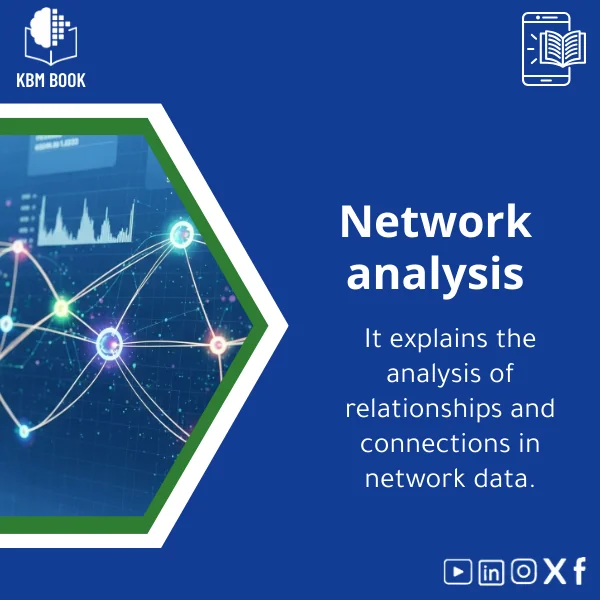
Network Analysis Guide for Data Link and Relationship Insights
Original price was: 199.00 $.159.00 $Current price is: 159.00 $.
A structured, searchable knowledge base module for network analysis: methods, metrics, workflows and ready-to-use data schemas that let students, researchers and professionals find reliable answers about links and relationships in network data—fast.
Key benefits & value for the buyer
This KBM translates the abstract concepts of network analysis into a compact, navigable knowledge database. Rather than reading scattered articles or a long textbook, you get:
- Faster decision-making: Lookup guidance for selecting similarity measures, choosing centrality metrics, or deciding on a community detection algorithm in seconds.
- Reproducible workflows: Step-by-step pipelines with sample code and data schemas so you can reproduce analyses or adapt them to your datasets.
- Cross-disciplinary coverage: Examples and notes tailored to social networks, bibliometrics (co-authorship), cyber-security graphs, and marketing referral networks.
- Compact learning path: A structured “introduction to network analysis” that progresses to advanced topics without unnecessary repetition.
- Searchable knowledge: Built-in index and JSON schemas make it easy to extract specific rules, formulae, or implementation tips programmatically.
Use cases & real-life scenarios
Student research project
A graduate student mapping co-authorship patterns uses the KBM to identify relevant centrality measures and a reproducible pipeline to extract a co-author network from Scopus exports—saving weeks of trial and error.
Academic researcher
A researcher investigating information diffusion uses the module’s temporal network section and ready-made metrics to compare diffusion speed across simulation variants, with clear instructions for converting event logs into edge lists.
Data scientist or analyst
A marketing analyst evaluates a referral campaign by transforming CRM events into a directed graph and applying link prediction templates from the KBM to forecast high-value referral paths.
Security analyst
Incident response teams use the KBM’s attack-graph patterns and visualization tips to prioritize nodes for containment and to document findings in a structured format for audits.
Who is this product for?
This KBM is designed for:
- Students learning network theory and looking for an applied “introduction to network analysis”.
- Researchers requiring a reliable reference for network metrics and reproducible methods.
- Professionals and analysts who need quick, operational guidance for working with network data relationships in business, security, and science.
- Trainers and instructors who want a structured syllabus and examples to build course material.
How to choose the right KBM for your needs
When selecting a network analysis KBM, consider:
- Depth vs. breadth: This module balances both: foundational topics are concise while advanced sections provide practical templates.
- Formats you need: If you need a printable reference, the searchable PDF is ready; if you need programmatic access, use the JSON and CSV artifacts.
- Update policy and support: KBMbook provides version notes and patch updates—choose modules with recent updates if you work with evolving libraries.
- Integration: Check compatibility with your tools (NetworkX, igraph, Gephi). This KBM includes code snippets for common environments.
Quick comparison with typical alternatives
Consider three typical options and why the KBM format is often better for quick work:
- Textbook: Deep but linear and slow to search. The KBM is modular and searchable for targeted lookups.
- Research papers: Highly specific but fragmented. The KBM synthesizes methods across papers with reproducible steps.
- Software docs: Practical but tool-specific. The KBM is tool-agnostic, offering conceptual clarity plus example code for multiple toolchains.
Best practices & tips to get maximum value
- Start with the module’s “needs analysis” checklist to map your research question to the right metrics.
- Use the sample datasets to validate the pipeline before applying it to your production data.
- Export the JSON schema to integrate KBM entries into your internal knowledge system or lab notebooks.
- Annotate any changes you make to pipelines in your project repository; the KBM’s structured format makes tracking easier.
Common mistakes when buying or using network analysis resources—and how to avoid them
- Mistake: Buying a single-format PDF that can’t be reused in code.
Fix: Choose a KBM that includes JSON/CSV and sample scripts (this product does). - Mistake: Confusing metric names or misapplying centrality measures.
Fix: Use the decision-table in the module to match metric to question. - Mistake: Skipping data cleaning for network construction.
Fix: Follow the KBM’s preprocessing checklist to avoid analysis errors.
Product specifications
- Format: Searchable PDF; structured JSON index; CSV sample datasets; code snippets (Python & R)
- Size & scope: ~220 KBM entries organized in hierarchical modules (Fundamentals → Metrics → Methods → Applications)
- Languages: English (primary), with explanatory notes referencing Arabic terminology where relevant
- Usage: Instant download after purchase; commercial and academic use permitted under a single-user license (see license notes)
- Compatibility: Importable to common knowledge tools, notebooks and data analysis environments
- Updates: Minor updates included for 12 months; major version upgrades optional
FAQ
Is this a replacement for a network analysis book?
No—this KBM is intentionally different. It combines the structured depth of a book with modular, searchable entries and practical artifacts (data, code). If you want a narrative textbook, pair this KBM with a textbook; if you want quick implementation and reference, the KBM is superior.
Can I download the network analysis PDF and use it offline?
Yes. The product includes a searchable PDF optimized for offline reading and printing, plus JSON and CSV files for programmatic use.
Will the KBM work with NetworkX / igraph / Gephi?
Yes. The KBM provides example code and export formats that are compatible with NetworkX (Python), igraph (Python/R), and CSV imports for Gephi. Implementation notes help you adapt snippets to your environment.
What if I need updates or further support?
Minor updates are included for 12 months. For consulting, training packs or multi-user licenses, KBMBook offers paid add-ons—contact support through your account after purchase.
Ready to make network data relationships usable and repeatable?
Purchase the KBM and get immediate access to a structured network analysis knowledge base that saves research time and reduces implementation risk. The module includes step-by-step pipelines, sample data, and multiple export formats so you can start building confidently today.
Related products

Analytical Chemistry Book: Qualitative and Quantitative Methods Guide

Biological Anthropology Study Guide on Human Evolution

Comprehensive Botany Book on Plant Taxonomy and Photosynthesis
A structured, searchable botany book designed as a Knowledge Base Module (KBM) — an end-to-end reference on plant taxonomy, organ structure, and the biochemistry of photosynthesis. Built for students, researchers, and professionals who need reliable, hierarchical knowledge they can search, cite, and apply immediately.

Cosmology Book: Guide to Big Bang and Galaxy Evolution

Inorganic Chemistry Guide: Bonding and Crystal Solids
A structured, searchable Knowledge Base Module (KBM) that converts inorganic chemistry fundamentals and advanced topics—bonding models, lattice structures, defects, and solid-state properties—into a practical digital reference for students, researchers, and professionals who need fast, reliable answers without wading through textbooks.

Molecular Biology Guide: Transcription, Translation & Repair

Organic Chemistry Guide: Carbon Chains and Reactions

Physical Chemistry Guide: Energy, Thermodynamics & Interactions
A structured Knowledge Base Module (KBM) for Physical Chemistry that converts core theory, worked examples, and applied datasets into a searchable, hierarchical database — ideal for students, researchers, and professionals who need fast, reliable access to chemical thermodynamics basics and molecular interaction models.
Reviews
Clear filtersThere are no reviews yet.