


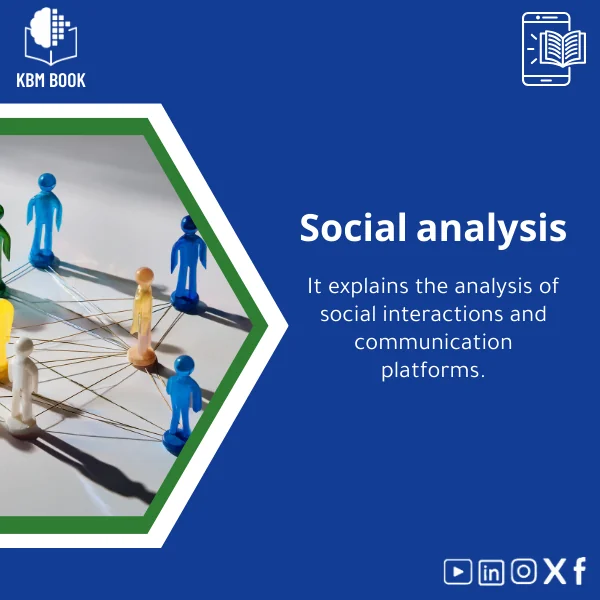
Social Analytics Guide for Analyzing Online Interactions
Original price was: 179.00 $.139.00 $Current price is: 139.00 $.
A practical, hierarchical knowledge base module (KBM) that turns social analytics into a ready-to-use research and workflow toolkit — complete templates, analysis forms, and checklists to speed reliable insight from online interactions.
Key benefits & value for the buyer
This KBM translates “social analytics” from abstract methods into concrete instruments you can apply immediately. Each feature maps to a buyer benefit:
- Structured templates: Reduce setup time — templates enforce consistent data capture for reproducible analysis.
- Analysis forms: The included social interaction analysis form standardizes coding of replies, tone, and network roles for reliable comparisons.
- Actionable checklists: A social media analytics checklist ensures nothing is missed during audits and campaign evaluations.
- Multi-format delivery: Use Excel for quick pivots, Google Sheets for collaboration, or JSON for integration with analysis tools.
- Learning scaffold: Hierarchical content guides novices to advanced metrics without fluff — great for classrooms and onboarding.
Use cases & real-life scenarios
Academic research
Students and researchers can use the KBM to code discussion forums, analyze discourse change over time, or extract features for network analysis. Example: a study on misinformation can use the template’s sentiment and source-veracity fields to create a clean dataset for statistical modeling.
Marketing & community management
Marketers can audit campaign conversations using the social media analytics checklist and map engagement types (questions, praise, complaints). Example: run weekly scans of campaign hashtags, export pivot tables, and produce slide-ready charts directly from the template.
UX & product teams
Product teams tracking feature requests across channels can use the social interaction analysis form to tag mentions and prioritize issues by frequency and sentiment.
Who is this product for?
Designed for students, researchers, and professionals who value structured, repeatable workflows:
- Graduate students doing content or network analysis.
- Research labs needing standardized coding protocols.
- Marketing analysts and social media managers requiring reliable audits and reports.
- Consultants and trainers who convert qualitative interactions into measurable indicators.
How to choose the right format and granularity
Not every buyer needs every file type. Choose based on your workflow:
- Excel / Google Sheets: Best for manual coding, pivots, and quick visual reports.
- CSV / JSON: Use when integrating with Python/R, databases, or automation pipelines.
- Printable checklist & PDF guide: Ideal for classroom use or fieldwork where internet access is limited.
If you need cross-team collaboration, pick the Google Sheets version first; for reproducible computational analysis, prefer JSON/CSV.
Quick comparison with typical alternatives
Most alternatives are either textbooks (theory-heavy) or one-off spreadsheets (flat, undocumented). This KBM differs by combining:
- Hierarchical documentation (learn progressively)
- Interchangeable file formats (manual and automated workflows)
- Pre-tested coding schemas and checklists (reduces researcher bias and rework)
Best practices & tips to get maximum value
- Start with the checklist: run a small pilot on 50–100 interactions to validate coding categories.
- Use the provided pivot examples to build dashboards before scaling data collection.
- Document any local modifications to the social interaction analysis form to preserve reproducibility.
- Combine qualitative tags with quantitative measures (e.g., sentiment + reply time) to get richer insight.
- Back up modified templates and version them for multi-researcher projects.
Common mistakes when buying or using social analytics resources — and how to avoid them
- Buying a single spreadsheet: Avoid if you need reproducible workflows — choose multi-format KBM instead.
- Skipping pilot tests: Always run the social interaction analysis form on a sample to refine categories.
- Mixing undocumented changes: Keep a change log to avoid inconsistent datasets.
- Overfitting metrics: Use the checklist to limit KPIs to those that map to action or research questions.
Product specifications
- Formats included: Excel (.xlsx), Google Sheets (share-ready), CSV, JSON, PDF guide, printable checklist.
- Core modules: Data collection, coding schema (sentiment, topic, role), network mapping fields, reporting templates.
- Sample size guidance: templates include examples for 100–10,000 interaction records.
- Compatibility: Excel 2016+, Google Workspace, common analysis tools (R, Python import-ready CSV/JSON).
- Language: English (structured, technical terminology).
- Delivery: Digital download — immediate access after purchase.
- Usage notes: Editable templates; keep original files as master copies.
Frequently asked questions
Can I use this with R or Python for larger datasets?
Yes. The KBM includes CSV and JSON exports designed for seamless import into R and Python. Field names and documentation are consistent to minimize preprocessing time.
Is the coding schema customizable for different platforms (e.g., Reddit vs. Twitter)?
Absolutely. Modules explain how to adapt categories by platform (character limits, threading, community norms) and include recommended mappings for common social networks.
What if my team needs collaborative access?
Use the Google Sheets version included. It is configured for multi-user editing and includes an audit column to track who made changes and when.
How does this differ from a textbook or a research paper?
This KBM is action-oriented: instead of long theory chapters, you get structured templates, checklists, and example datasets so you can implement analytical workflows immediately.
Ready to start analyzing online interactions with a reliable, ready-made toolkit?
Download a structured social analytics template that scales from classroom exercises to team-level audits. The KBM delivers templates, forms, and checklists that save time and increase reproducibility.
Immediate digital download — includes Excel, Google Sheets, CSV/JSON, printable checklist, and documentation.
Related products

Analytical Chemistry Book: Qualitative and Quantitative Methods Guide

Astrophysics Book: Understanding Stars, Galaxies, and Dark Energy
A searchable, hierarchical Knowledge Base Module (KBM) that converts astrophysics and cosmology into a practical, exam-ready and research-ready reference. Designed for students, researchers, and professionals who need immediate access to reliable explanations, equations, and data models for stars, galaxies, and dark energy.

Cell Biology Guide: Structure, Division, and Transport Insights

Cosmology Book: Guide to Big Bang and Galaxy Evolution

General Biology Book: A Guide to Cells, Genetics & Taxonomy

General Physics Book: Fundamentals of Force, Motion, Energy

Modern Physics Book: Quantum, Relativity, and Tech Applications Guide
A structured, searchable Knowledge Base Module (KBM) that turns modern physics — quantum mechanics, special & general relativity, and contemporary technological applications — into a hierarchical, practical reference for students, researchers, and professionals who need quick, reliable access to advanced concepts and formulas.

Reviews
Clear filtersThere are no reviews yet.