


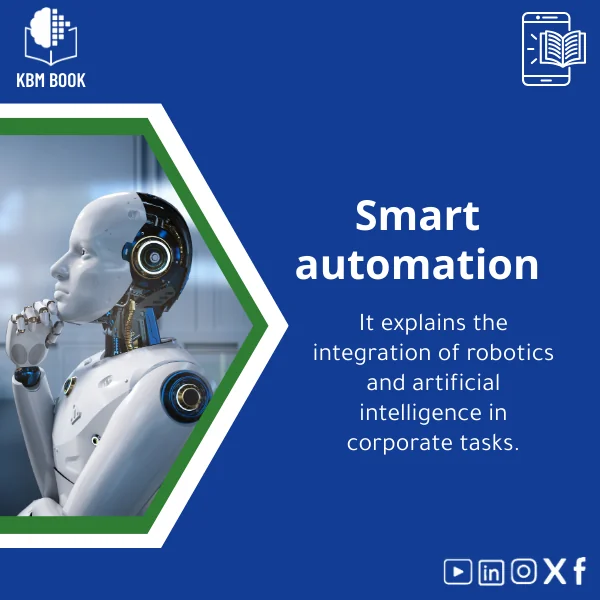
Intelligent Automation Guide for Robotics and AI Integration
Original price was: 179.00 $.139.00 $Current price is: 139.00 $.
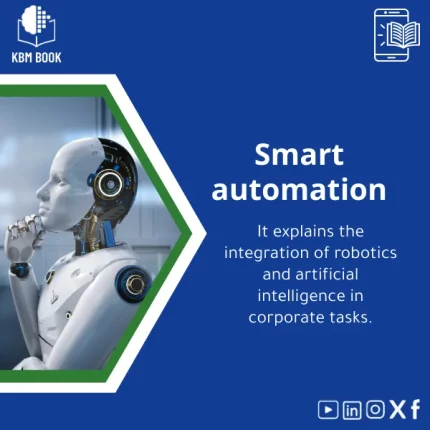
A structured Knowledge Base Module (KBM) that maps Intelligent Automation concepts, implementation patterns, and technical building blocks for integrating robotics and AI in enterprise workflows — designed for students, researchers, and professionals who need fast, reliable access to organized, actionable knowledge.
Key benefits & value for the buyer
The Intelligent Automation KBM translates complex, cross-disciplinary knowledge into searchable, reusable modules. Rather than a narrative book, you get a structured database organized into modular topics — each with concise definitions, implementation steps, code snippets, data schemas, decision trees, and validation tests.
What you gain
- Faster decision-making: Use taxonomy maps and prioritization matrices to select the right automation approach for a process in minutes, not weeks.
- Reduced implementation risk: Checklists and compatibility matrices reduce integration errors between RPA tools, AI models, and robot controllers.
- Reproducible designs: Blueprints and sample configurations let teams replicate proven patterns across projects.
- Learning acceleration: Students and researchers get a clear learning path from basics to advanced topics, including lab exercises and references.
Use cases & real-life scenarios
The KBM is organized around practical scenarios so you can locate applicable modules quickly.
Enterprise finance: automated invoice processing
Combine document understanding (OCR + NER), rule-based RPA for workflow orchestration, and a reconciliation AI model. The KBM includes data schemas for invoice line extraction, API stubs for ERP integration, and exception-handling decision trees — ready to adapt to your stack.
Warehouse automation: AI-guided picking robots
From perception models to fleet coordination, find sensor fusion patterns, simulation validation steps, and performance KPIs. The module includes example ROS topics, message formats, and test scripts that accelerate lab-to-floor trials.
Customer support: hybrid chat + robotic actions
Deploy conversational AI to capture intent and trigger backend RPA bots for account updates or order changes. The KBM provides integration examples with common ticketing systems and security considerations for automated actions.
Who is this product for?
This KBM is aimed at:
- Students and researchers who need structured, citable material and reproducible experiment setups.
- Systems architects and engineers planning RPA+AI projects and seeking integration blueprints.
- Product managers and consultants evaluating automation strategies with measurable ROI.
- Trainers and academic instructors building curricula on robotics and intelligent systems.
How to choose the right KBM edition
Editions are organized by depth and intended user role. Select based on your project scope and team size:
- Starter (Overview): High-level taxonomy, quick-checklists, and 3 core blueprints — best for students and early-stage feasibility.
- Professional (Implementation): Full blueprints, data schemas, API examples, and validation tests — recommended for practitioners and small teams.
- Enterprise (Integration + Governance): Extended compliance modules, enterprise connector templates, and governance playbooks for large deployments.
If you are unsure, choose the Professional edition; modules are interoperable and can be expanded later.
Quick comparison with typical alternatives
Compared with traditional books, online articles, or vendor documentation, the Intelligent Automation KBM offers:
- Structured searchability: Modular records to find a design pattern or schema quickly, unlike long narrative chapters.
- Interoperable assets: Machine-readable exports (CSV/JSON) and connector templates — not just prose.
- Neutral, cross-platform guidance: Implementation-agnostic patterns instead of vendor-locked how-tos.
Best practices & tips to get maximum value
- Start with the taxonomy map to align stakeholders on scope before diving into technical modules.
- Use the included validation tests early to define success criteria and KPIs (accuracy, throughput, MTTR).
- Prototype with the Starter blueprints in a sandbox; adapt schemas before integrating with production systems.
- Apply governance modules to manage model drift and access controls for automated actions.
Common mistakes when buying or using similar knowledge products — and how to avoid them
- Buying a generic guide: Avoid unstructured manuals; choose a KBM with explicit taxonomies and machine-readable assets.
- Skipping integration details: Ensure the KBM includes connector examples and data schemas to prevent integration delays.
- Ignoring validation: Use the KBM’s test plans to detect issues early rather than discovering them in production.
- Not budgeting for change management: Include training and governance modules from the KBM to increase adoption rates.
Product specifications
- Product type: Knowledge Base Module (KBM) — Intelligent Automation
- Formats included: Interactive JSON database, CSV exports, printable PDF summary, sample code snippets (Python, ROS, REST API examples)
- Language: English (primary); annotated references may include bilingual labels
- Delivery: Instant digital download after purchase
- License: Single-user with options for team and enterprise licenses (see checkout)
- Updates: 12 months of content updates and patch notes included for Professional & Enterprise editions
- Usage notes: Compatible with common RPA platforms, ROS-based robotics stacks, and standard ML frameworks (TensorFlow, PyTorch)
FAQ
Is this Intelligent Automation KBM suitable for academic research?
Yes. The KBM contains references, experiment setups, reproducible data schemas, and suggested metrics to support papers and lab work. Use the Starter edition for coursework and the Professional edition for reproducible experiments.
Will the modules work with my existing RPA or robotics stack?
The KBM is implementation-agnostic and includes connector patterns, API examples, and data formats that can be adapted to most RPA tools and robotics middleware. Specific integration samples are provided for common platforms to reduce porting work.
How often is the content updated?
Professional and Enterprise editions include 12 months of updates. Updates focus on evolving best practices, compatibility notes, and new integration patterns. Renewal options are available for ongoing access to updates.
I am worried about cost—how do I justify buying this KBM?
Consider the KBM as a productivity asset: it reduces discovery time, prevents common errors, and provides repeatable blueprints that speed projects. For many teams, the reduction in engineering hours and shortened time-to-value pays back the purchase within a single project.
Ready to integrate Robotics and AI with confidence?
Get the Intelligent Automation Guide for Robotics and AI Integration and start building reproducible, production-ready automation patterns today. Download the KBM and gain access to searchable modules, blueprints, and connector templates that shorten implementation cycles.
Instant download. Secure payment. Professional & Enterprise licensing available.
Related products
Atomic Physics Guide: Understanding Atomic and Electron Properties
Knowledge Base — Atomic/Electron Properties & Electromagnetic Interactions. A structured, searchable KBM for students, researchers, and professionals who need an authoritative atomic physics reference that organizes concepts, formulas, experiments, and practical applications from basics of atomic physics to advanced electron properties.
Biological Anthropology Study Guide on Human Evolution
Cell Biology Guide: Structure, Division, and Transport Insights
Comprehensive Botany Book on Plant Taxonomy and Photosynthesis
A structured, searchable botany book designed as a Knowledge Base Module (KBM) — an end-to-end reference on plant taxonomy, organ structure, and the biochemistry of photosynthesis. Built for students, researchers, and professionals who need reliable, hierarchical knowledge they can search, cite, and apply immediately.
Electromagnetism Book: A Comprehensive Guide to Fields and Circuits

General and Special Relativity Book on Einstein’s Theory
A structured, searchable Knowledge Base Module (KBM) that converts Einstein's General and Special Relativity into a clear, hierarchical reference: formulas, derivations, worked examples, practical applications (GPS, astrophysics), and a compact research bibliography — ready to download and integrate into study, teaching, or research workflows.
Reviews
Clear filtersThere are no reviews yet.