


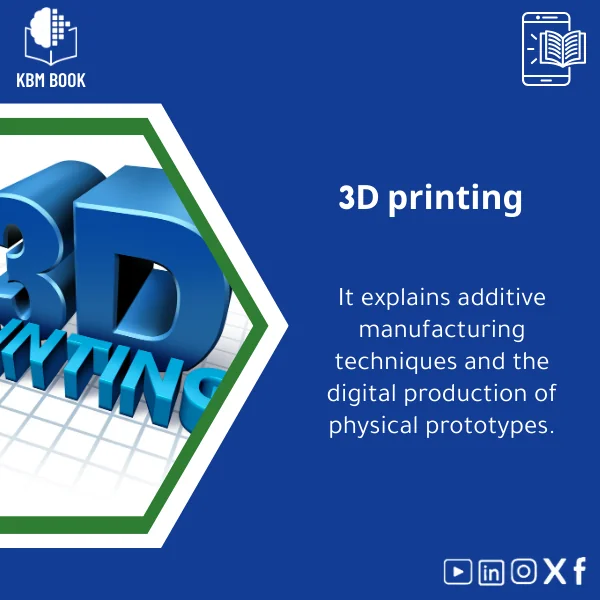
3D Printing Book: A Guide to Additive Manufacturing Techniques
Original price was: 179.00 $.139.00 $Current price is: 139.00 $.
A structured, searchable knowledge base that turns additive manufacturing theory and practical workflows into a step-by-step digital reference — ideal for students, researchers, and professionals who need fast, reliable access to 3D prototyping methods, materials, and process controls.
Key benefits & value for the buyer
This 3D Printing book is delivered as a Knowledge Base Module (KBM) — not a linear textbook. That means the content is organized hierarchically into searchable nodes (concepts, processes, materials, test results). The structure converts learning into practical action.
What you gain
- Speed: find the correct print parameters or troubleshooting checklist in seconds rather than searching multiple papers.
- Reliability: curated process controls and failure-mode tables reduce trial-and-error in the lab or workshop.
- Reproducibility: exportable parameter sets and versioned modules help teams reproduce prints and document experiments.
- Integrability: import into knowledge-management tools, ELNs (electronic lab notebooks), or LMS platforms for teaching and team use.
Use cases & real-life scenarios
Below are practical examples showing how the 3D Printing book (KBM) solves day-to-day problems across education, research, and industry.
Student project (undergraduate)
A student designing a mechanical part follows the “Design for Additive Manufacturing” module to reduce support structures, uses the materials comparison table to choose PETG over PLA for impact resistance, and applies the print parameter preset to get acceptable dimensional accuracy on the first prototype.
Research lab
A research team testing new composite filaments uses the KBM’s experimental templates to standardize specimen geometry, logging, and statistical analysis — reducing variability across experiments and speeding publication preparation.
R&D department
A product engineer uses the KBM to import calibration routines into a slicer and to document post-processing steps, ensuring consistent surface finish for small-batch production runs.
Who is this product for?
Designed specifically for our target audience:
- Students who need a compact, curriculum-aligned 3D Printing guide for projects and labs.
- Researchers who require a reproducible prototyping reference with parameterized experiments and citations.
- Professionals and trainers who need structured modules to teach, audit, and scale additive manufacturing processes.
How to choose the right edition & format
The KBM is offered in multiple formats to match workflow needs:
- Core KBM (recommended): full hierarchical database in JSON + PDF summary — best for researchers and labs that will import and extend content.
- Instructor Pack: includes slides and printable lab sheets for classroom use.
- Compact PDF: fast-reference version for students and field work.
Choose based on how you plan to use the content: import & automate (Core KBM), teach (Instructor Pack), or read offline (Compact PDF).
Quick comparison with typical alternatives
What makes the KBM different from conventional books, scattered articles, or forum threads:
- Structured vs. linear: modules let you jump directly to parameters or troubleshooting without reading whole chapters.
- Actionable vs. descriptive: contains ready-to-use checklists, presets, and experiment templates instead of long theoretical exposition only.
- Exportable vs. locked: downloadable data formats mean you keep control of workflows and can integrate with tools you already use.
Best practices & tips to get maximum value
- Start with the “Calibration & Validation” module before changing materials or machines.
- Import parameter sets into your slicer and save a named profile per material to reproduce results.
- Use the post-processing checklists to standardize finish and dimensional inspection across prints.
- Version-control your KBM exports when collaborating to track changes and experimental results.
Common mistakes when buying or using similar products — and how to avoid them
- Buying a textbook only: many sources explain theory but don’t provide usable process templates. Choose a KBM if you need practical, reusable datasets.
- Ignoring machine differences: always adapt parameter presets to your printer’s build volume and nozzle size; the KBM includes adaptation notes.
- Not versioning experiments: the KBM encourages structured logging; skip this and you lose reproducibility.
Product specifications
- Type: Knowledge Base Module (KBM) — 3D Printing book
- Coverage: FDM/FFF, SLA/DLP, SLS, metal additive fundamentals & advanced process controls
- Formats: JSON (hierarchical database), CSV (tables), PDF (readable manual), XLSX (summary tables)
- Contents: >120 modules (design rules, material datasheets, calibration routines, failure modes, post-processing)
- License: personal and institutional licensing options (details at checkout)
- Delivery: instant digital download after purchase
- Usage notes: import-ready for knowledge-management tools, ELNs, and LMS platforms
Frequently asked questions
What formats are included and which tool do I need to open them?
Files are provided as JSON, CSV, PDF, and XLSX. JSON and CSV can be imported into knowledge managers, databases, and spreadsheet tools; PDF and XLSX are suitable for immediate reading and printing. No proprietary software is required.
How often is the 3D Printing book updated?
KBMBook maintains periodic updates to reflect major advances and corrections. Buyers receive version-update notifications and can download minor updates free within the licensed period. Major revisions may be provided as discounted upgrades.
Can I use the content for classroom teaching or commercial projects?
Yes. We offer personal and institutional licenses. Classroom and internal commercial use are supported under standard license terms; redistribution or resale requires a separate agreement. See licensing options at checkout.
What if the KBM doesn’t meet my needs?
We provide a sample preview of core modules before purchase so you can verify fit. If you still decide it’s not suitable, check our refund policy at checkout for digital products.
Ready to convert knowledge into action?
Instantly download a structured 3D Printing book that organizes additive manufacturing into usable, repeatable modules. Save time on experiments, standardize your workflows, and scale learning across teams.
Need a specific format or institutional license? Contact our support team after purchase — we help you integrate the KBM into your systems.
Related products
Biological Anthropology Study Guide on Human Evolution

Comprehensive Evolutionary Biology Book on Natural Selection
Comprehensive Nuclear Physics Book on Structure and Radioactivity
Electromagnetism Book: A Comprehensive Guide to Fields and Circuits

Inorganic Chemistry Guide: Bonding and Crystal Solids
A structured, searchable Knowledge Base Module (KBM) that converts inorganic chemistry fundamentals and advanced topics—bonding models, lattice structures, defects, and solid-state properties—into a practical digital reference for students, researchers, and professionals who need fast, reliable answers without wading through textbooks.
Modern Physics Book: Quantum, Relativity, and Tech Applications Guide
A structured, searchable Knowledge Base Module (KBM) that turns modern physics — quantum mechanics, special & general relativity, and contemporary technological applications — into a hierarchical, practical reference for students, researchers, and professionals who need quick, reliable access to advanced concepts and formulas.

Reviews
Clear filtersThere are no reviews yet.