


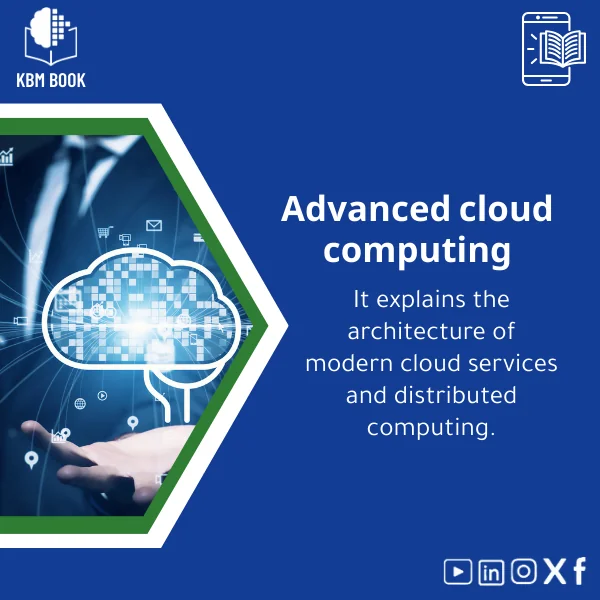
Advanced Cloud Computing Guide for Modern Architectures
Original price was: 199.00 $.159.00 $Current price is: 159.00 $.
A structured, searchable knowledge base module that maps advanced cloud computing concepts—distributed systems, resilient architectures, and cloud services design—into hierarchical, ready-to-use reference units for students, researchers, and professionals.
Key benefits & value for the buyer
This Advanced Cloud Computing KBM converts fragmented technical literature into a compact, navigable database so you can find the exact concept, pattern, or decision checklist in seconds. Key buyer benefits include:
- Time savings: Replace hours of searching with instant lookups—patterns and trade-offs are indexed and cross-referenced.
- Clear learning path: Follow the hierarchical sequence from cloud fundamentals to advanced distributed computing topics without gaps or repetition.
- Actionable outputs: Ready-to-use architecture checklists, sequence diagrams, and deployment considerations you can copy into design docs.
- Reliable sources: Concepts mapped to canonical papers, official cloud provider docs, and practical implementation notes—helpful for academic citation or design justification.
- Interoperable formats: Import into research tools, note apps, or internal knowledge platforms (JSON/SQLite/Markdown).
Use cases & real-life scenarios
For students
Use the KBM to prepare for exams or projects: follow the “Distributed Systems” module to understand consistency models, then run targeted quizzes or extract summaries for presentations.
For researchers
Quickly locate algorithm summaries (Raft, Paxos), research gaps, and curated references; export module nodes to include in literature reviews and reproducible experiments.
For professionals & architects
During architecture reviews, open the resilience checklist and the cost-optimization module to make trade-off decisions—generate a one-page design summary for stakeholders in minutes.
For instructors & trainers
Create lesson plans using pre-structured units: slide-ready summaries, examples, and test questions aligned to each module level.
Who is this product for?
This Advanced Cloud Computing KBM is designed for:
- Computer science and engineering students who need a compact, authoritative study resource.
- Researchers needing structured references and exportable nodes for papers and experiments.
- Cloud architects and senior engineers who make daily design decisions and need quick access to patterns, trade-offs, and checklists.
- Trainers and consultants building curricula or client deliverables on modern cloud architectures.
How to choose the right KBM for your needs
When selecting a knowledge base module on advanced cloud computing, compare three practical criteria:
- Scope: Does it cover both cloud services design and distributed computing theory? This KBM links service patterns (serverless, containers) to distributed algorithms and consistency models.
- Format & integration: If you import content into an LMS or internal KB, choose modules available in JSON/SQLite/Markdown. This KBM offers those formats and import guides.
- Depth vs. brevity: Need quick decision-checklists or deep theory with citations? This KBM provides layered content—summary nodes and deeper reading nodes—so you get both.
Quick comparison with typical alternatives
Typical alternatives are textbooks, scattered blog posts, or vendor documentation. Compared to those:
- Textbooks: deeper theory but slow to search—our KBM is searchable and modular for quick retrieval.
- Blog posts: practical but inconsistent—our KBM standardizes patterns and cites sources to avoid contradictory advice.
- Vendor docs: provider-specific—our KBM maps vendor features to vendor-agnostic design patterns and multi-cloud considerations.
Best practices & tips to get maximum value
- Start with the recommended learning path: Fundamentals → Distributed Systems → Deployment Patterns → Production Operations.
- Use the decision-checklists during design reviews to document trade-offs (latency vs. consistency, cost vs. availability).
- Import the JSON/SQLite files into your internal KB to link company-specific runbooks to the KBM nodes.
- Combine modules: use the “Security” and “Observability” modules together when planning production rollouts.
Common mistakes when buying/using similar resources — and how to avoid them
- Buying a text-only book: You can’t search or extract nodes easily. Choose structured KBMs that export to searchable formats.
- Assuming vendor docs are complete: Vendor materials often omit trade-offs—use this KBM to get vendor-agnostic patterns.
- Skipping fundamentals: Jumping to advanced topics without a sequence leads to design mistakes—follow the KBM’s hierarchy.
Product specifications
- Product type: Knowledge Base Module (KBM) — Advanced Cloud Computing
- Modules: 14 hierarchical modules (Fundamentals → Production Patterns → Advanced Distributed Algorithms)
- Entries: ~2,800 indexed nodes (definitions, patterns, checklists, references)
- Formats included: Searchable JSON, SQLite database, Markdown bundles, CSV export
- Delivery: Instant download (ZIP) with import guides and sample queries
- Usage notes: Single-user license; enterprise licensing options available on request
- Recommended audience: Students, researchers, architects, trainers
Frequently asked questions
Is the KBM suitable for academic citation?
Yes. Each in-depth node includes bibliographic references to canonical papers and official documentation to support citation and further reading. Use exported Markdown or CSV to include references in your literature review.
Which formats work best with note-taking apps and internal knowledge bases?
JSON and SQLite are ideal for programmatic import; Markdown is best for manual editing in note-taking apps. The package includes import instructions and sample queries to help you integrate quickly.
How do I know this KBM covers vendor-specific features I need (e.g., specific cloud services)?
The KBM focuses on vendor-agnostic design patterns and maps common provider features as examples. If you need a vendor-specific deep-dive, contact support for available add-ons or custom modules.
What if I’m unsure this is the right purchase?
Preview the sample module included on the product page to evaluate structure and depth. If you need assistance selecting the right module for your curriculum or project, our support team can advise on fit.
Ready to stop searching and start designing?
Download an actionable knowledge base that brings advanced cloud computing and modern cloud architectures into one structured, searchable resource. Save time on research, improve design quality, and standardize learning across teams.
Instant download includes import guides and sample queries so you can start integrating the KBM into your workflow today.
Related products
Astrophysics Book: Understanding Stars, Galaxies, and Dark Energy
A searchable, hierarchical Knowledge Base Module (KBM) that converts astrophysics and cosmology into a practical, exam-ready and research-ready reference. Designed for students, researchers, and professionals who need immediate access to reliable explanations, equations, and data models for stars, galaxies, and dark energy.
Cell Biology Guide: Structure, Division, and Transport Insights
Classical Mechanics Guide: Newton’s Laws and Dynamics
A searchable, hierarchical Knowledge Base Module (KBM) that turns classical mechanics into a practical, ready-to-use reference for fast problem solving, lecture preparation, and applied engineering. Designed for students, researchers, and professionals who need precise access to Newton’s laws, rotational motion, and applied dynamics without the noise of textbooks.

Comprehensive Evolutionary Biology Book on Natural Selection
General Physics Book: Fundamentals of Force, Motion, Energy

Inorganic Chemistry Guide: Bonding and Crystal Solids
A structured, searchable Knowledge Base Module (KBM) that converts inorganic chemistry fundamentals and advanced topics—bonding models, lattice structures, defects, and solid-state properties—into a practical digital reference for students, researchers, and professionals who need fast, reliable answers without wading through textbooks.
Introductory General Chemistry Book on Matter and Reactions
A structured, searchable Knowledge Base Module (KBM) that converts core general chemistry concepts — matter, elements, reactions, stoichiometry and molarity — into a hierarchical reference you can query, teach from, or integrate into study workflows. Ideal as a concise General Chemistry book alternative for students, researchers, and professionals who need accurate, practical chemistry knowledge fast.
Physical Chemistry Guide: Energy, Thermodynamics & Interactions
A structured Knowledge Base Module (KBM) for Physical Chemistry that converts core theory, worked examples, and applied datasets into a searchable, hierarchical database — ideal for students, researchers, and professionals who need fast, reliable access to chemical thermodynamics basics and molecular interaction models.
Reviews
Clear filtersThere are no reviews yet.