


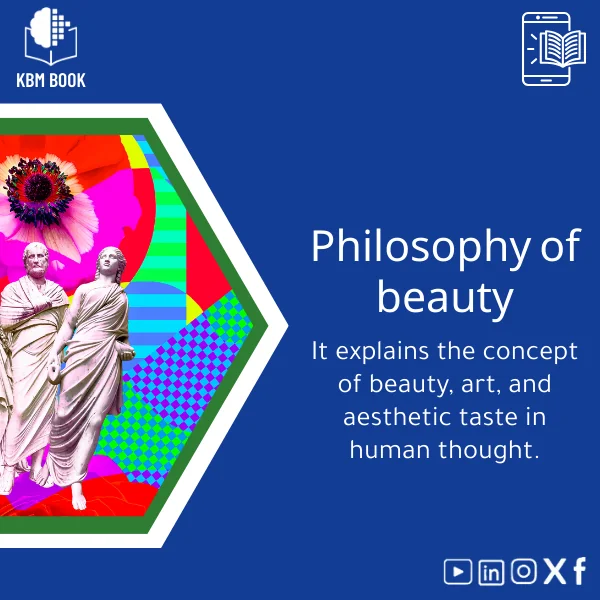
Aesthetics Book: Understanding Beauty, Art, and Taste
Original price was: 179.00 $.139.00 $Current price is: 139.00 $.
A structured, searchable knowledge base module that maps the field of aesthetics from first principles to applied criticism—designed for students, researchers, and professionals who need fast, reliable access to theories, concepts, and practical frameworks about beauty, art, and taste.
Key benefits & value for the buyer
This Aesthetics book is not a traditional narrative — it is a Knowledge Base Module (KBM) that converts dense theory into searchable, structured data you can use immediately. Benefits delivered:
From theory to usable reference
- Clear definitions and argument maps for major aesthetic theories (beauty, form, expression, taste).
- Sequential learning paths: introductory concepts → intermediate debates → advanced critiques.
- Ready-to-use teaching and research artifacts: outlines, bibliographies, and primary-source summaries.
Save time, increase accuracy
- Reduce hours spent locating sources — curated citations and summaries accelerate literature reviews.
- Standardized terminology reduces ambiguity in academic writing and classroom discussion.
Reliable, update-ready format
The module is designed to be maintained and extended: edits are simple, and new entries integrate without disrupting the hierarchical structure.
Use cases & real-life scenarios
Students: exam prep and essays
Use the Aesthetics book to compile topic summaries, extract quotes from primary sources, and generate exam-style questions tailored to course objectives.
Researchers: literature mapping and cross-referencing
Quickly map debates (e.g., formalism vs. contextualism), pull relevant citations, and export bibliographies for systematic reviews.
Professionals & educators: curriculum and critique
Design lecture series, create rubrics for art criticism, and prepare seminar materials with consistent terminology and progressive learning sequences.
Who is this product for?
Targeted at students, researchers, and professionals who need structured knowledge databases across humanities fields for quick access to reliable information. Specifically:
- Undergraduate and graduate students in philosophy, art history, cultural studies.
- Academic researchers preparing literature reviews or comparative analyses.
- University lecturers, course designers, museum educators, and independent scholars.
- Professionals in creative industries who require conceptual clarity about beauty and taste.
How to choose the right edition
Because this is a KBM, we offer editions tailored to depth and workflow:
- Intro edition: Best as an introduction to aesthetics — concise entries, core readings, and learning path (recommended for first-year students).
- Standard edition: Full coverage of modern and classical debates, case studies, and exportable bibliographies (recommended for most researchers and lecturers).
- Instructor edition: Includes slide-ready lecture outlines, assignment banks, and suggested assessment rubrics (recommended for course creators).
Choose based on your need for depth, teaching resources, and the amount of primary-source annotation you require.
Quick comparison with typical alternatives
How this Aesthetics book (KBM) differs from textbooks, anthologies, and scattered articles:
- Textbooks: linear and often selective — KBM is non-linear and queryable for specific facts and argument maps.
- Anthologies: curated primary texts — KBM pairs primary texts with concise contextual summaries and cross-references.
- Articles and web searches: fragmented — KBM centralizes vetted entries with consistent taxonomy and exportable citations.
Best practices & tips to get maximum value
- Start with the learning path that matches your level (Intro, Standard, Instructor) to avoid overload.
- Use the search-first layout: search by concept, thinker, or period to retrieve argument maps fast.
- Export bibliographies and import into your reference manager to save time on citation formatting.
- Integrate the KBM snippets into lecture slides or research notes rather than copy-pasting large sections — the structure is designed for modular use.
Common mistakes when buying or using similar products and how to avoid them
- Mistake: Buying a general textbook expecting a searchable reference. Fix: Choose this KBM if you need fast lookup and exportable assets.
- Mistake: Assuming all formats work with your tools. Fix: Check compatibility in the specifications (PDF, CSV, JSON export available).
- Mistake: Attempting to use the module without a learning path—results in scattered study. Fix: Follow the provided sequential paths for efficient mastery.
Product specifications
- Format: Downloadable KBM package (PDF summary, CSV/JSON data export, instructor slides for Instructor edition)
- Chapters / nodes: ~120 hierarchical nodes covering history, major schools, key thinkers, case studies, and applied criticism
- Searchability: Indexed terms and cross-reference tables for rapid lookup
- Languages: English with Arabic metadata support (KBM structure follows bilingual indexing)
- Compatibility: Works with common note-taking apps, reference managers, and learning-management systems
- License: Single-user digital license with optional institutional upgrade
- Delivery: Instant download after purchase — printable and copy-paste friendly
Frequently asked questions
Is this an Aesthetics philosophy book or a textbook?
It is a KBM-style Aesthetics philosophy book: structured as a searchable knowledge base rather than a single-author narrative textbook. It provides both concise summaries and the layered detail expected of a textbook.
Can I use the content in class and reproduce slides?
Yes—Instructor edition explicitly includes slide-ready materials and assignment banks. The single-user license permits classroom use by the purchaser; institutional licenses are available for broader distribution.
How does the KBM handle citations and primary sources?
Each node includes curated citations and short primary-source summaries. Bibliographies are exportable in common formats (BibTeX, RIS) to integrate with your reference manager.
Will this help with research on aesthetics in human thought?
Yes. The KBM maps major arguments across history and disciplines, making it easier to locate comparative frameworks and interdisciplinary links for research on aesthetics in human thought.
Ready to make aesthetics research faster and more reliable?
Acquire a searchable, well-organized Aesthetics book that turns theory into practical tools for study and teaching. Choose the edition that matches your workflow and get instant access.
Need institutional access or a demo? Contact KBMBook support for volume licensing and sample nodes.
Related products
Classical Mechanics Guide: Newton’s Laws and Dynamics
A searchable, hierarchical Knowledge Base Module (KBM) that turns classical mechanics into a practical, ready-to-use reference for fast problem solving, lecture preparation, and applied engineering. Designed for students, researchers, and professionals who need precise access to Newton’s laws, rotational motion, and applied dynamics without the noise of textbooks.
Inorganic Chemistry Guide: Bonding and Crystal Solids
A structured, searchable Knowledge Base Module (KBM) that converts inorganic chemistry fundamentals and advanced topics—bonding models, lattice structures, defects, and solid-state properties—into a practical digital reference for students, researchers, and professionals who need fast, reliable answers without wading through textbooks.
Introductory General Chemistry Book on Matter and Reactions
A structured, searchable Knowledge Base Module (KBM) that converts core general chemistry concepts — matter, elements, reactions, stoichiometry and molarity — into a hierarchical reference you can query, teach from, or integrate into study workflows. Ideal as a concise General Chemistry book alternative for students, researchers, and professionals who need accurate, practical chemistry knowledge fast.
Materials Physics Guide: Understanding Solid-State Properties
Molecular Biology Guide: Transcription, Translation & Repair
Organic Chemistry Guide: Carbon Chains and Reactions

Quantum Mechanics: A Beginner’s Guide to Superposition and Waves
Thermal Physics Guide: Understanding Heat, Energy, and Entropy
A downloadable, hierarchically structured Knowledge Base Module (KBM) that converts university-level thermodynamics into a searchable, practical digital database. Ideal for students, researchers, and professionals who need fast, reliable access to fundamentals and advanced topics in thermal physics.

Reviews
Clear filtersThere are no reviews yet.