


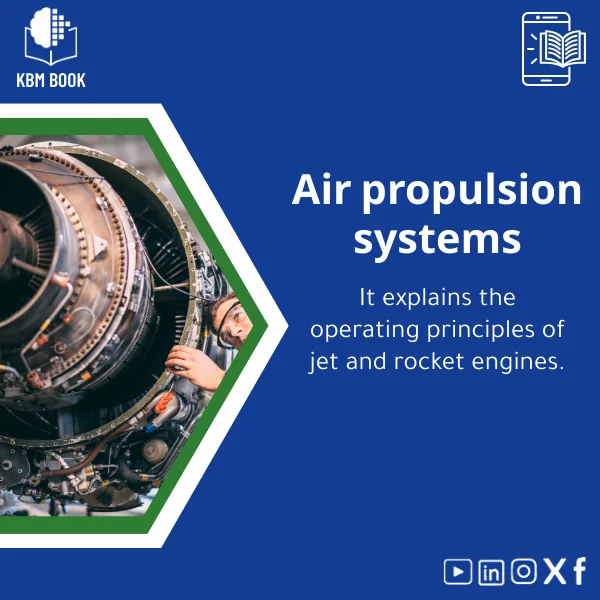
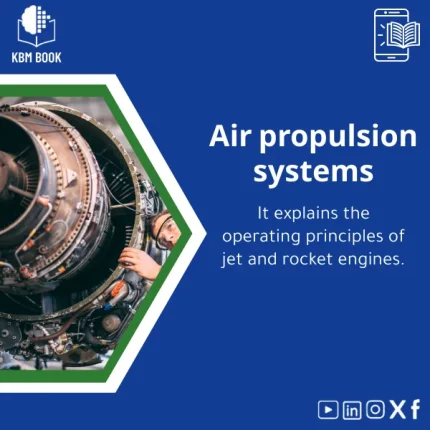
Air Propulsion Systems: Jet and Rocket Engine Principles Guide
Original price was: 199.00 $.159.00 $Current price is: 159.00 $.
A structured Knowledge Base Module (KBM) that converts jet and rocket propulsion theory into a searchable, hierarchical reference for students, researchers, and professionals who need fast, reliable access to aerospace propulsion fundamentals and applied workflows.
Key benefits & value for the buyer
From concept to calculation — fast
This Air Propulsion Systems KBM transforms dispersed textbooks, lecture notes, and standard papers into a compact, searchable knowledge database. Instead of flipping through chapters, you query a modular KBM and reach the exact principle, equation, or worked example in seconds — saving hours during study, simulation setup, or design reviews.
Accuracy and depth without redundancy
Entries are organized hierarchically: fundamentals (thermodynamics, compressible flow), component physics (inlets, compressors, turbines, nozzles), engine cycles (Brayton, rocket cycles), and applied methods (performance estimation, thermochemical calculations). Each item links to source references and practical notes so you get precise answers without repeated or unnecessary text.
Workflow-ready outputs
Includes ready-made calculation templates and parameter tables that you can adapt to spreadsheets or simulation inputs — ideal for lab assignments, research reproducibility, and engineering sanity checks.
Use cases & real-life scenarios
- Students: Prepare for aerospace propulsion exams by drilling core equations and stepwise solution examples rather than reading long chapters.
- Researchers: Rapidly locate derivations, standard approximations and reference constants while compiling literature reviews or validating models.
- Design engineers: Use the sizing checklists and component-specific performance tables during preliminary engine cycle studies and trade-off analyses.
- Instructors & trainers: Build lecture modules and assignments from modular KBM entries to ensure consistent coverage and assessment alignment.
- Cross-disciplinary teams: Provide mechanical, materials and control engineers a common reference to accelerate interdisciplinary discussions.
Example scenario: A masters student optimizing a turbofan bypass ratio uses the KBM to pull the precise Brayton cycle equations, standard atmospheric tables, and an example calculation — then adapts the JSON template to their MATLAB script within minutes.
Who is this product for?
Targeted segments include:
- Undergraduate and graduate aerospace students studying propulsion courses.
- Academic researchers needing a compact reference for engine models and constants.
- Engineers in propulsion labs or startups performing early-stage design and validation.
- Instructors creating consistent curricula and test materials.
If you need reliable, structured access to jet engine fundamentals or rocket propulsion basics — without wading through full-length textbooks every time — this KBM was designed for you.
How to choose the right KBM version
The KBM is offered in editions tailored to depth and format:
- Essentials (compact): Core equations, 350+ indexed items, printable PDF — best for undergraduate coursework and quick revision.
- Professional (complete): Full hierarchical database, 1,200+ items, JSON/CSV export, worked examples and templates — recommended for researchers and engineers.
- Instructor pack: Professional content plus lecture slides and assignment templates for classroom use.
Choose based on how you plan to use the KBM: reading and exam prep (Essentials), integration into tools or research (Professional), or teaching (Instructor).
Quick comparison with typical alternatives
Common alternatives: traditional textbooks, scattered lecture notes, or subscription knowledge platforms. Compared to these, the KBM offers:
- Faster lookup: modular entries and search index vs. linear textbook chapters.
- Interoperability: exports for scripts and databases vs. static PDF or book chapters.
- Focused practical workflows and templates vs. theoretical exposition only.
If you value time-to-answer, reproducibility, and integration into digital workflows, the KBM provides measurable advantage for study and engineering tasks.
Best practices & tips to get maximum value
- Import JSON tables into your analysis environment (MATLAB, Python) and map parameter names to your model variables for instant use.
- Create a personal “cheat sheet” from 10–15 KBM entries you use most often to speed routine checks.
- When preparing reports, cite the KBM entries and follow the included references to primary literature for reproducibility.
- Use the Instructor pack to standardize problem statements and scoring rubrics in courses.
Common mistakes when buying/using propulsion references — and how to avoid them
- Mistake: Buying broad textbooks expecting quick operational answers. Fix: Choose a KBM for direct access to formulas and templates.
- Mistake: Overlooking file format compatibility. Fix: Select the Professional edition with JSON/CSV if you plan to integrate with code.
- Mistake: Treating KBM entries as final design authority. Fix: Use KBM for initial estimates and pair with detailed simulation and testing for final design validation.
Product specifications
- Product type: Knowledge Base Module (KBM) — Air Propulsion Systems
- Contents: Hierarchical entries covering jet & rocket engine principles, equations, worked examples, reference constants, and design templates
- Entries: 1,200+ indexed items (Professional edition)
- Formats: JSON (hierarchical), CSV (tabular), searchable PDF, printable tables
- Language: English (technical terms standardized); Arabic metadata available for menu labels
- Delivery: Instant digital download after purchase
- License: Single-user and institutional licensing options available (see checkout)
- Updates: Periodic content updates and errata notes provided to buyers
- Usage notes: Designed for integration into research and teaching workflows; not a substitute for certification or experimental testing
Frequently asked questions
What is included in the Professional edition and which formats will I receive?
The Professional edition includes the full hierarchical KBM with 1,200+ entries, worked examples, calculation templates, and reference tables. Files are provided as JSON for hierarchical imports, CSV for spreadsheet use, and a searchable PDF for printing and quick reading.
Can I use the KBM for classroom materials or redistribution?
Instructor licensing allows use in courses and distribution to enrolled students under a class license. Personal licenses permit individual use only. Institutional or custom licensing is available—contact support for bulk access.
How often is the KBM updated and are updates free?
KBM updates include corrections, new worked examples, and additional references. Minor updates and errata are provided free to buyers; major edition upgrades may be offered as paid updates with upgrade discounts.
Will the KBM replace textbooks for advanced research?
The KBM is a structured reference and workflow tool designed to complement, not replace, primary research literature and detailed textbooks. Use it for rapid reference, reproducible calculations, and as a bridge from theory to applied estimates.
Ready to accelerate your learning and engineering workflow?
Download the Air Propulsion Systems KBM and get instant access to a compact, practical database of jet engine fundamentals and rocket propulsion basics. Integrate entries into your code, classroom, or lab to reduce time-to-result and improve consistency.
Secure digital delivery. Multiple license options at checkout for individual, instructor, and institutional use.
Related products
Astrophysics Book: Understanding Stars, Galaxies, and Dark Energy
A searchable, hierarchical Knowledge Base Module (KBM) that converts astrophysics and cosmology into a practical, exam-ready and research-ready reference. Designed for students, researchers, and professionals who need immediate access to reliable explanations, equations, and data models for stars, galaxies, and dark energy.

Comprehensive Evolutionary Biology Book on Natural Selection
Comprehensive Genetics Book: DNA, Mendelian Genetics & Engineering
A structured, searchable knowledge base module (KBM) that turns genetics theory and practice into an immediately usable digital reference — from DNA structure to Mendelian genetics and contemporary genetic engineering techniques — optimized for students, researchers, and professionals who need reliable answers fast.
Electromagnetism Book: A Comprehensive Guide to Fields and Circuits

General Biology Book: A Guide to Cells, Genetics & Taxonomy

Inorganic Chemistry Guide: Bonding and Crystal Solids
A structured, searchable Knowledge Base Module (KBM) that converts inorganic chemistry fundamentals and advanced topics—bonding models, lattice structures, defects, and solid-state properties—into a practical digital reference for students, researchers, and professionals who need fast, reliable answers without wading through textbooks.
Materials Physics Guide: Understanding Solid-State Properties
Modern Physics Book: Quantum, Relativity, and Tech Applications Guide
A structured, searchable Knowledge Base Module (KBM) that turns modern physics — quantum mechanics, special & general relativity, and contemporary technological applications — into a hierarchical, practical reference for students, researchers, and professionals who need quick, reliable access to advanced concepts and formulas.
Reviews
Clear filtersThere are no reviews yet.