


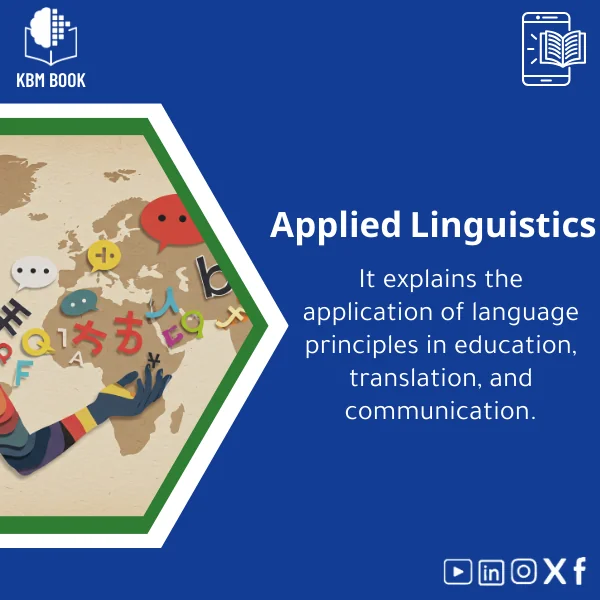
Applied Linguistics Guide for Education and Translation
Original price was: 179.00 $.139.00 $Current price is: 139.00 $.
A structured, searchable knowledge base for applied linguistics — designed to help students, researchers, translators, and educators find reliable, hierarchically organized information fast: from foundational theory to classroom practice and translation workflows.
Key benefits & value for students, researchers, and professionals
This applied linguistics KBM converts dispersed knowledge into a compact, navigable resource that saves time and reduces cognitive friction. Instead of searching multiple articles or textbooks, you get:
- Time savings: Instant access to curated summaries, definitions, and recommended procedures for classroom application and translation decisions.
- Consistency: Standardized terminology and annotated examples prevent ambiguity when teams work on curriculum, research coding, or bilingual projects.
- Actionable outputs: Templates for lesson plans, translation checklists, corpus query examples, and research outlines you can adapt immediately.
- Reliable sourcing: Each entry references primary literature and practical sources so you can trust and cite what you use in assignments or proposals.
Use cases & real-life scenarios
University students — study and assignment speed
When preparing a term paper on second language acquisition, use the KBM to pull a concise literature map, definitions, and a sample methodology section in minutes. Export citations and build your bibliography without hunting through dozens of PDFs.
Researchers — reproducible methods and corpora
Researchers designing corpus-based studies benefit from ready examples of concordance queries, annotation schemas, and reliability checks — all available in a repeatable, hierarchical format that simplifies replication.
Teachers & curriculum designers — lesson-ready modules
Build lessons from modular content: learning objectives, target language items, formative assessment tasks, and quick classroom activities linked to theoretical justification.
Translators & localization professionals
The KBM offers translation-oriented entries: terminology strategies, register analyses, common error patterns, and glossaries that improve speed and quality in real projects.
Who is this product for?
This applied linguistics KBM is built for:
- Undergraduate and graduate students seeking a single reference for course work and exam revision.
- Academic researchers needing structured methods, annotated bibliographies, and reproducible workflows.
- Language teachers and curriculum developers wanting ready-to-deploy lesson modules tied to theory.
- Translators, editors, and localization managers who need quick access to practical linguistic analyses and glossaries.
- Professionals in education policy, assessment, and communication who require evidence-based language guidance.
How to choose the right KBM configuration
Because this product is a digital knowledge base, “size” and “format” mean depth and delivery format. Choose based on intended use:
- Compact (Summary): Best for students who need quick revision and key definitions. Smaller file, faster to scan.
- Standard (Teaching & Translation): Includes practical templates, glossaries, and classroom activities — recommended for practitioners.
- Comprehensive (Research-grade): Full hierarchical database with corpus queries, annotated references, and exportable JSON/CSV — ideal for researchers.
Select a format (PDF for reading, JSON/CSV for integration into tools, or combined package) depending on whether you prefer human-readable guides or machine-ready data.
Quick comparison with typical alternatives
Alternatives include textbooks, scattered articles, and static lecture notes. Compared to these, the KBM delivers:
- Faster lookup than textbooks (modular index vs linear chapters).
- More practical templates than research articles (ready-to-use items vs abstract discussion).
- Better integration than PDFs alone (JSON/CSV exports for digital tools).
If you need a deep theoretical read, a textbook complements this KBM. But if your priority is quick access, repeatable procedures, and practical outputs, the KBM is the better purchase.
Best practices & tips to get maximum value
- Start with the module index: identify the 3–5 modules most relevant to your project and export them first.
- Use the JSON export to populate a private knowledge tool or notes app for fast queries during work.
- Pair KBM entries with one canonical textbook per topic for depth; the KBM accelerates application and experimentation.
- Use provided templates (lesson plans, translation checklists) verbatim at first, then adapt to your context to ensure fit.
Common mistakes when buying/using applied linguistics resources — and how to avoid them
- Mistake: Buying a single-format PDF when you need machine-readable data. Fix: Choose the package with JSON/CSV if you plan to integrate into tools.
- Mistake: Expecting a complete course in one file. Fix: Use the KBM as a structured reference and combine it with a course syllabus or textbook.
- Mistake: Overlooking licensing and reuse terms. Fix: Check the usage notes in Product specifications before redistributing materials.
Product specifications
- Title: Applied Linguistics Guide for Education and Translation
- Format: PDF (readable guide), JSON & CSV (structured modules), sample SQL-ready export for database import
- Scope: 10 core modules + 35 submodules (phonetics, syntax, pragmatics, corpus methods, translation strategies, assessment)
- Language: English (with bilingual glossary entries where relevant)
- File size: Varies by package (Compact: ~12MB PDF; Standard: ~40MB combined; Comprehensive: ~120MB including datasets)
- License: Personal & institutional use allowed; redistribution and resale restricted — see included license file
- Compatibility: Works with common data tools and reference managers (Zotero, EndNote) and spreadsheet/database software
- Updates: Minor content updates included for 12 months from purchase (update policy documented in package)
FAQ
Is this an applied linguistics book or a searchable database?
It is a Knowledge Base Module (KBM): a structured, searchable database with human-readable PDF summaries. Think of it as both a reference “book” and a machine-friendly dataset tailored for applied linguistics use.
Can I use the content in classroom materials or published research?
Yes — the KBM supports academic and teaching use under the included license. Attribution and adherence to the redistribution terms are required for any public or commercial reuse. Check the license file in your package for specifics.
What file formats are included and can I integrate them with my tools?
Packages include PDF, JSON, and CSV. The JSON/CSV are structured for import into databases, learning management systems, or analysis tools; templates for common imports are provided.
How often is the KBM updated?
Minor updates (corrections, new references) are included for 12 months. Major expansions are released as new editions; purchasers receive upgrade discounts when available.
Ready to speed up your applied linguistics work?
Purchase a KBM designed to make applied linguistics practical and portable — whether you need lesson-ready modules, translation guides, or researcher-focused datasets. Buy once, integrate quickly, and start producing consistent, evidence-based work.
Need a different package? After purchase you will be able to download Compact, Standard, or Comprehensive exports depending on your workflow needs.
Related products
Astronomy Observational Techniques Guide for Celestial Motion
Biochemistry Book: Understanding Chemical Processes in Living Systems
Comprehensive Evolutionary Biology Book on Natural Selection
Comprehensive Nuclear Physics Book on Structure and Radioactivity
General and Special Relativity Book on Einstein’s Theory
A structured, searchable Knowledge Base Module (KBM) that converts Einstein's General and Special Relativity into a clear, hierarchical reference: formulas, derivations, worked examples, practical applications (GPS, astrophysics), and a compact research bibliography — ready to download and integrate into study, teaching, or research workflows.
Inorganic Chemistry Guide: Bonding and Crystal Solids
A structured, searchable Knowledge Base Module (KBM) that converts inorganic chemistry fundamentals and advanced topics—bonding models, lattice structures, defects, and solid-state properties—into a practical digital reference for students, researchers, and professionals who need fast, reliable answers without wading through textbooks.
Molecular Biology Guide: Transcription, Translation & Repair
Thermal Physics Guide: Understanding Heat, Energy, and Entropy
A downloadable, hierarchically structured Knowledge Base Module (KBM) that converts university-level thermodynamics into a searchable, practical digital database. Ideal for students, researchers, and professionals who need fast, reliable access to fundamentals and advanced topics in thermal physics.
Reviews
Clear filtersThere are no reviews yet.