


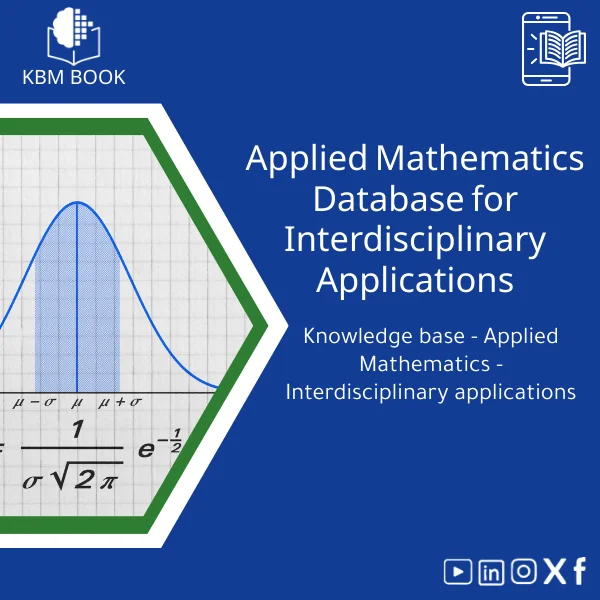
Applied Mathematics Knowledge Base for Interdisciplinary Applications
Original price was: 179.00 $.139.00 $Current price is: 139.00 $.
A hierarchically organized, searchable knowledge base that turns applied mathematics concepts into practical, ready-to-use modules — ideal for students, researchers, and professionals who need precise formulas, worked examples, and implementation-ready references across engineering, physics, economics and data science.
Key benefits & value for the buyer
The Applied Mathematics KBM translates academic content into a practical, hierarchical reference that saves time and reduces errors when applying mathematics to real problems. Each feature below is presented as a buyer value — not just a description.
From theory to action
Instead of reading long chapters, use concise entries that provide the assumption, derivation outline, final formula, parameter guidance, and an example application (with numerical values). That means faster problem setup and fewer mistakes in analysis or code.
Reliable, curated content
Modules are curated to avoid duplication and filled with cross-checked derivations and references to standard results. For a researcher or engineer, this reduces the time spent hunting through papers and textbooks for validated methods.
Interoperable formats
Delivered in searchable formats (PDF for quick reading, structured JSON/CSV for integration, and code snippets for common languages), the KBM fits into workflows — whether you are building simulations, writing a thesis, or preparing lecture notes.
Use cases & real-life scenarios
Graduate student — thesis & simulations
Example: A student modeling diffusion with PDEs can quickly find the relevant boundary-value setups, discretization schemes (finite difference / finite element), stability criteria, and a ready-to-adapt code example — cutting days of trial-and-error.
Researcher — cross-disciplinary modeling
Example: An economics researcher applying stochastic optimization can access a dedicated module linking stochastic calculus, numerical methods, and calibration examples for economic models so the theoretical results translate into reproducible code and experiments.
Engineer / Data Scientist — production-ready
Example: An engineer implementing control algorithms or an ML practitioner tuning optimization routines will find parameter heuristics, unit tests, and common pitfalls documented to reduce deployment bugs.
Who is this product for?
- Undergraduate and graduate students seeking a compact, reliable reference of applied mathematics concepts.
- Researchers needing cross-referenced derivations and reproducible example setups.
- Engineers and professionals integrating mathematical models into design, simulation, and control workflows.
- Instructors preparing problem sets and lecture materials with consistent notation and worked examples.
How to choose the right KBM for your needs
The Applied Mathematics KBM is modular. When selecting, match the KBM depth and format to your workflow:
- Need quick review? Choose the “Fundamentals” module for concise summaries and essential formulas.
- Implement models? Include the “Numerical Methods” and “Code Snippets” modules with JSON/CSV exports.
- Interdisciplinary projects? Add domain-focused modules (engineering applications of mathematics, economic modeling) to map concepts to your field.
- Collaboration & reproducibility? Ensure you get the structured formats (JSON + sample scripts) for version control and sharing with teammates.
Quick comparison with typical alternatives
Consider three common alternatives: traditional textbooks, scattered articles/notes, and online lecture videos. The KBM sits between these options:
- Vs textbooks: More targeted, faster to search, and includes implementation notes; textbooks provide broader theory but are slower to navigate for specific applications.
- Vs scattered articles: Articles may be current but inconsistent; KBM is curated and consistent, reducing verification time.
- Vs videos: Videos teach intuition but are hard to extract formulas or code from; KBM delivers ready references and reusable code.
Best practices & tips to get maximum value
- Start with the index and use the cross-references to map related modules before deep-diving — this prevents redundant work.
- Use the JSON/CSV exports to integrate formulas into notebooks or simulation projects, ensuring reproducibility.
- Adopt the provided unit tests and example cases to validate your implementation quickly.
- Keep notes on parameter choices and edge cases; the KBM’s modular structure makes it easy to update your project documentation.
Common mistakes when buying or using similar products — and how to avoid them
- Mistake: Buying raw lecture notes or a single textbook expecting ready-to-run solutions. Fix: Choose a KBM that includes worked examples and code snippets for implementation.
- Mistake: Overlooking format compatibility (can’t import into your tools). Fix: Confirm the KBM provides JSON/CSV and sample scripts for your environment.
- Mistake: Assuming everything is applicable without checking assumptions. Fix: Use the KBM’s assumption checklists before applying a formula or method.
Product specifications
- Product type: Digital Knowledge Base Module (KBM)
- Topics covered: Differential equations (ODEs, PDEs), numerical methods, linear algebra, optimization, probability & stochastic processes, applied statistics, modeling examples
- Formats included: Searchable PDF, structured JSON, CSV tables, code snippets (Python/Julia/Matlab pseudocode)
- Size: ~450 content units (entries) with 120+ worked examples and 60+ code snippets
- Language: English (notations and examples aligned with standard academic practice)
- Delivery: Instant download after purchase + instructions for integration
- License: Personal/educational use with team/campus licensing options available
- Updates: Minor updates included for 12 months; option to extend maintenance
Frequently asked questions
Is this KBM a substitute for an applied mathematics book or recorded course?
The KBM is not a lecture or a single textbook replacement; it is a practical reference built from curated theory, worked examples, and implementation-ready resources. Use it alongside courses for efficient problem solving and as a faster bridge to applied work than a standard textbook.
What formats are provided for integration into my projects?
You receive a searchable PDF for reading, structured JSON and CSV for programmatic use, and example code snippets in Python/Julia/Matlab-style pseudocode to accelerate implementation and testing.
How current and accurate is the material?
Content is curated by subject-matter experts and cross-checked with standard references. Minor updates are included for 12 months; you can purchase extended maintenance for ongoing updates and new modules.
Can I use this KBM for commercial projects?
Personal and educational use is included. Commercial or team-wide deployment requires a commercial license — contact KBMBook support to upgrade your license for commercial use.
Ready to convert theory into practical workflows?
Purchase the Applied Mathematics Knowledge Base and get immediate access to a structured, interdisciplinary reference tailored for practical use in research, engineering, and education.
Related products
Classical Mechanics Guide: Newton’s Laws and Dynamics
A searchable, hierarchical Knowledge Base Module (KBM) that turns classical mechanics into a practical, ready-to-use reference for fast problem solving, lecture preparation, and applied engineering. Designed for students, researchers, and professionals who need precise access to Newton’s laws, rotational motion, and applied dynamics without the noise of textbooks.
Comprehensive Genetics Book: DNA, Mendelian Genetics & Engineering
A structured, searchable knowledge base module (KBM) that turns genetics theory and practice into an immediately usable digital reference — from DNA structure to Mendelian genetics and contemporary genetic engineering techniques — optimized for students, researchers, and professionals who need reliable answers fast.
Cosmology Book: Guide to Big Bang and Galaxy Evolution
General Biology Book: A Guide to Cells, Genetics & Taxonomy

Inorganic Chemistry Guide: Bonding and Crystal Solids
A structured, searchable Knowledge Base Module (KBM) that converts inorganic chemistry fundamentals and advanced topics—bonding models, lattice structures, defects, and solid-state properties—into a practical digital reference for students, researchers, and professionals who need fast, reliable answers without wading through textbooks.
Modern Physics Book: Quantum, Relativity, and Tech Applications Guide
A structured, searchable Knowledge Base Module (KBM) that turns modern physics — quantum mechanics, special & general relativity, and contemporary technological applications — into a hierarchical, practical reference for students, researchers, and professionals who need quick, reliable access to advanced concepts and formulas.
Physical Chemistry Guide: Energy, Thermodynamics & Interactions
A structured Knowledge Base Module (KBM) for Physical Chemistry that converts core theory, worked examples, and applied datasets into a searchable, hierarchical database — ideal for students, researchers, and professionals who need fast, reliable access to chemical thermodynamics basics and molecular interaction models.
Thermal Physics Guide: Understanding Heat, Energy, and Entropy
A downloadable, hierarchically structured Knowledge Base Module (KBM) that converts university-level thermodynamics into a searchable, practical digital database. Ideal for students, researchers, and professionals who need fast, reliable access to fundamentals and advanced topics in thermal physics.
Reviews
Clear filtersThere are no reviews yet.