


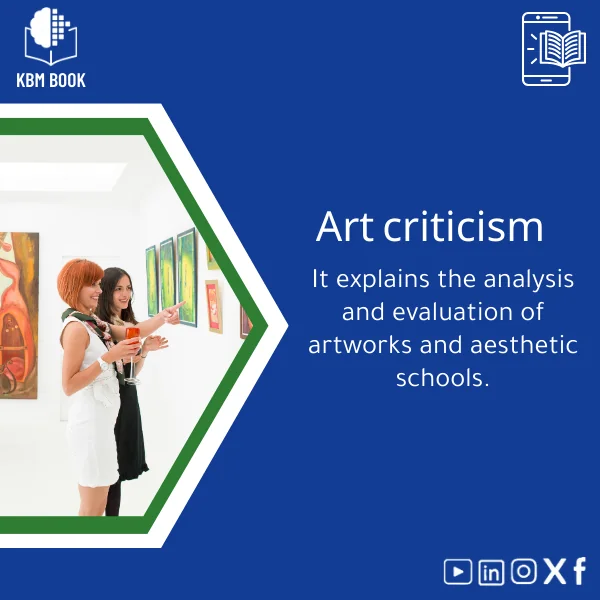
Art Criticism Guide: Analyzing and Evaluating Artworks
Original price was: 179.00 $.139.00 $Current price is: 139.00 $.
A searchable, hierarchical knowledge base for art criticism that turns theoretical frameworks, methods of analysis, and surveys of aesthetic schools into a practical reference — designed to speed up research, support coursework, and guide professional evaluations.
Key benefits & value for the buyer
This Art Criticism KBM translates academic knowledge into action. Instead of long, scattered readings, you get a compact, logical database that supports decision-oriented tasks: writing critiques, preparing lectures, conducting comparative studies, or compiling annotated bibliographies.
What you accomplish faster
- Produce a formal analysis in 20–40 minutes using guided checklists rather than starting from scratch.
- Compare two aesthetic schools quickly via side-by-side diagnostic features and representative case studies.
- Generate classroom handouts and assignment templates from ready-made modules.
Why structured knowledge matters
Art criticism is both method and language. The KBM removes ambiguity by standardizing terminology, mapping analytical steps, and linking examples to theory — reducing the time spent hunting for reliable explanations and increasing consistency across projects.
Use cases & real-life scenarios
Scenario 1 — Visual arts student preparing a portfolio review
Use the “formal analysis” module to annotate images, summarize compositional strategies, and cite appropriate critical vocabulary. Export the notes as a single PDF to include in your portfolio submission.
Scenario 2 — Researcher writing on aesthetic schools
The “aesthetic schools reference” contains concise histories and hallmark criteria for movements (Realism, Impressionism, Modernism, Postmodernism, etc.), with links to primary sources and suggested reading lists — speeding literature review and ensuring accuracy in classification.
Scenario 3 — Lecturer designing a course
Build modular lectures by assembling chapters on theory, sample critiques, and student exercises. Each block includes learning objectives and recommended assessment rubrics.
Who is this product for?
Explicitly built for visual arts students, art historians, critics, curators, and educators who need dependable, fast access to structured information. Also valuable for professionals in museums, galleries, and cultural institutions who must evaluate, document, or contextualize artworks.
- Undergraduate and graduate students seeking a reliable art criticism book alternative that is searchable and modular.
- Researchers needing an exportable art criticism PDF sections for citations and notes.
- Professionals who require an on-hand guide to art analysis and an aesthetic schools reference during appraisals or curatorial planning.
How to choose the right KBM for your needs
Selecting the right knowledge base depends on three criteria: depth, format, and licensing. The Art Criticism Guide is optimized where depth and practical formats matter most.
Depth
Choose this KBM if you need both foundational entries (terms, methods) and advanced topics (theory debates, comparative frameworks). If you only need surface-level summaries, a shorter primer may suffice.
Format
Available as structured PDF and exportable CSV/JSON snippets for integration into lecture slides and database tools—select the format that integrates with your workflow.
Licensing
Single-user license for personal academic use, and multi-user or institutional licenses for classroom or departmental use. Consider upgrade options if you intend to redistribute content.
Quick comparison with typical alternatives
Compared to textbooks, article collections, or unstructured notes, the KBM minimizes time-to-insight and maximizes reusability.
- Textbooks: deep but linear — KBM is modular and searchable.
- Journal articles: specific and granular — KBM aggregates and synthesizes the methods you need.
- Lecture notes: personal but inconsistent — KBM provides standardized terminology and consistent rubrics for evaluation.
Best practices & tips to get maximum value
- Start with the “analytic checklist” for every artwork to build consistent critiques across assignments.
- Use the “schools comparison” sheet when labeling a work’s aesthetic lineage — it prevents misclassification.
- Export lesson modules as PDF for students and keep the KBM master for in-depth research.
- Cross-link the KBM sections with your bibliography manager to maintain source traceability.
Common mistakes when buying or using similar products — and how to avoid them
- Mistake: Buying a single-format file without export options. Fix: Choose a KBM that includes PDF plus structured exports.
- Mistake: Over-relying on summaries and skipping primary sources. Fix: Use KBM as an organized gateway to primary texts; follow the reading lists provided.
- Mistake: Ignoring licensing limits for classroom use. Fix: Check institutional license options before purchase.
Product specifications
- Title: Art Criticism Guide: Analyzing and Evaluating Artworks
- Format: Structured PDF + exportable CSV and JSON snippets
- Size: ~180 pages equivalent; modular entries (120+ discrete modules)
- Language: English (with recommended Arabic index for regional instructors)
- Scope: Formal analysis, contextual methods, critical vocab, aesthetic schools reference, case studies
- License: Single-user standard; institutional license available
- Delivery: Instant digital download after purchase
- Usage notes: Editable sections for lecture customization; citation-ready summaries
FAQ
Is this an art criticism book or a database? Can I get an art criticism PDF?
The product is a Knowledge Base Module (KBM) — a structured digital database that can be exported as an art criticism PDF for offline reading. It blends the pedagogical depth of a book with the searchability and modularity of a database.
Will this help me identify which aesthetic school an artwork belongs to?
Yes. The aesthetic schools reference provides diagnostic features, timelines, representative artists, and comparative checklists to support accurate classification and justification in academic or professional contexts.
Can I use the KBM in classroom materials or distribute it to students?
Single-user licenses allow personal and teaching use when distributing PDFs to enrolled students. For broader redistribution or departmental use, choose an institutional license to comply with terms.
How often is the KBM updated?
KBMBook commits to periodic updates that reflect new scholarship and corrected entries. Update policies differ by license tier; institutional customers receive priority updates.
Ready to speed up your art criticism work?
Purchase a professional, classroom-ready KBM that replaces fragmented notes and scattered readings with a single, reliable reference. Get immediate access and integrate the guide into your research, lectures, and critiques.
Still unsure? Use the sample module included on the product page to review the structure and a sample critique before you buy.
Related products
Astrophysics Book: Understanding Stars, Galaxies, and Dark Energy
A searchable, hierarchical Knowledge Base Module (KBM) that converts astrophysics and cosmology into a practical, exam-ready and research-ready reference. Designed for students, researchers, and professionals who need immediate access to reliable explanations, equations, and data models for stars, galaxies, and dark energy.
Biochemistry Book: Understanding Chemical Processes in Living Systems
Classical Mechanics Guide: Newton’s Laws and Dynamics
A searchable, hierarchical Knowledge Base Module (KBM) that turns classical mechanics into a practical, ready-to-use reference for fast problem solving, lecture preparation, and applied engineering. Designed for students, researchers, and professionals who need precise access to Newton’s laws, rotational motion, and applied dynamics without the noise of textbooks.
Comprehensive Microbiology Book on Bacteria, Viruses, and Fungi
General Biology Book: A Guide to Cells, Genetics & Taxonomy
Inorganic Chemistry Guide: Bonding and Crystal Solids
A structured, searchable Knowledge Base Module (KBM) that converts inorganic chemistry fundamentals and advanced topics—bonding models, lattice structures, defects, and solid-state properties—into a practical digital reference for students, researchers, and professionals who need fast, reliable answers without wading through textbooks.
Modern Physics Book: Quantum, Relativity, and Tech Applications Guide
A structured, searchable Knowledge Base Module (KBM) that turns modern physics — quantum mechanics, special & general relativity, and contemporary technological applications — into a hierarchical, practical reference for students, researchers, and professionals who need quick, reliable access to advanced concepts and formulas.
Thermal Physics Guide: Understanding Heat, Energy, and Entropy
A downloadable, hierarchically structured Knowledge Base Module (KBM) that converts university-level thermodynamics into a searchable, practical digital database. Ideal for students, researchers, and professionals who need fast, reliable access to fundamentals and advanced topics in thermal physics.
Reviews
Clear filtersThere are no reviews yet.