


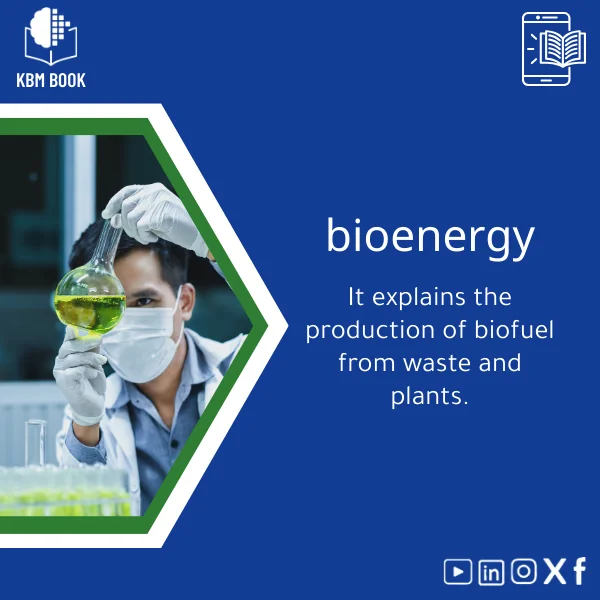
Bioenergy Book: Guide to Biofuel Production from Waste and Crops
Original price was: 179.00 $.139.00 $Current price is: 139.00 $.
A structured, searchable knowledge base module that converts bioenergy science into step-by-step, practical tools — from feedstock selection and thermochemical conversion to lifecycle assessment and policy implications — designed for rapid reference and applied work.
Key benefits & value for students, researchers, and professionals
The Bioenergy book is built as a Knowledge Base Module (KBM) — a hierarchical, non-redundant database that organizes bioenergy knowledge into reusable components. Each feature of the KBM translates directly into practical value:
Faster research & learning
Indexed topic nodes (e.g., feedstock properties, pretreatment options, reactor selection) reduce search time so you spend more time on analysis and less on hunting references.
Ready-to-use project tools
Includes experimental templates, mass/energy balance examples, and cost templates that can be adapted for grant proposals or lab planning. These actionable elements shorten the path from idea to pilot.
Reliable, cited content
Summaries are linked to primary sources and sample datasets. That makes the KBM suitable for citation in academic work and defensible in peer review or regulatory discussions.
Use cases & real-life scenarios
The KBM structure supports a broad range of real-world tasks. Examples:
- Undergraduate lab: Instructor uses the book to assemble a practical module on biodiesel synthesis from waste cooking oil — uses the protocol and risk checklist directly.
- Graduate research: A student extracts yield variability data and integrates the CSV feedstock tables into a life-cycle assessment model.
- Policy briefing: An analyst compiles a one-page summary and cost comparisons between anaerobic digestion and gasification from pre-formatted policy templates.
- Industry pilot: An engineer estimates scale-up costs with the included cost-estimation sheet and selects a conversion pathway using flow-decision diagrams.
Who is this product for?
The Bioenergy book is tailored for the target audience who need structured, reliable information fast:
- Students (undergraduate and graduate) who need clear conceptual maps and lab-ready protocols.
- Researchers who require organized datasets and quick access to comparative conversion efficiencies.
- Professionals and consultants preparing feasibility studies, pilot plans, or regulatory documentation.
- Trainers and lecturers building modular curricula on renewable energy from waste and crops.
How to choose the right format & depth
This is a digital KBM delivered in multiple formats. Choose based on how you will use it:
- PDF (comprehensive): Best if you want a readable, printable textbook-style reference with figures and tables.
- JSON / CSV extracts: Best for researchers and data-savvy users who need to import structured tables into models or databases.
- Compact summary sheets: Use for teaching or briefing — quick overviews and decision charts.
If unsure: download the PDF first for full context and use the CSV/JSON extracts for follow-up data needs.
Quick comparison with typical alternatives
Common alternatives include standard textbooks, scattered journal articles, and non-structured web articles. The KBM approach delivers:
- Faster retrieval: Unlike books, content is modular and searchable for specific tasks.
- Practical templates: Unlike academic papers, the KBM includes ready-to-use tools for projects and labs.
- Less noise: Unlike web searches, content is curated to avoid duplication and low-quality sources.
Best practices & tips to get maximum value
- Start with the decision-flow charts to pick a conversion pathway before reading technical chapters.
- Import CSV feedstock tables into your model to test sensitivity quickly.
- Use experimental templates verbatim for initial runs, then adapt parameters — this preserves reproducibility.
- Keep the KBM open during proposal writing: the formatted citations speed up literature sections and build credibility.
Common mistakes when buying or using similar resources — and how to avoid them
- Buying a generic textbook: Many textbooks lack modular tools; prefer KBMs when you need templates and datasets.
- Overlooking data formats: If you need to run models, ensure CSV/JSON extracts are included (this KBM includes them).
- Using outdated numbers: Always check the version and update notes; the Bioenergy book includes a changelog and data sources.
Product specifications
- Title: Bioenergy Book: Guide to Biofuel Production from Waste and Crops
- Formats included: PDF (print-ready), JSON extract, CSV tables, and printable summary sheets
- Length & scope: ~220 pages of structured content + 12 machine-readable datasets
- Modules: Feedstocks, Pretreatment, Conversion Technologies (biochemical, thermochemical), Yields & Efficiencies, LCA & emissions, Economics, Policy
- Languages: English (primary). Arabic interface and metadata available via KBMBook platform.
- Compatibility: Works with standard PDF readers; JSON/CSV compatible with Excel, R, Python, and common LCA tools
- License: Single-user commercial and academic use; multi-seat and institutional licenses available (see purchase options)
- Delivery: Instant digital download after purchase; updates available via your account
Frequently asked questions
Is this Bioenergy book suitable for a capstone or thesis?
Yes. The KBM includes literature summaries, cited references, datasets, and experimental templates that make it suitable as a primary resource for designing experiments and writing methodology sections. Use the JSON/CSV extracts for reproducible analysis.
Can I use data tables directly in my models (R, Python, LCA tools)?
Yes. The product contains CSV and JSON extracts formatted for easy import into R, Python (pandas), and common LCA software. Each dataset includes metadata and source citations to ensure traceability.
What if I need institutional access or multiple copies?
Institutional and multi-user licenses are available. Contact KBMBook support for a quote and license terms tailored to your team or class.
How often is the content updated?
KBMBook maintains a changelog and issues periodic updates to data tables and policy sections. Purchasers receive access to minor updates; major version upgrades may require a small fee depending on license type.
Ready to use structured bioenergy knowledge in your work?
Purchase the Bioenergy book today to stop piecing together scattered sources and start using a professionally organized, citation-ready KBM for your projects, courses, and research.
Still unsure? The KBM comes with a preview of the table of contents and one sample dataset so you can verify fit before you commit.
Related products
Astronomy Observational Techniques Guide for Celestial Motion
Atomic Physics Guide: Understanding Atomic and Electron Properties
Knowledge Base — Atomic/Electron Properties & Electromagnetic Interactions. A structured, searchable KBM for students, researchers, and professionals who need an authoritative atomic physics reference that organizes concepts, formulas, experiments, and practical applications from basics of atomic physics to advanced electron properties.
Biological Anthropology Study Guide on Human Evolution
Classical Mechanics Guide: Newton’s Laws and Dynamics
A searchable, hierarchical Knowledge Base Module (KBM) that turns classical mechanics into a practical, ready-to-use reference for fast problem solving, lecture preparation, and applied engineering. Designed for students, researchers, and professionals who need precise access to Newton’s laws, rotational motion, and applied dynamics without the noise of textbooks.
General Biology Book: A Guide to Cells, Genetics & Taxonomy
Organic Chemistry Guide: Carbon Chains and Reactions
Physical Chemistry Guide: Energy, Thermodynamics & Interactions
A structured Knowledge Base Module (KBM) for Physical Chemistry that converts core theory, worked examples, and applied datasets into a searchable, hierarchical database — ideal for students, researchers, and professionals who need fast, reliable access to chemical thermodynamics basics and molecular interaction models.
Thermal Physics Guide: Understanding Heat, Energy, and Entropy
A downloadable, hierarchically structured Knowledge Base Module (KBM) that converts university-level thermodynamics into a searchable, practical digital database. Ideal for students, researchers, and professionals who need fast, reliable access to fundamentals and advanced topics in thermal physics.
Reviews
Clear filtersThere are no reviews yet.