


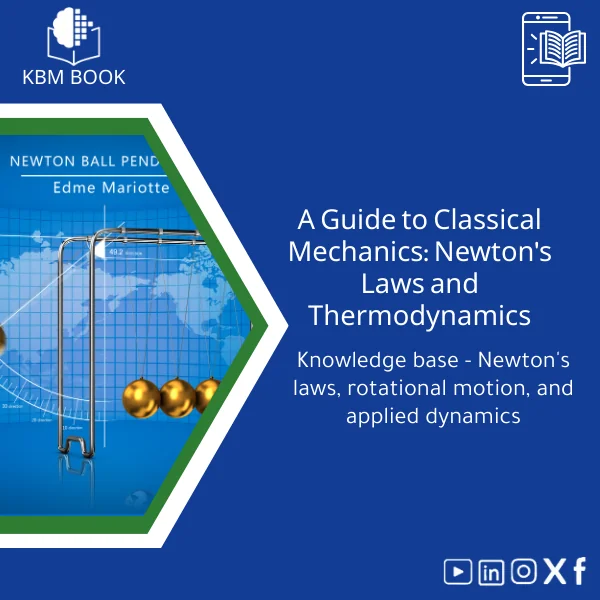
Classical Mechanics Guide: Newton’s Laws and Dynamics
Original price was: 179.00 $.139.00 $Current price is: 139.00 $.
A searchable, hierarchical Knowledge Base Module (KBM) that turns classical mechanics into a practical, ready-to-use reference for fast problem solving, lecture preparation, and applied engineering. Designed for students, researchers, and professionals who need precise access to Newton’s laws, rotational motion, and applied dynamics without the noise of textbooks.
Key benefits & value for the buyer
This Classical Mechanics KBM translates comprehensive domain knowledge into a compact, actionable database. Instead of reading a classical mechanics textbook end-to-end, you get:
- Speed: Find the exact equation, assumption, or worked example in seconds using the index and internal search.
- Clarity: Concepts broken down hierarchically — definitions, governing equations, boundary conditions, and common approximations.
- Reliability: Concise derivations and references to canonical results reduce the risk of misapplied formulas.
- Practicality: Ready-to-use formula tables, unit conversions, and code snippets for common computations (moment of inertia, torque balance, small-angle approximations).
- Reusability: Export modules into slides, lab sheets, or simulation inputs without retyping formulas.
Use cases & real-life scenarios
For students
Use as a study companion: when preparing for classical mechanics exams, open the KBM to the Newton’s laws module for focused derivations, or to the rotational motion module for torque and angular momentum problems. Worked examples include stepwise solutions commonly seen in university exams.
For researchers
Speed up model-building: reference the rigid-body dynamics entries and canonical coordinate transformations when deriving equations of motion for experimental setups. The KBM’s concise assumptions help avoid hidden pitfalls in approximations.
For professionals & instructors
Lecture prep and on-the-job calculations become faster: extract formula tables for handouts, use code snippets to verify calculations, or consult the applied dynamics module when designing mechanical systems.
Example scenario: a robotics engineer needs the moment-of-inertia formulas and rotation matrix examples to prototype a limb. Instead of searching multiple papers, use the KBM’s “rotational motion” folder to copy formulas and a tested Python snippet that computes principal moments from a mesh.
Who is this product for?
- Undergraduate and graduate students studying classical mechanics or preparing for exams.
- Researchers who need quick access to derivations, assumptions, and standard solutions.
- Engineers and applied scientists performing motion analysis, control, or mechanical design.
- Instructors and trainers preparing concise, accurate course materials and problem sets.
How to choose the right format & depth
KBMs are digital and adaptable. Choose based on how you plan to use the content:
- Student / reading-first: Searchable PDF with clear hierarchy and worked problems.
- Integration & automation: JSON/CSV exports and code snippets to import formulas and tables directly into scripts or spreadsheets.
- Teaching & distribution: Use the slide-ready extract and printable formula sheets for classroom handouts.
If unsure, select the standard package (searchable PDF + CSV tables). It covers most workflows: study, citation, and light automation. For team use, consider the multi-license option for shared access.
Quick comparison with typical alternatives
Classical textbooks and lecture notes are comprehensive but linear. Articles contain depth but are scattered. This KBM combines accuracy with immediate usability:
- Textbook: Deep narrative; slower for targeted queries. KBM: faster lookup and modular use.
- Lecture notes: Often inconsistent in scope. KBM: standardized structure and complete coverage of core topics.
- Web articles / blogs: Varying quality. KBM: curated, hierarchical, and referenceable content.
Best practices & tips to get maximum value
- Start with the module map to identify which folders (kinematics, rigid bodies, rotational motion) match your task.
- Use the CSV export for batch calculations and the JSON API for programmatic access in simulations.
- Cross-check boundary conditions and assumptions listed at the top of each derivation before applying a formula.
- Keep a versioned copy of any extracted formulas in your project repository to ensure reproducibility.
Common mistakes when buying/using similar products and how to avoid them
- Mistake: Buying a long textbook when you need quick answers. Fix: Choose a KBM that’s search-first and modular.
- Mistake: Assuming formulas apply without checking assumptions. Fix: Use the KBM’s “assumptions” block before applying results.
- Mistake: Overreliance on examples without testing. Fix: Run provided code snippets with your parameters and test edge cases.
Product specifications
- Title: Classical Mechanics Guide — Newton’s Laws and Dynamics (KBM)
- Coverage: Newton’s laws, kinematics, dynamics of particles, rotational motion, rigid body dynamics, energy & momentum, constraints, non-inertial frames, selected advanced topics.
- Includes: Formula tables, step-by-step derivations, worked problems, code snippets (Python/Matlab-style pseudocode), unit conversion tables.
- Formats: Searchable PDF, CSV formula tables, JSON export for integration (choose on checkout).
- Delivery: Instant digital download after purchase; printable and integrable assets included.
- License: Single-user and team licenses available; academic use allowed with attribution (see license file).
- Updates: Periodic content updates and errata included for 12 months from purchase.
Frequently asked questions
Is this a replacement for a classical mechanics textbook?
No — it’s a complementary, practical knowledge base. The KBM is optimized for rapid retrieval, applied calculations, and integration into workflows; textbooks remain useful for deep theoretical study and historical context.
Which formats are included and can I integrate with code?
The standard package includes a searchable PDF and CSV tables. JSON exports and code snippets are available for integration into simulations and scripts. Use the CSV/JSON to feed formulas directly into your code.
Can I use this in class materials or redistribute parts?
You can use extracts for classroom materials with proper attribution. Redistribution of the KBM files is not permitted unless you purchase a teaching or institutional license — see the license details on checkout.
What if the KBM doesn’t match my syllabus?
Contact support for guidance; most syllabi align with the KBM’s modular structure. If gaps exist, we offer tailored modules or recommend a focused supplement from our catalog.
Ready to accelerate your work in Classical Mechanics?
Instant download, editable tables, and integration-ready assets let you move from question to calculation in minutes. Purchase now and get a 12-month update guarantee plus clear licensing options for classroom or team use.
Related products
Astrophysics Book: Understanding Stars, Galaxies, and Dark Energy
A searchable, hierarchical Knowledge Base Module (KBM) that converts astrophysics and cosmology into a practical, exam-ready and research-ready reference. Designed for students, researchers, and professionals who need immediate access to reliable explanations, equations, and data models for stars, galaxies, and dark energy.
Atomic Physics Guide: Understanding Atomic and Electron Properties
Knowledge Base — Atomic/Electron Properties & Electromagnetic Interactions. A structured, searchable KBM for students, researchers, and professionals who need an authoritative atomic physics reference that organizes concepts, formulas, experiments, and practical applications from basics of atomic physics to advanced electron properties.

Comprehensive Evolutionary Biology Book on Natural Selection
Cosmology Book: Guide to Big Bang and Galaxy Evolution
Electromagnetism Book: A Comprehensive Guide to Fields and Circuits
General and Special Relativity Book on Einstein’s Theory
A structured, searchable Knowledge Base Module (KBM) that converts Einstein's General and Special Relativity into a clear, hierarchical reference: formulas, derivations, worked examples, practical applications (GPS, astrophysics), and a compact research bibliography — ready to download and integrate into study, teaching, or research workflows.
Reviews
Clear filtersThere are no reviews yet.