


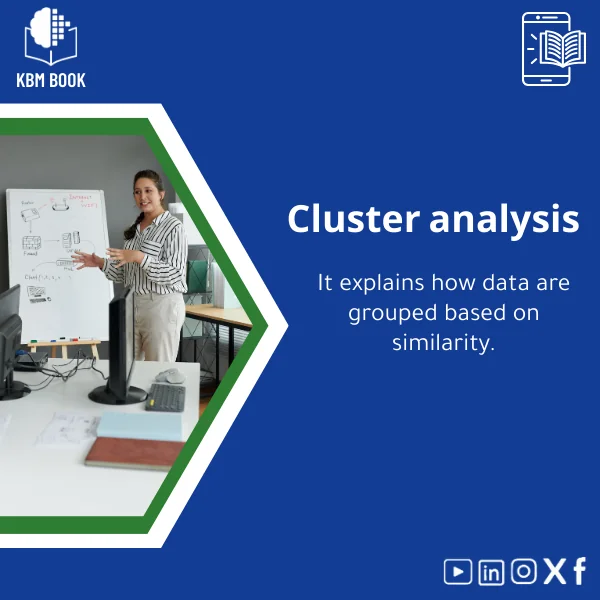
Cluster Analysis Guide for Data Classification Techniques
Original price was: 179.00 $.139.00 $Current price is: 139.00 $.
A structured, searchable Knowledge Base Module (KBM) that converts cluster analysis theory and practice into an indexed, ready-to-use database — for students, researchers, and professionals who need fast, reliable guidance on statistical cluster analysis and data clustering methods.
Key benefits & value for the buyer
From scattered notes to a single searchable KBM
Cluster Analysis Guide consolidates definitions, algorithms, example datasets, and evaluation metrics into a single hierarchical knowledge base. Instead of consulting multiple papers or an unwieldy textbook, you get an indexed resource that points you to the right method for your data size, scale, and research question.
Practical outcomes, not only theory
Each module pairs conceptual explanation with practical code and a small example dataset. Expect immediate outcomes: reproduce a clustering pipeline, run cross-validation for clustering indices, or prepare results for publication — faster and with fewer mistakes.
Time and confidence savings
- Reduce literature search time by 60% with curated references and “When to use” tags.
- Avoid common misapplications (e.g., using Euclidean distance on categorical data) with built-in checks and recommendations.
- Export-ready figures and reproducible scripts for lab reports and presentations.
Use cases & real-life scenarios
Academic research: reproducible experiments
A researcher testing new cluster validation can leverage the KBM’s example pipelines and sample datasets (with ground truth where available) to benchmark methods under controlled conditions.
Coursework and exam prep
Students can use the KBM instead of a cluster analysis book to access bite-sized theory sections, step-by-step tutorials, and exercises with solutions — ideal for labs and assignments.
Industry analytics
Product managers and analysts running customer segmentation or anomaly detection can quickly select suitable data clustering methods (density-based for noisy logs, model-based for mixed-type features) and apply ready-made scripts to production-sized samples.
Who is this product for?
This KBM is designed for:
- Students learning cluster analysis and needing structured study resources.
- Researchers seeking reproducible pipelines and curated references for statistical cluster analysis.
- Data analysts and professionals who require reliable, fast guidance on choosing and validating clustering algorithms.
If you frequently switch between literature, code, and datasets, this KBM is tailored to streamline that workflow.
How to choose the right format
The Cluster Analysis KBM is offered in multiple formats to match your workflow. Choose based on how you work:
- Searchable PDF — best if you prefer a read-first approach and want printable sections (quick lookup, citations, diagrams).
- Structured JSON/CSV — ideal for programmatic integration into analysis platforms or for building custom GUIs.
- Code-ready package (R/Python notebooks) — includes reproducible scripts and sample data for hands-on practice.
- Combined bundle — PDF + structured files + notebooks for teams that need both documentation and runnable code.
Consider your tools: use the JSON/CSV for automated pipelines, the notebooks for teaching or prototyping, and the PDF for citation and quick reading.
Quick comparison with typical alternatives
Traditional textbooks and scattered PDFs vs. this KBM:
- Textbooks: deep theory but heavy reading and poor searchability. KBM: modular, searchable, and linked to code.
- Journal articles: specific but narrow scope. KBM: synthesized guidance across methods with practical notes.
- Online tutorials: varied quality and repetition. KBM: curated, non-redundant, and referenced to primary sources.
If your goal is practical application and reproducibility rather than exhaustive textbook reading, the KBM delivers higher immediate value per hour invested.
Best practices & tips to get maximum value
- Start with the “When to use” matrix to identify candidate methods for your dataset (size, feature types, noise level).
- Run the included example scripts on a small subset before scaling to full data to validate assumptions and speed.
- Use the provided validation checklist (silhouette, Davies–Bouldin, gap statistic) and compare results, not a single metric.
- Document parameter choices and random seeds — the KBM includes a reproducibility template for lab notebooks and reports.
Common mistakes when buying or using cluster analysis resources — and how to avoid them
- Buying generic “overview” content: avoid resources that only summarize methods without examples. Look for runnable code — included here.
- Applying algorithms blindly: the KBM flags inappropriate distance measures and suggests preprocessing steps.
- Ignoring validation: use the module’s built-in validation workflows to compare cluster stability and interpretability.
- Overpaying for fragmented content: this KBM replaces multiple scattered downloads with a single curated package, reducing hidden costs of time and integration.
Product specifications
- Title: Cluster Analysis Guide for Data Classification Techniques
- Formats included: Searchable PDF, structured JSON/CSV exports, Jupyter notebooks (Python), R scripts
- Modules: Distance metrics, hierarchical clustering, partitioning methods, density-based clustering, model-based clustering, validation indices, applied examples
- Language: English
- License: Single-user digital license with optional team license (see purchase options)
- Delivery: Immediate download after purchase; contains README and quick-start guide
- Compatibility: Works with standard data tools (Pandas, scikit-learn, R’s cluster & mclust packages)
Frequently asked questions
Can I use the KBM with my existing Python or R projects?
How is this different from a cluster analysis book or a free PDF?
What if I’m new to statistics — is this too advanced?
Do you provide updates or support after purchase?
Ready to stop searching and start classifying?
Purchase the Cluster Analysis KBM and get an organized, evidence-based toolkit that reduces trial-and-error and accelerates reproducible results. Immediate download — include it in coursework, research, or your analytics stack today.
Not sure which format you need? Choose the combined bundle for maximum flexibility — downloadable immediately after checkout.
Related products
Atomic Physics Guide: Understanding Atomic and Electron Properties
Knowledge Base — Atomic/Electron Properties & Electromagnetic Interactions. A structured, searchable KBM for students, researchers, and professionals who need an authoritative atomic physics reference that organizes concepts, formulas, experiments, and practical applications from basics of atomic physics to advanced electron properties.
Classical Mechanics Guide: Newton’s Laws and Dynamics
A searchable, hierarchical Knowledge Base Module (KBM) that turns classical mechanics into a practical, ready-to-use reference for fast problem solving, lecture preparation, and applied engineering. Designed for students, researchers, and professionals who need precise access to Newton’s laws, rotational motion, and applied dynamics without the noise of textbooks.
Inorganic Chemistry Guide: Bonding and Crystal Solids
A structured, searchable Knowledge Base Module (KBM) that converts inorganic chemistry fundamentals and advanced topics—bonding models, lattice structures, defects, and solid-state properties—into a practical digital reference for students, researchers, and professionals who need fast, reliable answers without wading through textbooks.
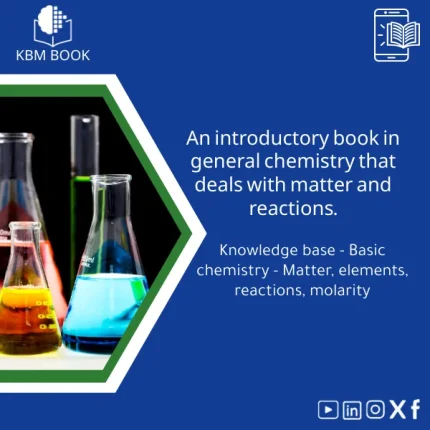
Introductory General Chemistry Book on Matter and Reactions
A structured, searchable Knowledge Base Module (KBM) that converts core general chemistry concepts — matter, elements, reactions, stoichiometry and molarity — into a hierarchical reference you can query, teach from, or integrate into study workflows. Ideal as a concise General Chemistry book alternative for students, researchers, and professionals who need accurate, practical chemistry knowledge fast.
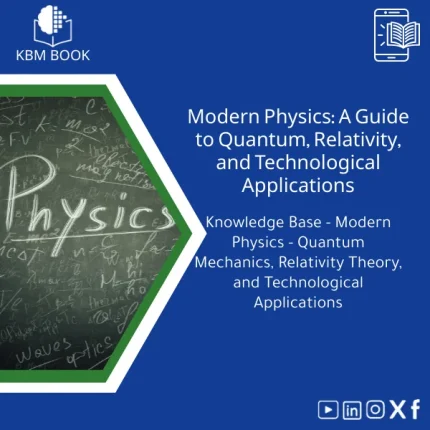
Modern Physics Book: Quantum, Relativity, and Tech Applications Guide
A structured, searchable Knowledge Base Module (KBM) that turns modern physics — quantum mechanics, special & general relativity, and contemporary technological applications — into a hierarchical, practical reference for students, researchers, and professionals who need quick, reliable access to advanced concepts and formulas.
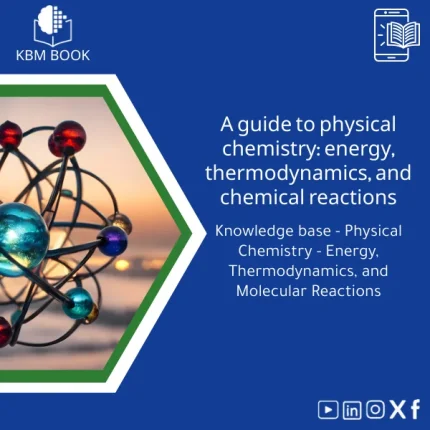
Physical Chemistry Guide: Energy, Thermodynamics & Interactions
A structured Knowledge Base Module (KBM) for Physical Chemistry that converts core theory, worked examples, and applied datasets into a searchable, hierarchical database — ideal for students, researchers, and professionals who need fast, reliable access to chemical thermodynamics basics and molecular interaction models.
Reviews
Clear filtersThere are no reviews yet.