


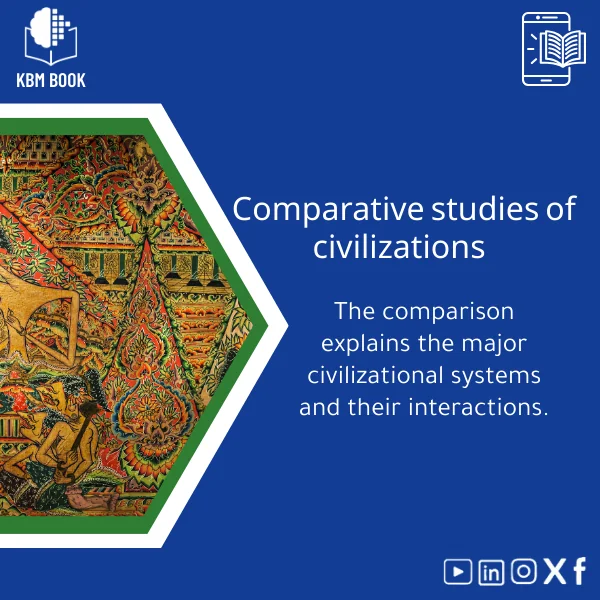
Comparative Civilizations Studies: A Guide to Civilizational Interactions
Original price was: 179.00 $.139.00 $Current price is: 139.00 $.
A structured, searchable Knowledge Base Module (KBM) that maps major civilizations, their institutions, contact zones, and interaction mechanisms — designed for students, researchers, and professionals who need fast, reliable access to organized comparative knowledge.
Key benefits & value for the buyer
Comparative Civilizations Studies transforms dispersed scholarship into a compact, navigable database. Instead of hunting through books and articles, you get a modular reference with clear taxonomies, interaction typologies (trade, diplomacy, migration, diffusion), and evidence-linked summaries.
Practical advantages
- Save research time — jump directly to curated entries and instantly export tables for citations.
- Consistent structure — every civilization profile follows the same hierarchy (political systems, economy, religion, external relations), enabling reliable cross-case comparison.
- Reproducible outputs — data tables and JSON exports make it simple to reproduce results in papers or teaching materials.
- Durability — digital formats designed for long-term academic use and future-proof migration.
Use cases & real-life scenarios
How researchers and professionals use this KBM in daily workflows:
Students
Build a literature-backed comparative essay quickly: use pre-classified sources, export a timeline of interactions, and paste formatted citations into your reference manager.
Researchers
Generate comparative matrices for journal articles: filter entries by period, interaction type, or region and export CSV for quantitative coding.
Policy analysts & educators
Create concise briefs and classroom modules: extract policy-relevant case studies and chronological contact maps to illustrate cross-civilizational dynamics.
Example scenario
Preparing a seminar on Silk Road exchanges: import the KBM’s trade-network table into Excel, filter for 8th–14th centuries, and create a visualization in minutes — complete with source links for student reading lists.
Who is this product for?
The KBM is built for anyone who needs structured knowledge about civilizational interactions:
- Undergraduate and graduate students in history, anthropology, political science, and cultural studies.
- Academic and independent researchers conducting comparative or cross-cultural analyses.
- Professionals in cultural policy, diplomacy, and education who need reliable, concise references.
- Instructors who want plug-and-play modules for syllabi and assessment design.
How to choose the right format & license
The KBM is offered in multiple formats to fit common workflows. Choose based on how you plan to use the data.
- Markdown + PDF: Best for teaching packs, student readings, and printed summaries.
- CSV / XLSX: Ideal for quantitative coding, spreadsheets, and visualization tools.
- JSON: Use when integrating with research apps, databases, or custom web tools.
- Single-user vs. Institutional license: Single-user for independent research; institutional for courses and team use — choose institutional if you plan to share within an organization.
Quick comparison with typical alternatives
Compared with traditional books or scattered article collections, this KBM emphasizes structure, machine-readability, and exportability.
- Books: deep narrative but hard to extract tabular data quickly.
- Literature reviews: rich context but often inconsistent taxonomy and duplication.
- This KBM: consistent taxonomy, ready-to-export datasets, and linked sources for verification.
Best practices & tips to get maximum value
- Decide your workflow first — choose CSV/JSON for analysis, Markdown for teaching materials.
- Use filters (period, contact type, region) before exporting to limit scope and improve focus.
- Reference the KBM citation metadata when publishing — each entry includes source links to primary literature.
- Combine KBMs — layer Comparative Civilizations Studies with other KBMs (e.g., trade networks, religious systems) for multidisciplinary projects.
Common mistakes when buying/using similar products and how to avoid them
- Mistake: Buying a single-format file and discovering it’s not importable into your tools. Fix: Choose the format that matches your toolchain (CSV/JSON/Markdown).
- Mistake: Assuming all KBMs use the same taxonomies. Fix: Read the module’s taxonomy overview — this KBM uses explicit, documented hierarchies.
- Mistake: Overlooking licensing for classroom sharing. Fix: Select an institutional license if you intend distribution within a course.
Product specifications
- Product type: Digital Knowledge Base Module (KBM) — Comparative Civilizations Studies
- Formats included: Markdown, PDF (summaries), CSV, XLSX, JSON
- Structure: Hierarchical taxonomy — Civilizational Families → Periods → Institutions → Interactions → Sources
- Size: ~250+ indexed entries, 1,200+ cited source links, 10+ comparative matrices and timelines
- Compatibility: Import-ready for spreadsheet apps, reference managers, Obsidian/Notion (Markdown/JSON)
- License options: Single-user, Multi-user (team), Institutional
- Delivery: Instant download after purchase — compressed archive with readme and usage notes
- Usage notes: Citation metadata included (author, year, source link); export templates for APA/Chicago
Frequently asked questions
What exactly is included in the Comparative Civilizations Studies KBM?
The KBM includes hierarchical civilization profiles, interaction typologies (e.g., trade, migration, diplomacy), pre-built timelines, comparative matrices, and raw export files (CSV/JSON/Markdown) with full citation metadata. Each entry links to primary or secondary sources for verification.
Can I use data from the KBM in published research?
Yes. The KBM is designed for academic use. Each entry has source information you must cite. Check your license: single-user covers personal research; institutional licenses are required for course-wide distribution or commercial reuse.
Is the KBM updated with new scholarship?
KBMBook maintains periodic updates. Purchase includes the current version and the option to receive update notifications. Major dataset revisions may be offered as paid upgrades depending on scope.
What if I need a custom export or additional fields?
We provide usage notes and simple scripts for common exports. For bespoke dataset requests (e.g., additional fields, custom taxonomies), contact KBMBook for a consulting or customization quote.
Ready to streamline your research?
Purchase the Comparative Civilizations Studies KBM to get a structured, research-ready database that saves hours of literature searching and organization. Instant download, multiple formats, and clear citation metadata make this KBM a reliable foundation for papers, lectures, and policy work.
Still unsure? If you worry about format fit or licensing, select the single-user option and test the files immediately — refunds and support options are available within the purchase policy window.
Related products
Analytical Chemistry Book: Qualitative and Quantitative Methods Guide
Atomic Physics Guide: Understanding Atomic and Electron Properties
Knowledge Base — Atomic/Electron Properties & Electromagnetic Interactions. A structured, searchable KBM for students, researchers, and professionals who need an authoritative atomic physics reference that organizes concepts, formulas, experiments, and practical applications from basics of atomic physics to advanced electron properties.
Classical Mechanics Guide: Newton’s Laws and Dynamics
A searchable, hierarchical Knowledge Base Module (KBM) that turns classical mechanics into a practical, ready-to-use reference for fast problem solving, lecture preparation, and applied engineering. Designed for students, researchers, and professionals who need precise access to Newton’s laws, rotational motion, and applied dynamics without the noise of textbooks.
Comprehensive Nuclear Physics Book on Structure and Radioactivity
Electromagnetism Book: A Comprehensive Guide to Fields and Circuits
Introductory General Chemistry Book on Matter and Reactions
A structured, searchable Knowledge Base Module (KBM) that converts core general chemistry concepts — matter, elements, reactions, stoichiometry and molarity — into a hierarchical reference you can query, teach from, or integrate into study workflows. Ideal as a concise General Chemistry book alternative for students, researchers, and professionals who need accurate, practical chemistry knowledge fast.

Reviews
Clear filtersThere are no reviews yet.