


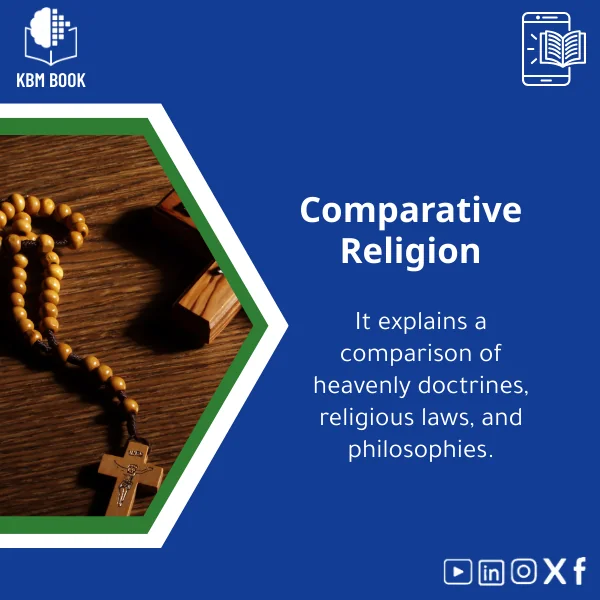
Comparative Religion Study Guide and Resource Tool
Original price was: 349.00 $.279.00 $Current price is: 279.00 $.
A structured, searchable Knowledge Base Module (KBM) for comparative religion: compare doctrines, laws, and religious philosophies across traditions in a hierarchical, research-ready format — designed for students, researchers, and professionals who need quick, reliable access to organized religious knowledge.
Key benefits & value for the buyer
This KBM translates the complex field of comparative religion into a practical, evidence-centered tool. Instead of scattered notes or lengthy monographs, you get a compact, searchable database that emphasizes clarity, traceability, and practical comparability.
How features translate into benefits
- Structured hierarchy: Learn progressively — from foundational beliefs to specialized jurisprudence — reducing time-to-insight for exams, papers, or policy briefs.
- Side-by-side matrices: Quickly identify convergences and divergences between traditions for classroom debate or comparative analysis.
- Source-tagging and citations: Every item links to primary sources and accepted secondary literature, so you can cite reliably without re-checking every claim.
- Exportable data: Pull tables into spreadsheets, qualitative analysis software, or LMS platforms — practical for research and teaching workflows.
Use cases & real-life scenarios
Examples that show immediate ROI for students, researchers and professionals:
- Graduate seminar prep: Build weekly readings and lecture slides from KBM topic modules (doctrine, ritual law, hermeneutics) in minutes, not days.
- Comparative thesis: Extract standardized data tables to support coded content analysis across traditions and populate methodology appendices.
- Interfaith policy development: Provide concise, sourced summaries of legal positions and ethical teachings to stakeholders crafting inclusive guidelines.
- Continuing education for clergy and trainers: Use pre-organized modules to create short courses with assessment-ready materials.
- Exam revision: Students can create flashcards from the module’s labeled propositions and key quotations.
Who is this product for?
The Comparative Religion Study Guide and Resource Tool is specifically tailored to:
- Undergraduate and graduate students in theology, religious studies, and anthropology.
- Academic researchers conducting comparative studies or systematic reviews.
- Policy analysts, educators, and interfaith coordinators who need concise, sourced summaries.
- Consultants and trainers who prepare curriculum or continuing-education materials.
How to choose the right KBM format
The KBM is offered in multiple formats. Choose based on how you will use the data:
- Searchable PDF (recommended for reading & citation): Ideal for students and lecturers who need paginated, citable text.
- CSV tables (recommended for coding & quantitative comparison): Use when performing content analysis or importing into statistical software.
- JSON schema (recommended for developers & LMS integration): Plug the KBM into web apps or internal knowledge systems.
- Combined package: If you need both citation-ready text and raw data, choose the bundle to save time and ensure consistency between formats.
Quick comparison with typical alternatives
How this KBM differs from books, articles, or personal notes:
- Books: Deep but linear — good for narrative learning. KBM is modular and searchable for targeted research tasks.
- Journal articles: Focused and novel, but narrow. KBM aggregates canonical positions and established secondary research across topics.
- Personal notes: Unstructured and inconsistent. KBM provides a standardized taxonomy that scales across projects and collaborators.
Best practices & tips to get maximum value
- Start with the top-level taxonomy to define your research questions; use submodules to drill down.
- When preparing a syllabus, export the “required readings” table and attach direct citations to week-by-week modules.
- For coding and analysis, use the CSV exports and map the KBM fields to your codebook to reduce preprocessing time.
- Always cross-reference the KBM citations when making claims in publications — the KBM is a tool for efficiency, not a substitute for primary-source scholarship.
Common mistakes when buying or using similar products — and how to avoid them
- Mistake: Buying a single-format file and later needing the data. Fix: Choose the bundle with PDF + CSV/JSON.
- Mistake: Assuming summaries equal primary sources. Fix: Use the KBM’s source links to verify and cite original texts.
- Mistake: Poor integration into workflows. Fix: Use provided JSON schema or CSV templates to automate imports into your LMS or analysis tools.
Product specifications
- Title: Comparative Religion Study Guide and Resource Tool
- Formats: Searchable PDF, CSV tables, JSON schema, combined bundle
- Coverage: Doctrines, ritual laws, ethical frameworks, interpretative traditions; 12 major world traditions + comparative matrices
- Structure: Hierarchical taxonomy (Chapters → Themes → Claims → Sources)
- Language: English (Arabic metadata and navigation available in KBMBook ecosystem)
- Compatibility: Standard CSV / UTF-8; JSON follows a documented schema for direct integration
- License: Single-user digital license; institutional and teaching licenses available at purchase
- Delivery: Immediate digital download after purchase
Frequently asked questions
Can I cite the KBM directly in academic work?
Yes — the searchable PDF includes paginated, source-tagged sections designed for citation. However, the KBM aggregates primary and secondary materials; when making original claims, you should also consult and cite the primary sources linked within the KBM.
Does the KBM include non-Western religious traditions?
Yes. The module covers twelve major traditions (including Abrahamic, Dharmic, East Asian, and indigenous systems) and provides comparative matrices that highlight thematic overlaps and differences.
What formats are included and which should I choose?
Choose PDF for teaching and citation, CSV for data analysis, and JSON if you want programmatic access or LMS integration. The combined bundle is recommended for research teams and instructors.
What about updates and accuracy?
KBMBook curates and updates modules periodically. Purchased KBMs include a version history and update notes. Institutional buyers can request tailored updates or additional sourcing packages.
Ready to integrate comparative religion into your workflow?
Purchase a research-ready KBM that saves hours of preparation and gives you reliable, source-linked comparisons across traditions. Immediate download and multi-format exports make it easy to start.
Not sure which format fits your project? Contact our support team or select the combined bundle for maximum flexibility.
Related products
Analytical Chemistry Book: Qualitative and Quantitative Methods Guide
Atomic Physics Guide: Understanding Atomic and Electron Properties
Knowledge Base — Atomic/Electron Properties & Electromagnetic Interactions. A structured, searchable KBM for students, researchers, and professionals who need an authoritative atomic physics reference that organizes concepts, formulas, experiments, and practical applications from basics of atomic physics to advanced electron properties.
Cell Biology Guide: Structure, Division, and Transport Insights
Comprehensive Genetics Book: DNA, Mendelian Genetics & Engineering
A structured, searchable knowledge base module (KBM) that turns genetics theory and practice into an immediately usable digital reference — from DNA structure to Mendelian genetics and contemporary genetic engineering techniques — optimized for students, researchers, and professionals who need reliable answers fast.
Electromagnetism Book: A Comprehensive Guide to Fields and Circuits
Modern Physics Book: Quantum, Relativity, and Tech Applications Guide
A structured, searchable Knowledge Base Module (KBM) that turns modern physics — quantum mechanics, special & general relativity, and contemporary technological applications — into a hierarchical, practical reference for students, researchers, and professionals who need quick, reliable access to advanced concepts and formulas.
Molecular Biology Guide: Transcription, Translation & Repair
Physical Chemistry Guide: Energy, Thermodynamics & Interactions
A structured Knowledge Base Module (KBM) for Physical Chemistry that converts core theory, worked examples, and applied datasets into a searchable, hierarchical database — ideal for students, researchers, and professionals who need fast, reliable access to chemical thermodynamics basics and molecular interaction models.
Reviews
Clear filtersThere are no reviews yet.