


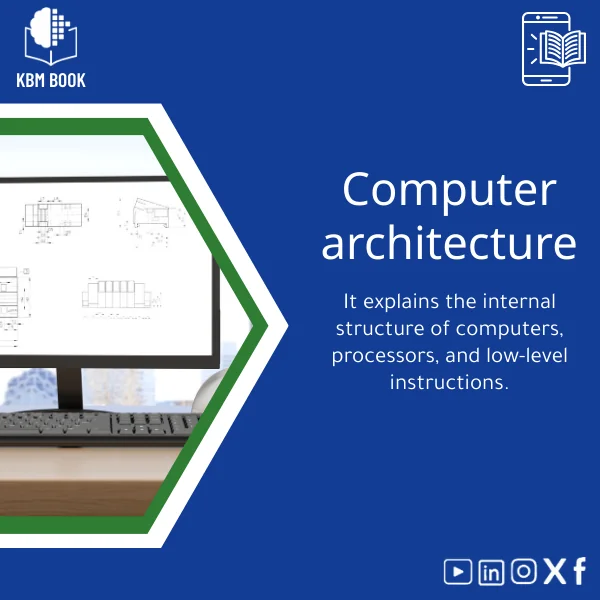
Computer Organization Book: Understanding Hardware and Software Interaction
Original price was: 179.00 $.139.00 $Current price is: 139.00 $.
A structured, searchable Computer Organization book designed as a Knowledge Base Module (KBM) that maps hardware components to software behavior — ideal for students, researchers, and professionals who need fast, reliable access to organized technical knowledge.
Key benefits & value for the buyer
This Computer Organization book is organized as a Knowledge Base Module (KBM) — not a long, linear textbook. Every topic is modular, cross-referenced, and optimized for rapid lookup and practical application.
What you gain
- Speed of access: Hierarchical indexing and keyword-ready entries reduce search time in study and work scenarios.
- Clarity of concepts: Visual diagrams and step-by-step flows translate circuit-level details into software-facing effects.
- Actionable examples: Real assembly examples, microarchitecture timing, and diagnostics you can reuse in labs and projects.
- Repeatable learning path: From beginner to advanced modules, the KBM maps a reliable progression without redundant content.
- Portable knowledge: Downloadable PDF and data exports integrate with note systems, LMS, or research databases.
Use cases & real-life scenarios
Below are common ways the Computer Organization book is used in academic and professional workflows.
For students
Use as a fast reference during labs and exams: look up pipeline hazards, cache coherence examples, or sample assembly sequences without flipping entire textbooks. Follow the guided modules to prepare assignments step-by-step.
For researchers
Cross-reference hardware-level assumptions when modeling systems. The KBM includes concise summaries of microarchitectural trade-offs and citations for deeper reading — saving research time and reducing errors in simulation assumptions.
For professionals
Systems engineers and embedded developers use the KBM to debug performance issues: find the exact interaction between instruction sets and memory hierarchy that explains latency spikes, with concrete diagnostic steps to test hypotheses.
Who is this product for?
Designed for:
- Undergraduate and graduate computer science students seeking a reliable Computer Organization textbook alternative.
- Researchers who need an authoritative, searchable Computer Organization PDF for citation and quick checks.
- Engineers and developers who must understand hardware and software interaction to optimize systems or debug hardware-related software faults.
- Instructors and trainers building modular lesson plans and labs.
How to choose the right version
The KBM is offered in formats to fit typical workflows. Choose according to how you’ll use it:
- PDF (single-file) — best for offline reading, printing for class, or archiving.
- Interactive KB export (CSV/JSON) — ideal for integrating into searchable knowledge systems, LMS, or personal databases.
- Bundle — includes both PDF and export formats plus an errata log and upcoming-update access.
Pick the PDF if you want a ready-to-read Computer Organization book. Pick the KB export if you will integrate entries into tools or build custom study apps.
Quick comparison with typical alternatives
Traditional textbooks vs. KBM-based Computer Organization book:
- Length: Textbooks are long and linear; the KBM is modular and indexable.
- Searchability: KBM entries are optimized for keyword lookup; textbooks require manual navigation.
- Updates: KBMs are designed for periodic revisions and errata; printed books can become outdated faster.
- Practical orientation: KBM emphasizes practical examples and diagnostics; many textbooks focus on theory first.
Best practices & tips to get maximum value
- Start with the “Foundations” module to align terminology and avoid confusion when reading advanced modules.
- Use the included example-led diagnostics when troubleshooting real hardware/software issues — replicate the steps in a controlled environment.
- Integrate the KB export into your note-taking tool to make a custom cheat-sheet keyed to your projects or courses.
- Subscribe to update notifications (bundle purchasers) to receive errata and module revisions relevant to new architectures.
Common mistakes when buying or using similar products — and how to avoid them
- Buying a long textbook expecting fast lookup: Choose the KBM for targeted searches and quick answers.
- Using examples without context: Read the module introduction before applying an example; hardware behavior depends on surrounding assumptions.
- Assuming a single format fits all workflows: If you integrate with tools, get the export format rather than only a PDF.
- Ignoring updates: Check the revision log to avoid working with outdated microarchitecture details.
Product specifications
- Title: Computer Organization Book — Understanding Hardware and Software Interaction
- Format options: PDF (print-ready), KB export (CSV/JSON), Bundle (PDF + KB export + errata)
- Structure: Hierarchical KBM — Foundations → Microarchitecture → ISA → Memory Systems → Peripherals → OS Interaction → Case Studies
- Pages (PDF approx.): 280 pages of structured content with diagrams and code snippets
- Searchability: Indexed entries with keywords and cross-references
- Language: English (technical terminology aligned to standard CS usage)
- License: Single-user digital license; institutional and classroom licenses available
- Updates: Periodic content updates; bundle includes update notifications
- Usage notes: Suitable for integration with learning management systems and research databases
Frequently asked questions
What formats are included and how do I open them?
The primary formats are PDF for reading and print, and export files (CSV/JSON) for integration with knowledge tools. PDFs open in any modern reader; CSV/JSON can be imported into databases, spreadsheets, or learning platforms.
Is this a substitute for a Computer Organization textbook?
It depends on your need. The KBM is superior for fast lookup, labs, and practical diagnostics. If you need extended narrative theory and exercises in a coursebook style, use the KBM as a focused complement to a traditional textbook.
Can I share the KBM with my class or colleagues?
Digital license is single-user by default. Institutional or classroom licenses are available — contact KBMBook for group licensing options and integration assistance.
What if the material becomes outdated?
KBMBook issues periodic updates and errata logs. Bundle purchasers receive notifications and updated files where applicable. We also document assumptions and architecture versions within each module to make changes transparent.
Ready to work with hardware and software with clarity?
Get a professionally organized, searchable Computer Organization book that saves study and debug time. Choose the format that fits your workflow and start building reliable system knowledge today.
Related products
Biochemistry Book: Understanding Chemical Processes in Living Systems

Comprehensive Evolutionary Biology Book on Natural Selection

Cosmology Book: Guide to Big Bang and Galaxy Evolution

General Physics Book: Fundamentals of Force, Motion, Energy

Introductory General Chemistry Book on Matter and Reactions
A structured, searchable Knowledge Base Module (KBM) that converts core general chemistry concepts — matter, elements, reactions, stoichiometry and molarity — into a hierarchical reference you can query, teach from, or integrate into study workflows. Ideal as a concise General Chemistry book alternative for students, researchers, and professionals who need accurate, practical chemistry knowledge fast.


Reviews
Clear filtersThere are no reviews yet.