


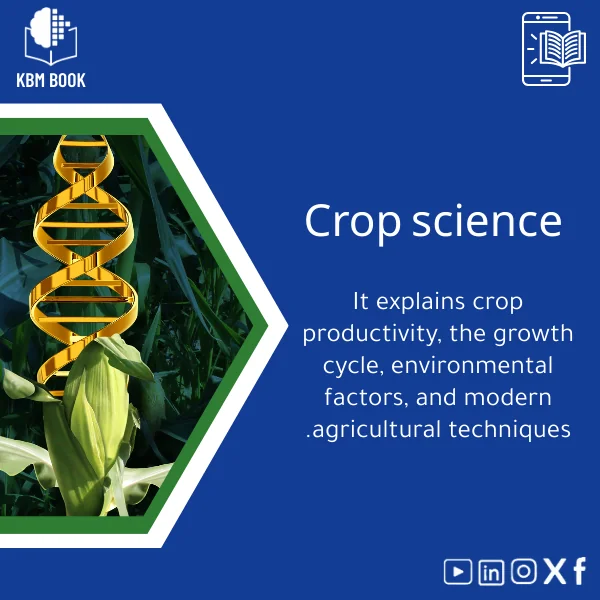
Crop Science Guide: Productivity and Growth Techniques
Original price was: 179.00 $.139.00 $Current price is: 139.00 $.
A structured, searchable Knowledge Base Module (KBM) that converts crop science into a hierarchical, practical reference — from crop production fundamentals and growth stages to environmental management and modern techniques — designed for rapid lookup, teaching, and applied research.
Key benefits & value for students, researchers and professionals
This crop science KBM reframes academic content into a pragmatic digital database so you can find validated procedures, definitions, and thresholds without reading whole chapters. Benefits translate directly into measurable outcomes:
- Faster decision-making: field diagnostics and corrective actions (fertilization rates, irrigation windows) presented as quick decision trees.
- Reliable references: each entry cites primary sources and experimental ranges — suitable for laboratory reports and field records.
- Modular learning paths: instructors can assemble a course sequence (seed biology → growth stages → yield analysis) in minutes.
- Cross-disciplinary links: integrates soil science, plant physiology, pest management, and post-harvest practices for end-to-end workflows.
Use cases & real-life scenarios
Undergraduate and university courses
Replace fragmented lecture notes with a consistent “university crop science text” that instructors adapt into weekly modules, quizzes, and lab worksheets.
Research planning and literature synthesis
Researchers extract experimental parameters (e.g., optimal planting densities, growth stage sampling windows) and export them into project spreadsheets for reproducibility.
Extension and on-farm advisory
Extension officers use quick-reference threshold tables and spray timing calendars to provide actionable recommendations to farmers during the season.
Professional certification & continuing education
Professionals preparing for certification exams or competency assessments use the KBM as a compact “crop production fundamentals” syllabus with practice checklists.
Who is this product for?
The KBM is explicitly designed for:
- Students seeking a structured, exam-focused “crop science book” alternative.
- Researchers needing quick access to protocols and parameter ranges for experimental design.
- Agronomists and field technicians who require portable, evidence-based decision aids.
- Instructors and curriculum designers who want modular materials without building content from scratch.
How to choose the right KBM format
This is a digital product; choose the package that matches your workflow:
- PDF-first (readable): best for students who prefer printable chapters and annotated study notes.
- Data-first (CSV/JSON): ideal for researchers and labs that import tables into analysis software or field apps.
- Combined package: includes indexed PDF + exportable tables for instructors and extensionists who need both formats.
- License options: single-user, classroom, or institutional; pick classroom/institutional when reusing content for courses.
Quick comparison with typical alternatives
Compared to textbooks, articles, or scattered lecture slides, the KBM offers:
- Faster retrieval: topic-based indices vs. linear chapters.
- Practical tables: ready-to-use thresholds, sample sizes, and sampling schedules vs. narrative descriptions.
- Reduced redundancy: consolidated technical entries instead of duplicated explanations across papers.
If your priority is deep theoretical exposition, a full textbook still helps; if your priority is applied crop productivity work, the KBM is the more efficient tool.
Best practices & tips to get maximum value
- Start with the “Growth Stages” module before applying nutrient or pest modules — it aligns diagnostics to phenology.
- Use the CSV exports to build your field-monitoring spreadsheets and feed them into your farm-management system.
- Keep the KBM’s version notes with your lab notebook so results remain traceable to the content revision used.
- Combine the KBM with local extension bulletins to adapt thresholds to regional climates and cultivars.
Common mistakes when buying or using similar products — and how to avoid them
- Buying a single-format file only: If you later need data, you’ll waste time retyping. Choose the combined package if you expect to analyze data.
- Assuming universal thresholds: Avoid applying generic nutrient or pesticide thresholds without local calibration; use the KBM as a starting point, not a substitute for local trials.
- Not checking licensing: For classroom reuse, select a classroom or institutional license to avoid copyright issues.
Product specifications
- Title: Crop Science Guide: Productivity and Growth Techniques
- Format: Indexed PDF (readable); CSV & JSON exports (data tables); optional packaged ZIP for combined purchase
- Modules: 12 core modules + 30 submodules (seed biology, phenology, water management, nutrition, pests, diseases, post-harvest)
- Language: English (KBMbook provides Arabic metadata and support notes)
- Compatibility: Any PDF reader; CSV/JSON importable into Excel, R, Python, or farm-management apps
- License: single-user, classroom, institutional (select at checkout)
- Delivery: instant download after purchase; includes version notes and citation guide
Usage notes: Designed as a practical reference; always pair with local field data for final recommendations.
Frequently asked questions
What file formats are included? Can I buy a PDF only?
The standard package includes an indexed PDF plus CSV/JSON tables for the data-driven sections. A PDF-only option is available if you need printable chapters, but we recommend the combined package for researchers and instructors who will export data.
Is this material suitable as a “university crop science text” for course adoption?
Yes — the KBM is structured for course construction with modular chapters, learning objectives, and exportable worksheets. For institutional reuse, please select the classroom or institutional license at checkout.
How often is the KBM updated and are updates free?
KBMs receive periodic updates for methodology and important new findings. Minor updates are free for purchasers of the combined package for one year; major edition releases are available at a discounted upgrade rate. Update policy is detailed at download.
Can I cite the KBM in my thesis or report?
Yes. Each module contains a recommended citation and links to primary sources. Use the provided citation guide to ensure academic referencing standards are met.
Get the Crop Science KBM and start applying knowledge faster
Confidently move from theory to field practice with a structured, evidence-linked knowledge base. Choose the format that matches your workflow and purchase the package that removes friction from research, teaching, and field advisories.
Concerns about price, format, or fit? Contact support for a sample preview of the table of contents and one module extract before purchase. We also provide classroom licensing and upgrade options to match institutional needs.
Related products
Astronomy Observational Techniques Guide for Celestial Motion
Biological Anthropology Study Guide on Human Evolution
Comprehensive Botany Book on Plant Taxonomy and Photosynthesis
A structured, searchable botany book designed as a Knowledge Base Module (KBM) — an end-to-end reference on plant taxonomy, organ structure, and the biochemistry of photosynthesis. Built for students, researchers, and professionals who need reliable, hierarchical knowledge they can search, cite, and apply immediately.
Comprehensive Genetics Book: DNA, Mendelian Genetics & Engineering
A structured, searchable knowledge base module (KBM) that turns genetics theory and practice into an immediately usable digital reference — from DNA structure to Mendelian genetics and contemporary genetic engineering techniques — optimized for students, researchers, and professionals who need reliable answers fast.
Comprehensive Nuclear Physics Book on Structure and Radioactivity
Electromagnetism Book: A Comprehensive Guide to Fields and Circuits
Organic Chemistry Guide: Carbon Chains and Reactions
Physical Chemistry Guide: Energy, Thermodynamics & Interactions
A structured Knowledge Base Module (KBM) for Physical Chemistry that converts core theory, worked examples, and applied datasets into a searchable, hierarchical database — ideal for students, researchers, and professionals who need fast, reliable access to chemical thermodynamics basics and molecular interaction models.
Reviews
Clear filtersThere are no reviews yet.