


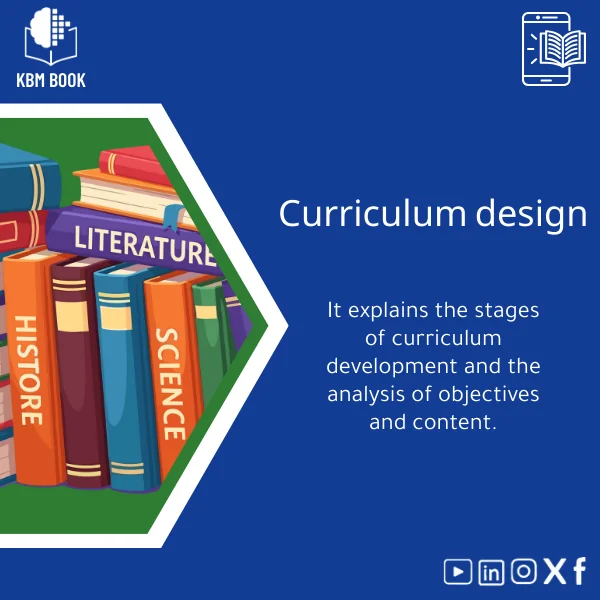
Curriculum Design Guide for Objectives and Content Analysis
Original price was: 179.00 $.139.00 $Current price is: 139.00 $.
A structured, searchable knowledge base module that guides you through curriculum design stages — from defining objectives to detailed content analysis — built for students, researchers, and professionals who need reliable, ready-to-use curriculum frameworks.
Key benefits & value for the buyer
This Curriculum Design knowledge base translates raw pedagogy into repeatable workflows. Rather than a long, unstructured book, you get a compact, hierarchical database that makes curriculum design actionable:
From features to buyer value
- Structured objectives library: Save time when writing course outcomes — select, adapt, and map objectives to assessments instantly.
- Content analysis matrices: Identify gaps and redundancies so your syllabus is coherent and balanced across cognitive levels.
- Interoperable templates: Export to Word, PDF, or CSV for LMS import and accreditation reports — practical for committees and reviewers.
- Versionable modules: Update learning sequences without rebuilding from scratch — useful for iterative course improvement.
Use cases & real-life scenarios
How people actually use this curriculum design book (KBM) in day-to-day work:
Academic instructor preparing a semester
Example: A lecturer mapping three course objectives to weekly topics. They use the objectives analysis table to assign assessments and recommended readings, then export a syllabus template for the LMS — done in under 2 hours instead of multiple days.
Program coordinator aligning outcomes for accreditation
Example: A program coordinator runs the content analysis to produce an alignment matrix that shows where each graduate attribute is assessed across modules, creating a clean report for accrediting bodies.
Graduate researcher building a literature-informed curriculum
Example: A PhD candidate uses the knowledge base to compare competency frameworks, annotates sources, and produces a reproducible content map for thesis appendices.
Who is this product for?
Designed for students, researchers, and professionals who need structured knowledge databases across education and training fields for quick access to reliable information. Typical users:
- University instructors and course designers
- Curriculum specialists and accreditation teams
- Education researchers conducting comparative analysis
- Instructional designers and workplace trainers
How to choose the right module
Not all curriculum resources are equal. Use these criteria to decide if this KBM fits your needs:
- Scope: Do you need a focused module on objectives & content analysis or a broader curriculum design book? This KBM is optimized for objectives-to-content workflows.
- Format compatibility: Do you need exports for LMS, PDF reports, or data tables for research? This module supports common export formats.
- Depth vs. speed: If you prefer concise, actionable templates rather than theory-dense textbooks, this guide is appropriate.
Quick comparison with typical alternatives
How this Curriculum design KBM differs from books, articles, or generic templates:
- Vs. traditional books: Faster to use — searchable fields and templates replace long narrative chapters.
- Vs. academic articles: Practical alignment tools and exportable matrices, not just conceptual frameworks.
- Vs. generic templates: Hierarchical modules and evidence-based guidance reduce the need for customization from scratch.
Best practices & tips to get maximum value
- Start with the objectives library: select and adapt objectives before drafting weekly content.
- Use the content analysis matrix to discover overlaps early and merge redundant sessions.
- Export interim versions for stakeholder review — it keeps approvals focused on the right elements.
- Version your KBM snapshots after major changes to keep a clean revision history for accreditation evidence.
Common mistakes when buying/using similar products and how to avoid them
Avoid these pitfalls:
- Buying a generic “syllabus pack”: These often lack objective-to-assessment alignment — choose a module that includes mapping tools.
- Ignoring export needs: If your institution requires specific formats, confirm compatibility before purchase.
- Skipping validation: Validate chosen objectives against your local program outcomes to prevent misalignment.
Product specifications
- Product type: Digital Knowledge Base Module (KBM) focused on curriculum design (objectives & content analysis)
- Structure: Hierarchical modules, subcategories for objectives, content units, assessment mapping
- Formats included: PDF guide, editable Word/ODT templates, CSV/Excel export for matrices, JSON for database import
- Compatibility: LMS import via CSV, standard office software, and simple JSON ingestion for research tools
- Language: English (structured, referenced)
- Delivery: Instant download after purchase — reusable and updatable files
- Usage notes: Designed for customization; license permits individual and institutional use per KBMBook terms (see store for details)
Frequently asked questions
Does this guide cover all curriculum development stages?
Yes — the KBM concentrates on the critical stages from objectives definition through content analysis and alignment. If you need broad instructional design models, this module integrates those concepts into practical templates rather than long theoretical discussions.
What file formats are included and can I import them into my LMS?
The package includes PDF, editable Word/ODT templates, CSV/Excel for matrices, and JSON for database import. CSV exports are designed to be compatible with common LMS import tools; some mapping may be required for specific platforms.
How up-to-date and reliable is the content?
KBMBook modules are curated by subject specialists and formatted as structured data for traceability. Each entry includes references and a revision-friendly layout so you can update local policy or standards as needed.
I’m on a budget — is the KBM worth the price?
Consider the time saved and the reduction in revision cycles for syllabus approvals. This KBM converts weeks of alignment work into hours, which often offsets the upfront cost for instructors and program teams.
Ready to build better curricula, faster?
Purchase a practical, evidence-aligned curriculum design book structured as a knowledge base module. Instant download — start mapping objectives to content today.
Related products
Analytical Chemistry Book: Qualitative and Quantitative Methods Guide
Comprehensive Botany Book on Plant Taxonomy and Photosynthesis
A structured, searchable botany book designed as a Knowledge Base Module (KBM) — an end-to-end reference on plant taxonomy, organ structure, and the biochemistry of photosynthesis. Built for students, researchers, and professionals who need reliable, hierarchical knowledge they can search, cite, and apply immediately.

Comprehensive Evolutionary Biology Book on Natural Selection

Comprehensive Microbiology Book on Bacteria, Viruses, and Fungi

Inorganic Chemistry Guide: Bonding and Crystal Solids
A structured, searchable Knowledge Base Module (KBM) that converts inorganic chemistry fundamentals and advanced topics—bonding models, lattice structures, defects, and solid-state properties—into a practical digital reference for students, researchers, and professionals who need fast, reliable answers without wading through textbooks.
Physical Chemistry Guide: Energy, Thermodynamics & Interactions
A structured Knowledge Base Module (KBM) for Physical Chemistry that converts core theory, worked examples, and applied datasets into a searchable, hierarchical database — ideal for students, researchers, and professionals who need fast, reliable access to chemical thermodynamics basics and molecular interaction models.

Reviews
Clear filtersThere are no reviews yet.